Roasting in all its Simplicity

Roasted Onions

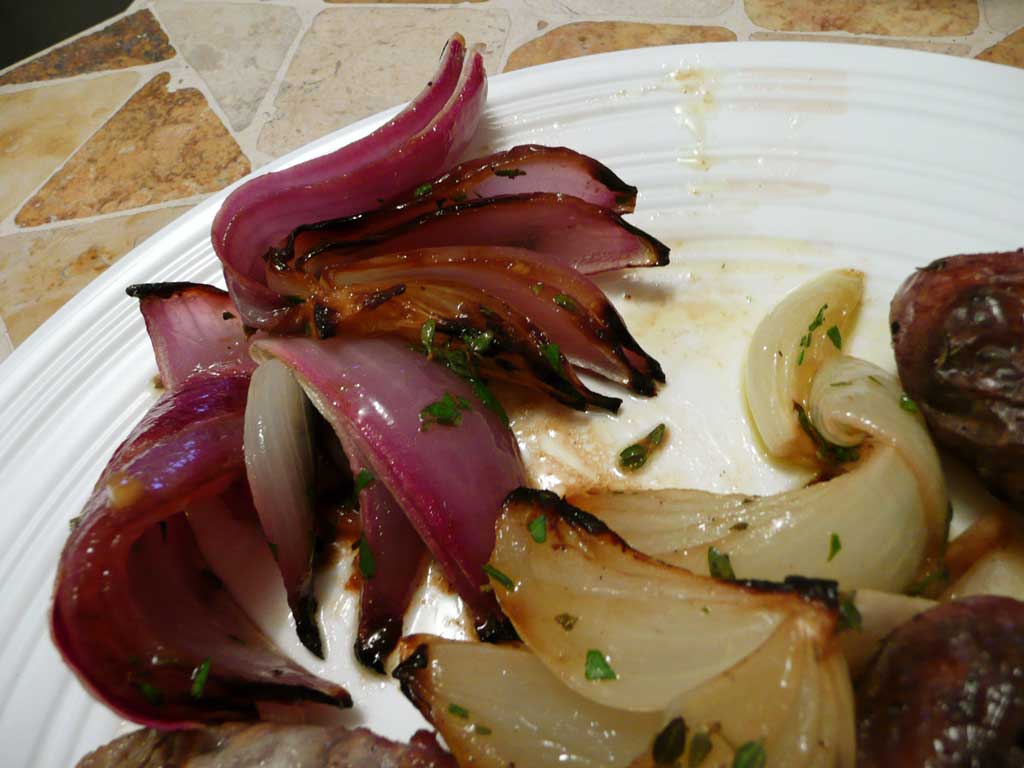
So today marks my first official contribution to the “Barefoot Bloggers” – a group of people who share of love of Ina Garten’s Barefoot Contessa cookbooks and cook their way through them, assigning a new recipe every two weeks.  How kind of them to select a supremely un-intimidating recipe to ease my entry to the fold!  Actually, Kelly who chose this recipe most likely picked it because she likes onions.  And I hope she likes mustard, too, because whoo-eee this recipe has a strong mustard flavor to it.  The components here are extremely simple – some onions, a nice mustard-herb dressing, salt and pepper.  However, unlike many roasted veggie side dishes, you will not overlook this one!  As I said, the mustard flavor is pungent (and delicious) but more importantly, the final product is gorgeous.  By keeping the root intact, the onions stay in their wedges, but they tend to separate at the layers, fanning out into tender, aromatic petals which gather the dressing in their folds.

By necessity (I only had one red onion on hand) my final product has reversed the ratio of red onions to yellow, a mistake I won’t make again.  Something about the way a red onion deepens in color and develops its blackened crust, curling up a bit at the edges – they are just so festive!  Not to mention the fact that they make for much better photos.  I would also have cut my wedges a bit thinner.  Ina did not specify how many wedges to make out of an onion, but I would suggest 8-12, depending on the size of your onions.  If the wedges are too thick, they will need more cooking time – you want to get all of the raw out of those puppies!  Of course, you could add other vegetables to your pan here – peppers, potatoes, brussel sprouts, parsnips to name a few – but the power of the Barefoot Contessa recipe is really in the simplicity.

So give this dish a try as is, then adjust to your liking – it really is infinitely adaptable.  I’m thinking my next version will incorporate some tarragon in the dressing, or maybe a drizzle of a balsamic syrup right at the end.  This could definitely be a great addition to your Thanksgiving table as well, I might add.

Roasted Onions Roasted Onions
2 red onions
1 yellow onion
2 Tbs. freshly squeezed lemon juice
1 tsp. Dijon mustard
1 tsp. minced garlic
1/2 Tbs. minced fresh thyme leaves
3/4 tsp. kosher salt
1/4 tsp. freshly ground black pepper
1/4 c. good olive oil
1/2 Tbs. minced fresh parsley leaves

Preheat the oven to 400 degrees F.

Remove the stem end of each onion and carefully slice off the brown part of the root end, leaving the root intact. Peel the onion. Stand each onion root end up on a cutting board and cut the onion in wedges through the root. Place the wedges in a bowl.
Roasted onions and vinaigrette
For the dressing, combine the lemon juice, mustard, garlic, thyme, salt, and pepper in a large bowl. Slowly whisk in the olive oil. Pour the dressing over the onions and toss well.

With a slotted spoon, transfer the onions to a sheet pan, reserving the vinaigrette that remains in the bowl. Bake the onions for 30 to 45 minutes, until tender and browned. Toss the onions once during cooking. Remove from the oven, and drizzle with the reserved dressing. Sprinkle with parsley, season to taste and serve warm or at room temperature. Roasted onions

Magazine Review: “Saveur” and Roasted Cranberry Sauce

roasted cranberry sauceThis is the second installment of my series of Thanksgiving magazine reviews.  You can see my evaluative criteria here.  My second food magazine review is of SAVEUR — a publication I became aware of through the Orangette blog, where several great recipes from Saveur have been featured.

112 pages total : 37 pages of ads (33%)
32 Recipes
News-stand price: $5.00
Price per recipe: $0.16
# of ads pretending to be articles: only one, and it’s very hard to spot.  It has the heading “The Saveur Chef Series” and includes a recipe for cauliflower with pine nut and current bread crumbs.  But for the miniscule “Advertisement” written across the top of the page, I would not have known it was advertising anything.  Come to think of it, I still am not quite sure what it is an ad for, except perhaps Bill Telepan’s eponymous NYC restaurant.
Recipe Index? Two indexes are provided – one, at the beginning, lists the recipes by article; the second lists them by category.  Both are ‘blink-and-you’ll-miss-em’ small.

Photos: Good, large pictures are scattered throughout the magazine, but are not labeled by recipe and are often separated by a page or two from the recipe they depict.  That’s fine for green beans with hazelnuts, but not so good when it comes to Kasespatzle.

Best Sections:
• The pantry – This section gives you resources to locate the esoteric ingredients used in some of the recipes.  Perfect for all of those “wait, where do I find Thai palm sugar?” moments.
• Source – a short feature story on a specific retailer or product.  This month it was Happy Girl Kitchen Co.’s pickled vegetables, including carrots, squash, and Italian beans – I am intrigued…
• In the Saveur Kitchen – “Discoveries and Techniques from our Favorite Room in the House”, including unusual uses of common ingredients and illustrated technique lessons.

Best Features:
• Within certain articles a little call-out box refers the reader to the web for more ways to use a specific ingredient or for similar or complementary recipes.
• This magazine’s content centers around articles on specific cuisines and their locales, always giving a list of “where to stay”, “where to eat” and “what to do” if you decide to follow in their footsteps.  This issue alone featured New Orleans, the Auvergne region of France, and Laos.
• Rather than always publishing in the traditional recipe format of serving size, ingredient list, then instructions, throughout the magazine you will find short blurbs called “Methods” which condense a recipe into a short prose paragraph – very much like your mom would relay Grandma’s Apple Pie to you over the phone.  The overall impression given is that you can adjust any of the methods to your own taste preference.

Thanksgiving at the Saveur house:
•Two separate sections deal with Thanksgiving – one about classic side dishes, and a second about how the holiday is celebrated in Louisiana.  Sweet Potato Casserole, Oyster Stuffing, Whipped Mashed Potatoes with Celery Root, Oyster stew, Leah Chase’s Roasted Turkey.  Ruling?  Very traditional.

Particularly Unappetizing:
• Traditional Mincemeat Pie (dried and fresh fruit plus rum and beef fat – shudder!!)
• Steamed Fish Mousse
• Pounti (Auvergne-style meatloaf with prunes)

I’m looking forward to cooking:
• *Roasted Cranberry Sauce
• Spinach and Artichoke Dip
• Brussel Sprouts Salad

In Summary, Saveur is a very interesting mixed bag.  The list of recipes, at least in this issue, ranged from a Chile con Queso dip made with Velveeta, canned Ro-Tel tomatoes and Corona beer, to Laap Moo (a Laotian minced pork salad) with chopped fresh galangal, toasted rice powder, kaffir lime leaves and lemongrass.  I recommend this magazine for the adventurous and ambitious chefs of this world – those who want to experience unique flavors from around the world or who want to teach themselves the authentic techniques of food preparation before the advent of the microwave or ready-made pie dough.

Make cranberry sauce*Roasted Cranberry Sauce, cited from Saveur No. 115

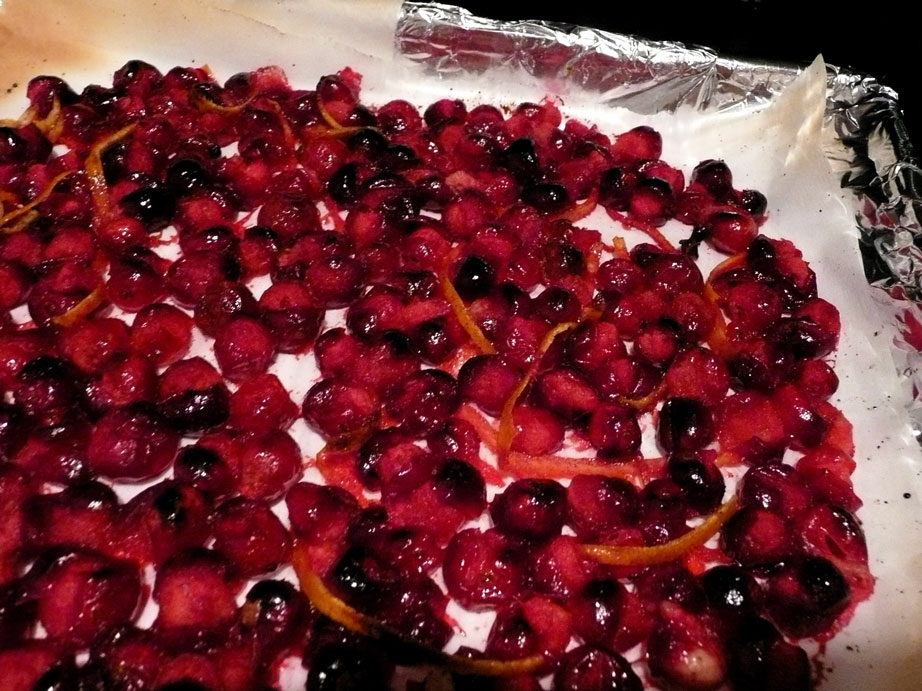
Heat oven to 450 degrees.  Using a peeler, remove peel from one orange, taking off as little of the white pith as possible.  Cut peel into very thin strips about 1 1/2 inches long.  Squeeze juice from orange; strain and reserve 1 Tbs. of the juice.  In a bowl, combine peel, 1 lb. fresh or thawed cranberries, 1 cup sugar, 2 Tbs. extra-virgin olive oil, 1 tsp. kosher salt, 4 smashed green cardamom pods, 4 whole cloves, 2 sticks cinnamon, and 1 small stemmed and thinly sliced jalapeno. Toss and transfer to a parchment paper-lined baking sheet.

Roast until cranberrries begin to burst and release their juices, 10-15 minutes.  Transfer cranberry mixture to a bowl; stir in reserved orange juice and 1 1/2 Tbs. of port.  Let sit for at least 1 hour so that hte flavors meld.  Remove and discard cardamom, cloves, and cinnamon before serving.  Makes 2 cups.

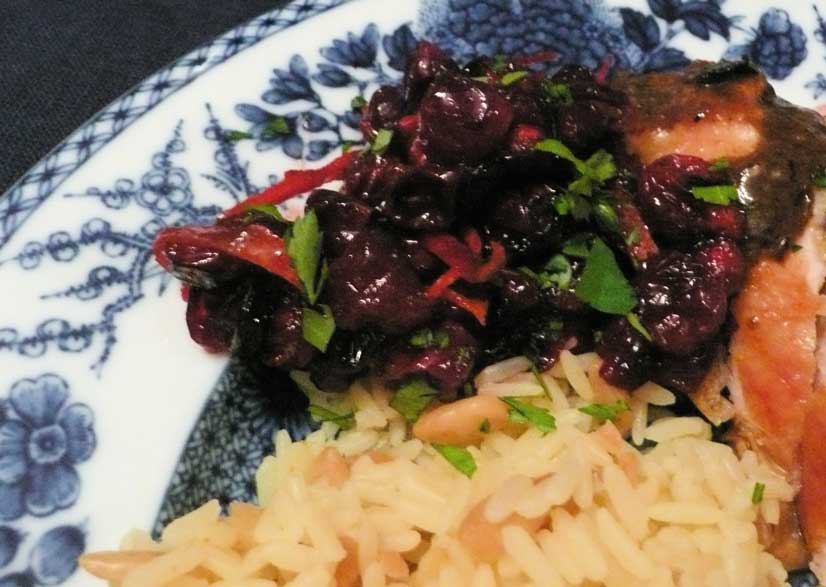
Plated cranberry sauceResults:  I don’t know about your feeling on this, but I found the prose-recipe method really frustrating.  I didn’t see that I needed a jalapeno until too late (so I left it out), and I had to keep rereading the whole recipe over and over to make sure that I only needed to save 1 Tbs. of the orange juice.  Though I know I’m supposed to follow these test recipes exactly, I used ground cardamom and ground cinnamon and omitted the jalapeno.  The results, however, were absolutely delicious.  The sauce was quite tart, which I liked, and the port gave it such a wonderful flavor without making it taste ‘alcoholic’ at all.  The texture was like a thick and chunky chutney, so if you like a more saucey version, this is not the recipe for you.  For me?  Yum yum yum!  This might become an annual feature of my holiday table!

Magazine Review: “Fine Cooking” and Delicata Squash

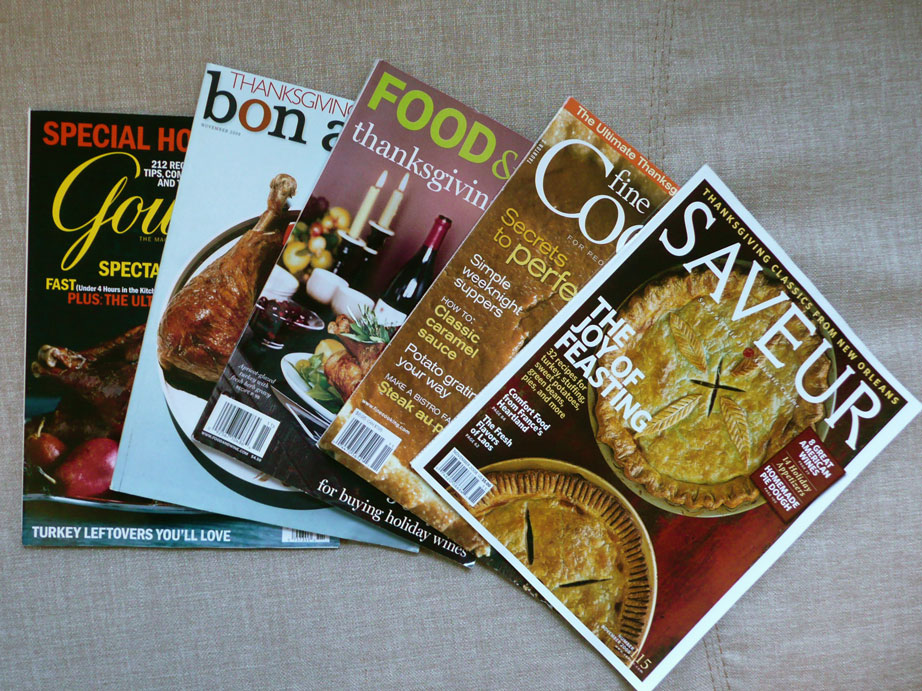
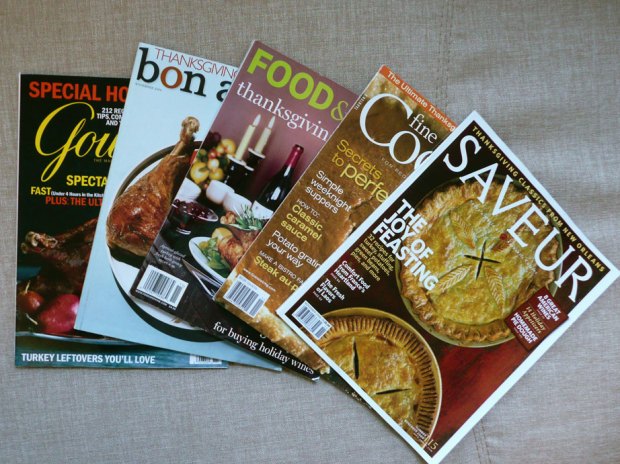
Food MagazinesI have taken on a new mission – you know, to keep things interesting here at “From My Table.”  Since I am a confessed food magazine addict and self-proclaimed connoisseur, I have decided to begin a series of reviews of popular cooking magazines.  To make it as fair a contest as possible, I will be comparing Thanksgiving issues – the one issue of the year where every food mag worth its weight in gravy will pull out all the stops.  In theory, the November issue of an epicurean publication (the issue with the highest sales for the year) will feature the best recipes, photos, and informational articles while showcasing any editorial biases in clear relief against rival periodicals.  When the basic building blocks are the same – turkey, cranberries, pumpkin, squash, and stuffing – one cannot help but notice if a particular magazine adheres to strict traditional techniques or, at the other extreme, commits blasphemy by defiling our American heritage (vanilla-cranberry foam?  Bread-less stuffing?  Come on, people!)

Here are my objective criteria:
• Ratio of the # of magazine pages (not including covers) to the # of full-page advertisements
• # of Recipes
• News-stand Price
• Price per Recipe
• # of “advertorials” – those ads that pose as articles or recipe sections to get you to buy their product.  Sometimes it is very difficult to tell they are not part of the magazine.
• Is a recipe index supplied?  How are the recipes sorted?

And here are my subjective criteria:
• How good is the photography?  How plentiful, mouthwatering, and informative is it?
• What are some of the unique or particularly good sections or features this magazine provides every issue?
• What is the take on the Thanksgiving classics: modern? drastic? traditional? boring?
• What recipes from this issue do I most look forward to trying?  What recipes look particularly unappetizing?

*I will also be making one recipe from my “Can’t wait to try” list exactly as directed, and will report on my results.  I hope this gets everybody into the November spirit – can you hear the Jingle Bells?

The first to contend is FINE COOKING – one of my favorite magazines of all time (no bias on the part of this judge):

• 98 pages total : 23 pages of ads (23%)
• 35 Recipes
• News-stand price: $6.95
• Price per recipe: $0.20
• # of ads pretending to be articles: 0
• Recipe Index?
Yes, sorted by type (i.e. side dish, dessert, poultry, fish/seafood, etc.) and labeled by special interest (i.e. quick, make-ahead, mostly make-ahead, and vegetarian).  Also includes a nutritional index in the back of the magazine, which is a great addition…if you like reading that sort of information…

Photos: absolutely excellent, often giving multiple viewpoints (cut pie/uncut pie; preparation/finished product) and most certainly mouthwatering!  Every recipe is photographed at least once, which is a huge bonus.

Best Sections:
• Cooking Without Recipes (one master recipe is featured each month and several pages explain the different steps of the method – in this issue, how to make a potato gratin – as well as the many ways it can be adapted to your taste – e.g. bacon, leek and Gruyere or artichoke and Comte)
• Quick and Delicious (self-explanatory, no?)
• Food Science (this section explains the “Whys” behind cooking results – how to fix a pie crust that isn’t flaky or that is too crumbly, for example)
• Menus – the editors mix and match the recipes from the issue into different menus, such as “Sunday Supper” or “Casual Dinner Party”

Best Features:
• Recipe Variations are provided with many of the sections, such as “try replacing red wine vinegar with balsamic for a sweeter flavor” or “try leftovers from this recipe cold in a pasta salad with green beans and feta”
• No advertisements are placed in the central recipe section of the magazine.

Thanksgiving at the Fine Cooking house:
• “Seven of the country’s best chefs share seven new takes on holiday classics” – Roasted Turkey with Juniper-Ginger Butter and Pan Gravy; Mashed Potatoes with Caramelized Shallots; Maple-Tangerine Cranberry Sauce; Sugar and Spice Pumpkin Pie with Ginger Cream.  Ruling?  Classic with a twist.

Particularly Unappetizing:
• Orange Crème Caramel
• Rosemary’s Pink Diamond Fizz
• Vietnamese Tilapia with Turmeric & Dill

I’m looking forward to cooking:Delicata Squash Recipe
• Sugar and Spice Pumpkin Pie with Brandied Ginger Cream
• *Delicata Squash with Caramelized Shallots and Sherry
• Cauliflower with Brown Butter, Pears, Sage, and Hazelnuts
• Steak au Poivre with Cognac Sauce

*Delicata Squash with Caramelized Shallots and Sherry
Serves four.  You can assemble this dish up to 2 hours before baking.

1 1/4 lb. delicata squash
2 Tbs. olive oil
1/4 c. dry sherry (such as fino)
Kosher salt and freshly ground black pepper
1 Tbs. unsalted butter
1 c. thinly sliced shallots (2 to 3 large)
4 tsp. finely chopped fresh sage

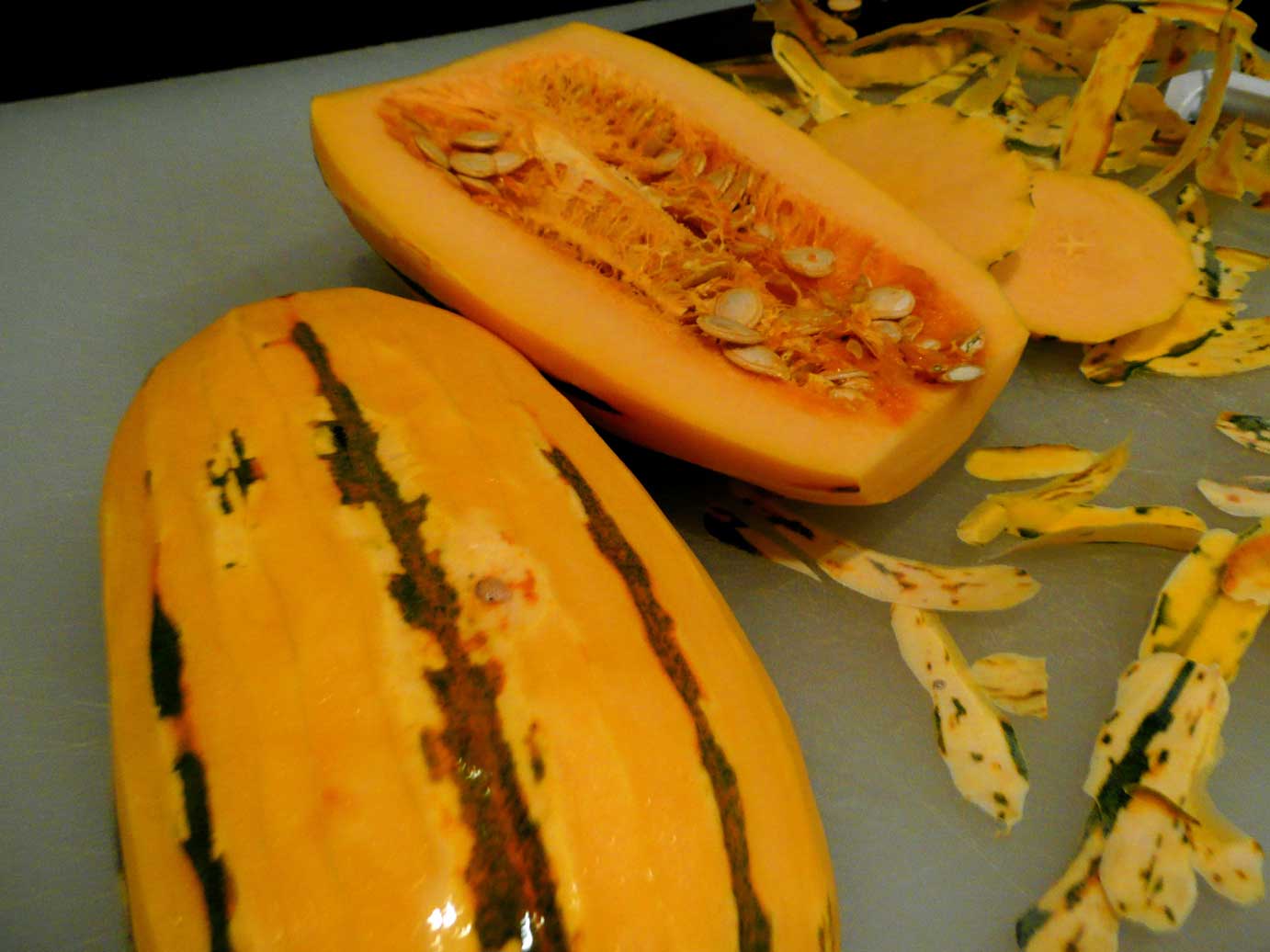
Heat the oven to 350 degrees.  Peel the squash, leaving the skin in the crevices (it’s tender enough to eat).  Trim the ends.  Cut the squash in half lengthwise and scoop out the seeds.  Slice the halves crosswise 1/2 inch thick.Saute of Delicata squash
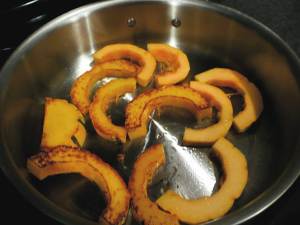
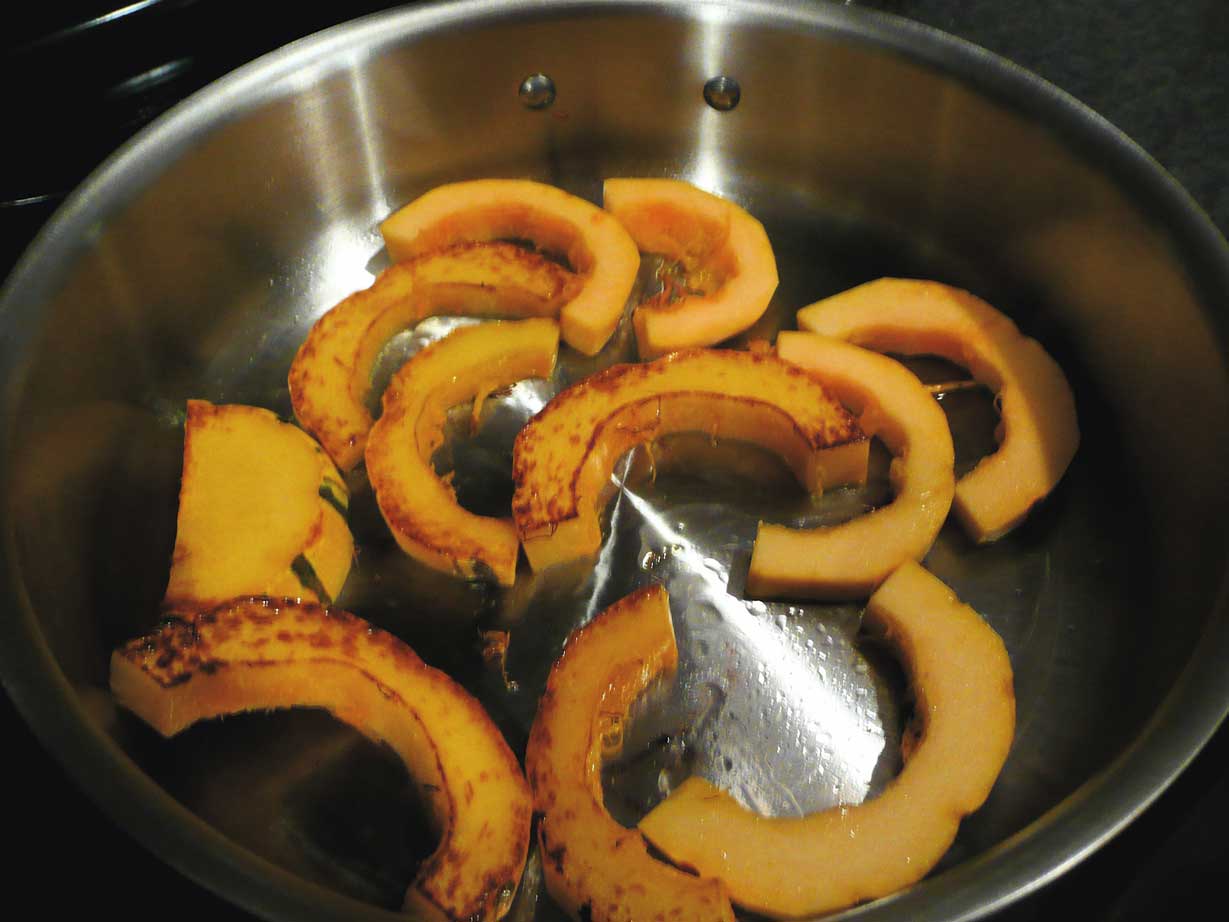
Heat 1 Tbs. of the oil in a 10-inch skillet over medium-high heat.  Add half the squash in a single layer and cook without moving until the slices begin to brown, about 2 minutes.  Flip and cook until the second side begins to brown, 1 to 2 minutes.  Transfer to a 9×13 inch baking dish. Sprinkle with 2 Tbs. of the sherry, 1/2 tsp salt, and a few grinds of pepper.
Heat the remaining 1 Tbs. olive oil and the butter in the skillet over medium heat.  Add the shallots and a pinch of salt and cook, stirring frequently, until the shallots turn deep golden brown on the edges, 3-5 minutes.  Take the pan off the heat and immediately add the sage and the remaining 2 Tbs. sherry, scraping up the browned bits on the bottom of pan.  Scatter the shallots over the squash.
Cover the pan with foil and bake until the squash is tender when pierced with a fork, 25-30 minutes.  Season to taste with salt and pepper.

Results:
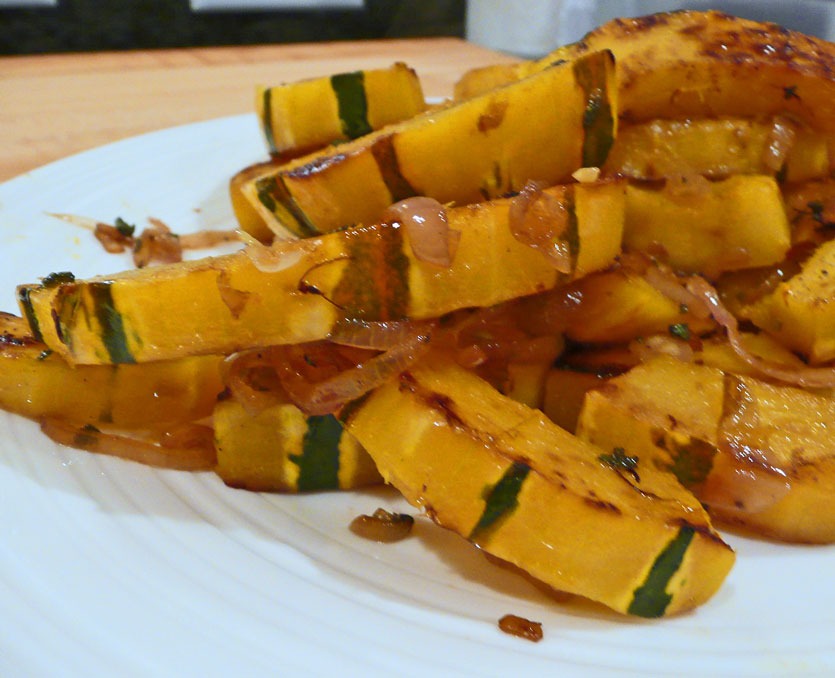
The squash tasted excellent – the caramelized shallots were sweet, and the sherry gave a contrasting nutty flavor.  As you can see, it looked very beautiful and interesting too!  Though I said I would follow the instructions meticulously, I did use Amontillado sherry rather than the suggested Fino – I’m not sure what difference this made, but fino is lighter in both color and flavor.  I should have put the squash in the oven a bit longer – closer to 30 minutes than 25 – so that it melted a bit more in my mouth; with that change I would definitely make this again.  Delicata squash has a slightly less sweet and slightly more vegetal flavor than butternut – very close to yellow-fleshed acorn squash.  I bet that this recipe would work well with either of those two types as well.

Delicata squash recipe