Prosciutto-Sage Pork Roast

Roast Pork Loin with Prosciutto-Sage Butter

Before my current job at a museum, I worked at a non-profit art gallery in Boston.  What I have come to find about the people that work in the arts – not so much the artists themselves but the ‘gallerinas’, the fundraising folks, the museum educators – is that they really like to eat and cook.  At the gallery, my colleagues and I would compare gourmet leftovers and fancy composed salads on our lunch break.  To celebrate a big sale or a successful opening, we would treat ourselves to fancy cheese, oysters and pate at the french restaurant across the street or even go out to the newest “it” restaurant in the South End.  I wonder if an appreciation for culinary arts is a natural extension of a love of the visual arts.  It is said that we eat with our eyes first…

In any case, one recipe shared over that convivial lunch table surrounded by paintings is the one that follows.  My dear friend Caroline, who generally is not fond of pork, shared this super simple preparation with me.  An easy-to-make compound butter really ramps up the flavor and presentation of the relatively inexpensive pork roast.  Perfect for the holidays and as an addition to my running list of don’t-break-the-bank-but-impress-your-guests-anyway recipes.  I have, on other occasions, mixed in a heavy tablespoon of roquefort cheese with the butter for a bit of a twist, but this is Caroline’s original recipe and it is fabulous.  It went so fast at my mom’s dinner party that by the time I’d grabbed my camera for the final shot, all that was left is what you see above!

Roast Pork with Prosciutto-Sage Butter

1/4 lb. thinly sliced prosciutto di Parma
2 Tbs. minced shallots
6-12 leaves fresh sage, chopped (choose number of leaves depending on size of the leaves and your taste for sage)
1 stick unsalted butter, softened
salt and pepper to taste
monstrous boneless pork loin (it doesn’t matter the size – if you have butter left over after coating it, just freeze it and use it later)

Preheat oven to 400 degrees F.  In a small bowl, mix together the prosciutto, shallots, chopped sage and softened butter.  Salt and pepper to taste, adjusting amount of salt if you are using salted butter.  Pork Loin roastIf you have any fancy flavored salts, this is a good time to use them as well – I have a “Sel de Merlot” from France which is delicious in this recipe.  Set butter aside.

Place pork on a cutting board, fatty side up.  Trim off as much fat as you can without completely (re)butchering the loin and wasting perfectly good meat [see photo :)].  The idea is to replace most of the pork fat with the flavored butter fat. 
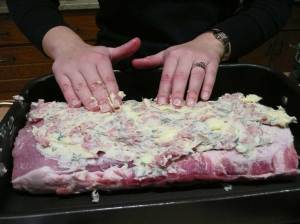
Pork roast with Flavored butterIf you think you made more butter than your pork loin will require, scoop butter out of the small bowl with a spoon in smaller batches so that you don’t contaminate the unused butter.  In my case, having such a monstrous loin, I just slathered the whole stick on there with my hands.  Definitely make sure you spread the butter out evenly and that the goodies are distributed across the top of the meat.

Roast the loin in the oven at 400 degrees for 15-20 minutes.  Then, turn the oven heat down to 325 degrees and cook for another 20 minutes per pound or so.  You should take the pork out of the oven when a meat thermometer stuck horizontally into the meat (parallel to the cutting board and in the center of the loin) reads 150 degrees internal temperature – I usually check it after an hour to see where I stand.  Do not overcook or the roast will be dry and nowhere near as yummy.  Again, feel free to experiment with different flavor combinations in the butter – if Michelangelo, Monet, and Picasso never experimented, the art scene would be pretty bland today!
Roast Chicken

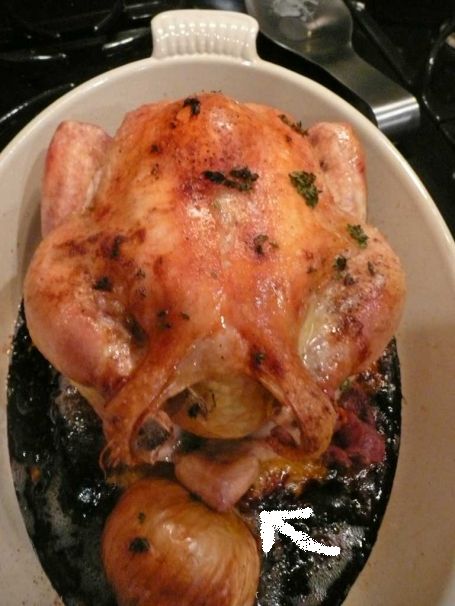
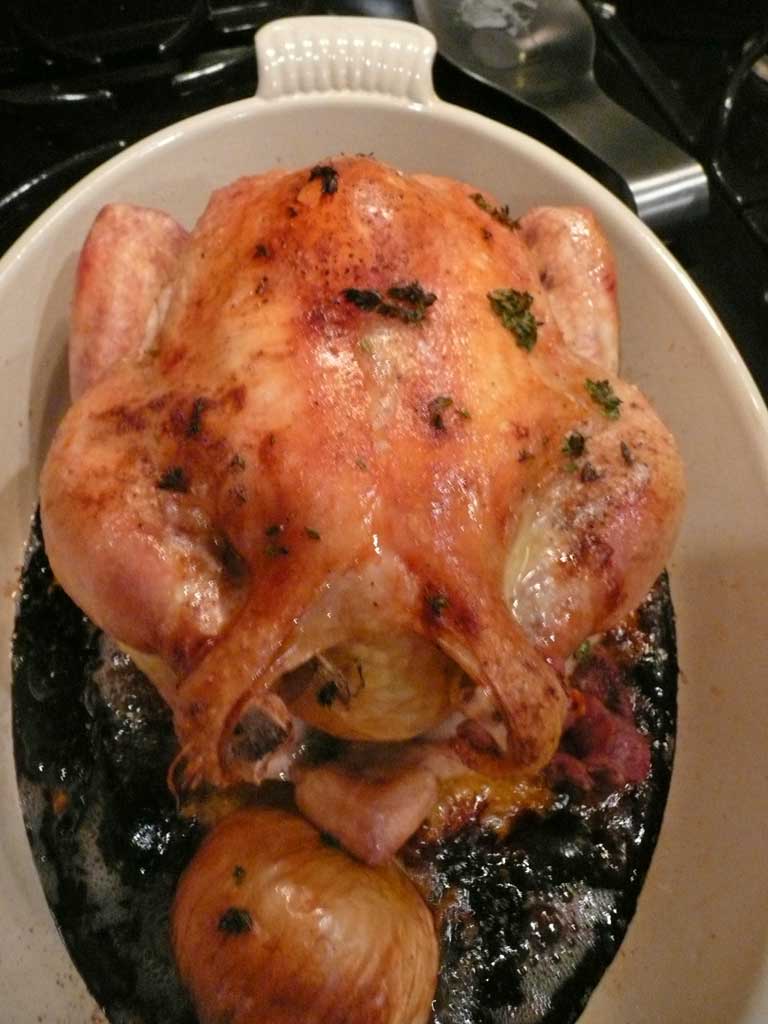
chickenForgive me yet another roasting post.  I henceforth declare (retroactively) this past week Roasting Week, in homage to all the crispy, browned, concentrated flavors that dry oven heat bestows upon us.  This does not count as a real post, I know.  I don’t have any teaser images or elaborate descriptions.  I just have something so delicious and essential that it must be added to the blog.  This ‘recipe’, if you can even call it that, serves so many purposes I simply have to share it.  For one, it looks great and is perfect for entertaining.  Second, it is quite adaptable to all manner of taste and preference.  Third, it leaves you with some great leftovers (which I will be dealing with in a future post).  In any case, read the post through before you start cooking so you can understand the whole concept…

The method is as follows: buy yourself a whole roasting chicken and get a good one (read: free range preferable, super-market bird less than acceptable).  I describe my bad experience with a not-so-special bird here, so try not to make the same mistake I did – I promise it makes a difference!  Rinse the bird with cold water inside and out, then pat dry.  Remove excess fat from the outside and inside of the bird.  Personally, I keep the “pope’s nose” (the fatty flap at the opening of the bird’s cavity) intact ‘cuz my Gammy likes it, but if your grandmother isn’t around, ditch it with the rest.  Salt and pepper the inside and outside of the bird to your own taste.

Now is your chance to improvise.  You want to stuff the bird with some aromatics, which can include any combination of the following: a halved onion; a halved head of garlic; a halved lemon; sprigs of thyme, rosemary and/or sage.  You want to fill the cavity without ramming junk in there to the breaking point.  

Depending on what you put inside the bird, you want to mix your basting butter accordingly.  If my bird is stuffed with herbs, I might make a minced shallot butter.  If I stuff with lemon, then parsley and tarragon butter tastes delicious.  Mix and match to your delight!  You will want your basting butter to be a mixture of 1 tablespoon of butter per pound of chicken plus some combination of chopped herbs, lemon juice, minced shallots or garlic.

Once the chicken is stuffed, tie the legs together with twine, or, as in the picture above, cut small holes in the skin of the bird below the leg and near to the cavity, then shove the ends of the legs into them.  This will ensure that the legs of the bird stay close to the breast.  Put the bird in a 425 degree oven for 20 minutes.  At the end of the 20 minutes, baste the bird with your melted butter mixture.  Turn the oven heat down to 375.  Cook for a total time (including the first 20 minutes) of 15-20 minutes per pound.  Every 15 minutes or so, baste with the flavored butter mixture.

When the time’s up, remove the chicken from the oven.  If you’re worried about done-ness, prick the thigh of the chicken (below the leg) with the tip of a knife and take a peek at the juices that come out.  If they’re red or pink, you want to put it back in the oven for a bit.  If they’re clear, let the chicken rest on a cutting board for 10 minutes to let the juices redistribute.  Carve and serve!

Now – you may be asking yourselves why it looks like the juices around my chicken are black in the pan.  For one thing, they were not actually black.  They were very dark brown.  And they looked that way because I modified my traditional prep (above) to add in tips from Anthony Bourdain‘s Les Halles Cookbook.  I put the giblets and half an onion on a pan and rested the raw chicken body on top of all of them.  Then I poured about a cup of white wine around the bottom of the pan and followed my own directions, above, for roasting the chicken.  This allowed me a great base for a pan sauce – I just had to put the chicken and other solids on a cutting board then mix some beurre manie and chicken stock into the pan to scrape up the fond (leftover roasted chicken bits) from the bottom of the pan.  This will result in a yummy chicken-y sauce which you can use just as is, or you can add a couple teaspoons of balsamic vinegar and cook a few minutes before pouring into a gravy dish.

Enjoy my mom’s chicken recipe – it’s no family secret or anything, but it’s a family classic.

Update: Since there seems to be some confusion about the issue, please see below picture of “The Pope’s Nose”pope2

A Meal Fit for Company

Today I bring you a full menu rather than one dish.  This meal is simple, delicious, quick and relatively healthy.  It can be multiplied to serve a crowd without much more effort or additional funds, and thus it is also a recent addition to my running list of “dinners fit for company costing less than $20.”

I thank Whole Foods, as much as anybody, for the idea.  I had been given the opportunity to shop there due to an overnight stay in Cambridge, MA and I was awed at the prospect.  For a girl that lives way, way up on the North Shore, the visit to this shopping Mecca where the peppers are never bruised and you can choose from 8 flavors of wood-smoked salmon was a treat indeed.  Thus, it took me about an hour and a half (no joke) to get through all the aisles.  There was a lot of internal dialogue involved, wherein I argued my need for fancy organic granola (“it has currants! Not raisins, currants! And coconut flakes!”) against the persistent reality of my checking account balance (“no you do not need Plugra butter”).  Plus, I had to decide what form of protein I was least likely to get at my home grocery, either because they don’t carry it or my husband won’t eat it.

I finally settled on a balanced, colorful meal of panko-crusted flounder, creamy Spinach, and roasted butternut squash with cranberries.  As the outline of the menu unfolds below, you may initially cringe at some of the flavor combos but let me tell you, these dishes really did work well together.  I would make this meal again in a heartbeat – or at least in 24 hours, if you promise me a ride to Whole Foods.

Roasted Butternut Squash with Cranberries

1 large butternut squash, peeled and scraped of seeds
3/4 c. to 1 c. fresh cranberries

Olive Oil
Maple Syrup
Salt

Preheat oven to 400˚F.   Cut butternut squash into medium-sized chunks, approximately 1 1/2 inches square.  Add them to a large mixing bowl toss with olive oil to coat.  Spread squash in a baking dish large enough to fit the squash in a single layer, not overlapping but not inches apart either.  Next, pour the cranberries (as much as you like, really) into the mixing bowl and coat with another tablespoon or so of olive oil.  Scatter the cranberries in and around the butternut squash pieces.  Sprinkle the whole pan with salt to taste, and then lightly drizzle with maple syrup, making sure that every bite of squash gets at least a couple drops.  Roast for about 1 hour – test the squash by stabbing a piece with a fork.  If you pull the fork back the squash should easily slip off the tines.   If it wants to follow with the fork, return the squash to the oven and roast for another 10 minutes before checking again.  When done, some of the cranberries will be blackened and shriveled – I think they’re yummy like this.  If you prefer your cranberries all to be juicy and full, add them halfway through the cooking rather than with the squash at the beginning.

Creamy Spinach and Mushrooms (sauce adapted from the Joy of Cooking)
3/4 c. milk
1/4 onion or 1 clove crushed garlic
bay leaf
pinch of nutmeg
3 Tbs. butter, divided
2 Tbs flour
4 oz. cremini mushrooms, sliced
1 lb. spinach or baby spinach
1 Tbs. Dijon mustard
1/4 c. grated cheese (gruyere, Jarlsberg, parmesan or some combination)

First simmer the milk with the onion (or garlic), bay leaf and nutmeg in a small pot for about 15 minutes.  Remove the solids (onion or garlic and bay leaf) and then set aside.  In a separate saucepan, melt the 2 tablespoons of butter, then whisk in the flour over low heat until fragrant, about 1 minute.  Slowly whisk in the milk mixture and return to low heat.  Simmer, whisking frequently, until thickened to a soup-like consistency (as you can see from the picture, I didn’t wait long enough…).  In the meantime, melt the final tablespoon of butter in a sauté pan over medium-high heat.  Add the cremini mushrooms and cook until lightly browned.  Add the spinach and stir gently until the spinach is cooked down.  To the milk sauce, add the mustard, followed by the grated cheese, stirring to blend.  Season with salt and pepper to taste.  Drain any excess liquid from the mushroom and spinach mixture.  Add the sauce to the cooked spinach gradually until you reach the creaminess level you are comfortable with.  For some, a touch of the sauce is plenty, others want the whole mess of it.


Sun-dried Tomato Panko-Crusted Flounder
3 filets of flounder (or 1 per person)
2 eggs
2 cups of Sun-dried Tomato Panko flakes (mine were courtesy of Whole foods, but feel free to make your own with chopped parsley, minced sun-dried tomatoes, and fresh breadcrumbs)

Here’s a simple one – pat the fish filets dry with paper towel.  Beat the eggs together in a shallow bowl or platter.  Dip the fish filets, one by one, in the egg to coat.  Let the excess egg drip back into the bowl, then dredge the filets in the breadcrumbs, turning to coat.  Over medium-high heat, melt a tablespoon of butter in a nonstick pan.  Lay the filets in the pan and cook about 3 minutes on one side, then flip to cook the other side for about a minute and a half.  Check for doneness – the fish should be opaque, not translucent – then transfer to dinner plates.