Profiteroles

Profiteroles

You will know that school is going well and that I have retained my sanity when posts appear here on From My Table.  As you can tell, it was touch and go there for a while, since my last post was put up here almost a month ago.  But today I finished writing my first paper (and it was a doozy!) and I finally have time to catch up here.  To set your minds at ease, it isn’t that I haven’t been eating or cooking.  I have just found that I can either post on the blog or cook and photograph, but not both.  I have stored up quite a few meals in my camera, but my typing time (and sterling wit) has been expended elsewhere for the past month — namely, at school.

Here’s the good news: I have a killer dessert for you.  Made of chou dough (the same used for gougères), these are simple and scrumptious and versatile to boot.  The ingredients are probably in your fridge and on your counter right now, and they take a mere half hour to make.  Plus (as if you needed further incentive), profiteroles cut an elegant figure and thus can be served at your next dinner party.  If you can wait that long…

Profiteroles, from the Moosewood Restaurant Book of Desserts

(Serves 6-8)

1 cup water
5 Tbs. butter
1 c. unbleached white flour
1/4 tsp. salt
2 tsp. sugar
4 large eggs

Preheat oven to 400 degrees F. In a saucepan, bring water and butter to a boil. Meanwhile, in a separate bowl, combine flour, salt, and sugar. When water and butter boil, add the dry ingredients at once, stirring vigorously with a wooden spoon. Continue stirring until the mixture forms a ball and pulls away from the sides of the pan, like so:
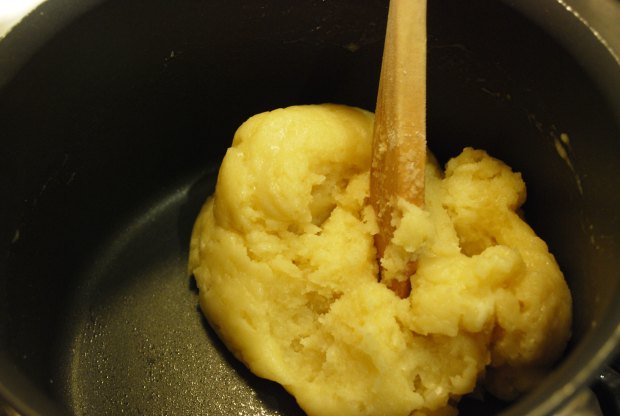
profiterole-dough-ball-stage

Remove from the heat and allow to cool for 2-3 minutes. Then, beat the eggs in, one at a time. Each egg will make the mixture gloppy and slimy for a minute, but will turn back into smooth dough after some sustained stirring.

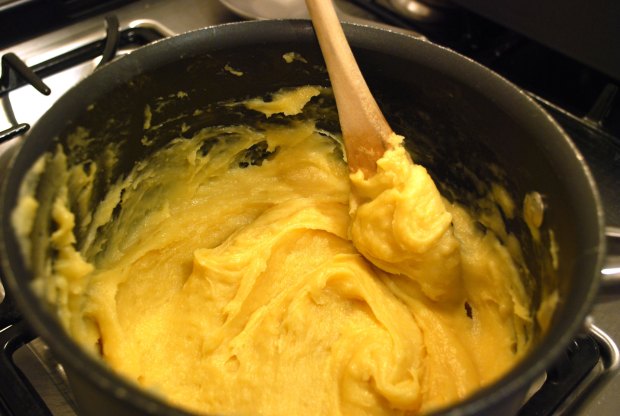
Profit-dough-gloppy

profit-smooth-dough

Lightly oil a baking sheet and/or line sheet with parchment paper. Using the wooden spoon or, if you’re fancy, a pastry bag, form mounds of dough 2 inches apart on the baking sheet. Use about 1/4 cup of dough for each large puff or about 2 1/2 Tbs. for smaller puffs. Bake for 10 minutes at 400 degrees then reduce temperature to 350 (don’t open the oven!) and bake for 20 minutes more for smaller puffs or 25 minutes more for larger puffs.

profit-dough-balls

When the puffs are firm, turn off the oven, remove the puffs, and using a small sharp knife, score a horizontal cut about 2/3 of the way up each puff (this is much easier right out of the oven when the puffs are crispy). Return the puffs to the still-warm oven for about 15 minutes to let the residual heat dry them a bit. Remove and cool completely.

Profiterole

When ready to serve, fill as desired by cutting the top from each puff at its scored mark, mounding the filling inside and replacing the top.

Profiterole-Caramel

My favorite fillings include:
Brigham’s vanilla ice cream with Herrell’s hot fudge sauce and/or dulce de leche (I used Stonewall Kitchen)
Home-made ice cream (coconut? strawberry? mocha chip?)
Apple chunks sauteed in butter, sugar, and cinnamon.
Cannoli filling (sweet ricotta, mmmm…)
Duck Lasagna Strapazatta

Duck Lasagna

The final recipe I tested for my Cookbook Challenge review of the Sweet Basil Cookbook was Duck Lasagna Strapazatta.  I picture many readers saying to themselves: “Duck – check.  Lasagna – check.  Strapa-wha?”  In general, I try not to go into long, pedantic descriptions of certain foods, as both the well-informed and the uninterested among us might yawn at a recounting of the conflicts over the definitive elements of cassoulet or the supposed aphrodisiacal properties of oysters. Yet strapazatta is not a term you come across frequently, and even my Google searches neglected to produce a consensus on the definition.

From what I gather, strapazatta literally translates to “bungled” in Italian and is used in cooking to refer to ‘free-form’ dishes.  I am copying the spelling directly from the cookbook, though online another recipe title often pops up: uova strapazzate, or scrambled eggs.  It seems likely that strapazatta is an Americanization of the word strapazzate and that the general concept is a stirred-up, rustic preparation — here, of lasagna (also known as lasagne: further proof of my theory).

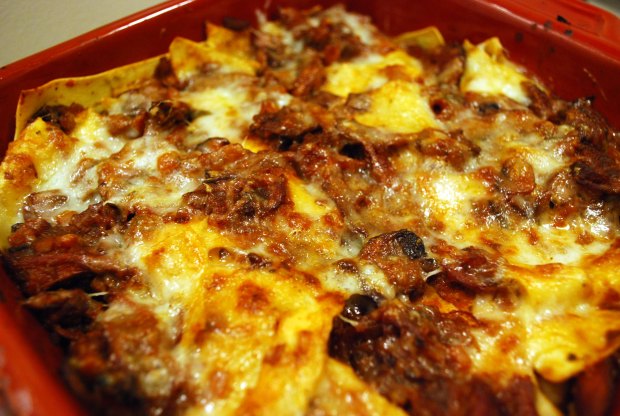
So much for avoiding long-winded explanations…  To keep the rest brief: I liked this, I didn’t love it.  I think the best translation based on what I put on the table was the first: “bungled”.  The port made the sauce quite sweet, and it neglected the strong savory component (oregano? more fontina?) to counter it.  In addition, the noodles refused to cooperate — the short lasagna pieces didn’t separate well and I ended up having to place them in the dish in rows, much as I would have with whole lasagna noodles.  The texture was phenomenal, however, with the pleasing contrast of rough shredded duck, sheets of smooth pasta, and crusty cheese topping.  If I hadn’t been following the recipe so closely, for the purposes of a proper review of the cookbook, I might have thinned out the sauce with some beef stock and added a couple of savory herbs to finish.  All told, however, the ragu had real merit as a concept — it just needed a few tweaks and a different pasta to top.

Duck Lasagna Strapazatta, from the Sweet Basil Cookbook [Printable Recipe]
(serves 4 to 6)

4 duck confit legs

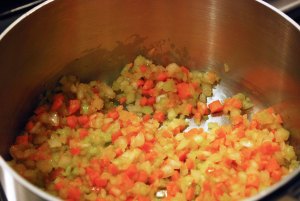
mirepoix2 Tablespoons olive oil
1 carrot, peeled and diced (about 1 cup)
1 Spanish onion, diced (about 1 cup)
2 stalks celery, diced (about 1 cup)
2 cloves garlic, minced (about 2 Tbs.)
10 white mushrooms, quartered (about 2 cups)
2 large portobello mushrooms, stemmed and sliced into 1/2 inch wide strips
1 Tbs. dried porcini mushrooms
2 cups port wine
1 bay leaf
1 tsp. chopped fresh sage
2 Tbs. Worcestershire sauce
1 cup red sauce (use your favorite marinara sauce or follow the recipe below)

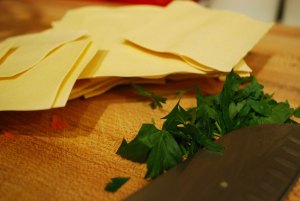
Fresh pasta sheets, cut into 3-inch wide strips
2 cups grated fontina cheese

In a large saucepan, heat the olive oil over moderate heat. Add the carrot, onion and celery. Saute the mixture for 5 to 10 minutes, until the ingredients begin to brown. Add the garlic and the white and portobello mushrooms. Continue sauteing for 5 more minutes, until the ingredients begin to caramelize. Add the dried porcini mushrooms, port, bay leaf, and sage. Bring the mixture to a boil, and then add the Worcestershire sauce and the red sauce. Decrease the heat and allow the sauce to stew for 8 to 10 minutes, until all of the flavors have had a chance to get acquainted. Stir the duck in with the sauce and remove from the heat.

Duck_RaguMeanwhile, in a large pot, bring 6 quarts of water to a boil. Add a pinch of salt and the pasta, stirring it to keep from sticking. Cook for 1 minute, or until al dente [I used no-boil lasagna noodles and 2 minutes of boiling softened them up, though I would recommend serving this over penne rigate or rigatoni or even pappardelle — adjust cook time accodingly]. Drain thoroughly.
Duck_pastaStir the cooked pasta in with the sauce. Transfer the pasta and sauce to a large casserole dish, sprinkle with the fontina, and bake in the oven [at 350 degrees] until the cheese is bubbling. Serve garnished with parsley.
P.S. — the cookbook also suggests that subbing in sliced eggplant for the duck would make a lovely vegetarian version.

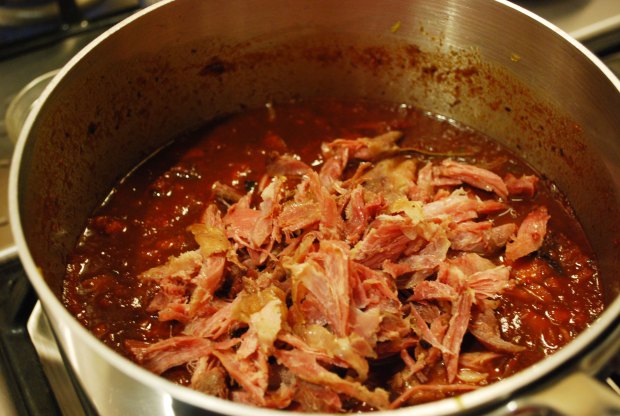
duck lasagna

Best Ever Chicken Scallopine

Scallopine

It seems I am not the only one lax in my blogging duties.  Some of my favorite sites are on indefinite breaks.  Granted, I don’t have a truly good excuse, as I am not in the middle of opening my own restaurant, mourning the loss of my pet, or recovering from a difficult break-up.  I’m more in the same league with Katie of Chaos in the Kitchen, who just wants to hang out with her kids, since my reason is that I’m pouty about not having my own kitchen.  This, however, is all about to change!  Starting July 6th, my table — of “From My Table to Yours” fame — will be relocated to Beacon Hill in Boston, MA.  From those heights overlooking the historic city, the dirty river Charles, and the ivory towers of Cambridge, I hope to bring my cooking to a whole new level.  Think: exotic cheeses from Formaggio Kitchen, game meats from Savenor’s, and guess what — a Whole Foods only a couple blocks from my front door!  If I can just manage to keep my graduate student homework to a minimum, I can really get something accomplished here!

So, unlike my compatriots listed above I am not on a break from posting, I simply need another week to gather myself together and get back into the swing of things.  To tide you over, I have a great recipe to share though I do need to make a confession.  While my Cookbook Challenge was conceived with the absolute best intentions, I always suspected it might come back to bite me in the arse.  The mission was to work my way through the massive collection of cookbooks I own so that I could at least say that I had tried several recipes from each one (and thus justify their purchase).  Yet deep down I knew that I had a dark secret — I buy books faster than I can cook from them.  Since the start of the challenge at the end of April, I have added five cookbooks to my collection, or seven if you count Ratio and The Flavor Bible in the count!  No matter — I won’t let my own weakness for shiny hardcovers and glossy photographs lessen my dedication to (or enjoyment of) the Sisyphean task of the Cookbook Challenge!

Next up: Sweet Basil by David Becker.  This book is particularly close to my heart since the restaurant Sweet Basil is located in my hometown of Needham, MA and is a favorite of mine.  Inside the small establishment, corrugated tin walls flank an open kitchen from which steam clouds billow and giant white bowls of pasta emerge.  Outside, crowds gather to await their tables, each couple sharing the burden of a mysterious brown paper bag.  Those in the know, of course, are aware that the bags contain wine and beer, since part of the charm of Sweet Basil is their BYOB policy.  And as Dave Becker confesses in the book, he’s seen wine harvested during the Reagan administration sitting on one table, with Schlitz in a can holding court at the adjacent one.  It’s just that kind of place.
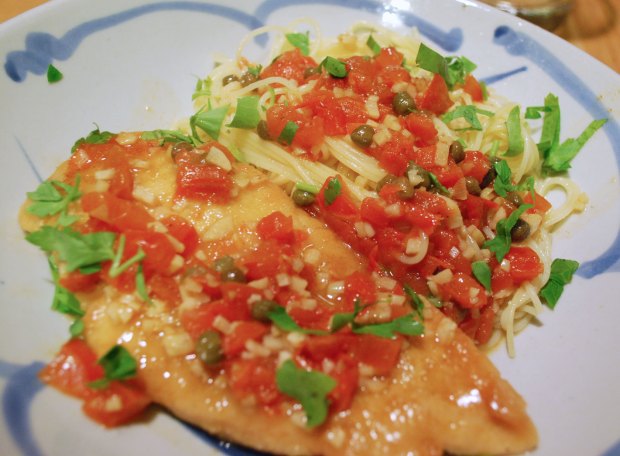
What I loved most about this first recipe is that it came out tasting just like it does at the restaurant.  The characteristic flavors of bright lemon juice, pungent garlic and, yes, sweet basil, were all present and accounted for.  Each bite came alive in my mouth – and each tastebud was singing in chorus: salt! sweet! sour! umami!  (it’s true – it’s from the parmesan cheese).  I would not call this recipe the “Best” unless it really was extremely good and the best I’ve tasted.  Please make this.  Go.  Now.  Cook!  Or if you don’t cook, get yourself over to Sweet Basil on Great Plain Ave in Needham.

Chicken Scallopini with Lemon, Capers, and Tomatoes, from Sweet Basil the Cookbook [Printable Recipe]
(Serves 4)

4 skinless, boneless chicken breast halves
All-purpose flour
Kosher salt and cracked black pepper
3 Tbs. olive oil
3 Tbs. unsalted butter
8 cloves garlic, minced (about 1/2 cup – don’t skimp too much!)
1/2 c. white wine
Juice of 2 lemons
2 c. chicken stock
2 plum tomatoes, diced (about 1 cup)
2 Tbs. salted capers, rinsed (I used the capers in brine)
1/4 c. chopped fresh parsley
1/4 c. chopped fresh basil
1/2 c. grated Parmigiano-reggiano cheese

Cooked angel hair pasta for serving

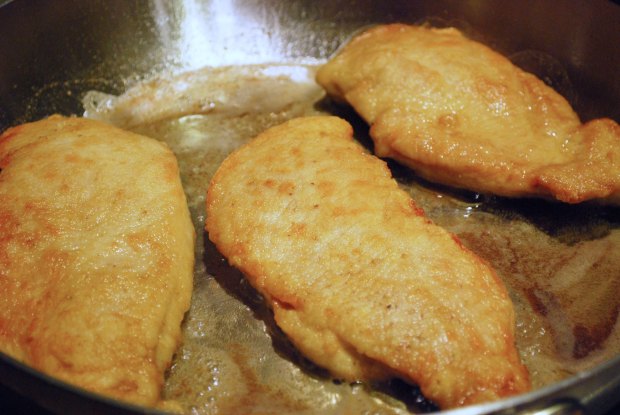
scallopine-chickenPlace the chicken breasts, two at a time, between 2 sheets of plastic wrap [or in a gallon-size Ziploc bag]. Use the smooth side of a meat mallet [or a rolling pin] to pound them to about 1/2 inch thickness. Arrange the flour in a shallow bowl. Season the chicken with a pinch each of salt and pepper, and then dredge generously with flour, coating both sides. Shake off the excess and set aside.
In a large skillet, heat the olive oil over medium-high heat. Add 1 Tbs. of the butter. When the butter melts, place the chicken in the skillet. Cook for 4-5 minutes, until golden brown on the bottom. Turn over and cook for 2 more minutes. Transfer the chicken to a plate (it is not cooked through at this point).

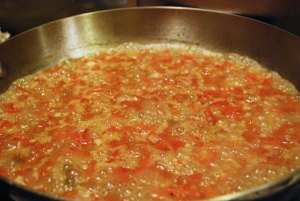
chicken scallopini sauceAdd the garlic to the pan and cook, stirring, for 30 seconds. Add the white wine and the lemon juice. Simmer, scraping up the browned bits on the bottom of the pan for a few minutes until almost all the liquid is gone. Add the chicken stock, tomatoes, and capers. Increase the heat to high, and bring the liquid to a boil. Simmer for 6 minutes, or until the liquid is decreased by about one-third.

Stir in the remaining 2 Tbs. of butter. Return the chicken to the pan and simmer for 2 minutes, or until the sauce thickens slightly and the chicken is cooked through. Season to taste with salt and pepper. Garnish with the herbs [and cheese] and serve immediately.

Fish en Papillote

Finished PapillotteAs I indicated in my last post, something naturally happens as the weather warms whereby I turn away from my many cookbooks (or in the case of this year, pack them into about 10 cardboard boxes and put them in a POD) and instead begin to develop a more spontaneous and improvisational cooking style.  Last night my sister’s plans for whole trout on the grill were thwarted by an ill-stocked fish counter, and I instead purchased two gargantuan halibut steaks (the ones cut cross-wise from the fish’s body) with a glimmer of an idea in mind.

Assembly

When I got home, I raided my mother’s cabinet and refrigerator, pulling out some prepared pesto, a half a tomato, jars of roasted red peppers and marinated artichokes, a lemon and some fresh thyme.  I then cut two large rectangles of parchment paper (you can also use aluminum foil), about 14-16 inches long for my huge steaks, and folded the sheets in half, then opened them up on the counter again.  I put one of the halibut steaks in the middle of one half of each of the parchment paper sheets.  Then, I improvised.

On one steak I rubbed pesto thickly across both cut sides, layered a couple of tomato slices on top, added some roasted red peppers (about three half-peppers), and a couple artichoke hearts, and then drizzled some oil from the artichoke marinade and the juice of half a lemon over the whole thing.  On the other steak, I put  leftover caramelized onions and fennel from my tartlettes, more artichokes, sliced kalamata olives and two tomato slices and doused again with the marinade and lemon.  I placed a big sprig of thyme on the top of each steak, and began the process of sealing up the parchment.

Wrapped

Fold the empty half of parchment over the loaded fish half so that the two cut edges of the parchment touch, and kind of hold those two pieces together (you can use a jar or something to weight them if you need to).  Begin at one of the edges of the center fold and begin working your way around the open edges of the parchment package, folding in tiny overlapping triangles.  Parchment holds fairly well, so just make your triangles tight and use the back of your thumbnail to sharpen the folds.  Aluminum foil is even easier and pretty self explanatory.

The Gourmet Cookbook suggests folding the last triangle under the package, to seal it “completely”.  I didn’t do that (my last fold was up, like the others) and I had one package open up in the oven, and one stay sealed.  Either way, it isn’ t a big deal if a bit of liquid leaks out in the cooking process.
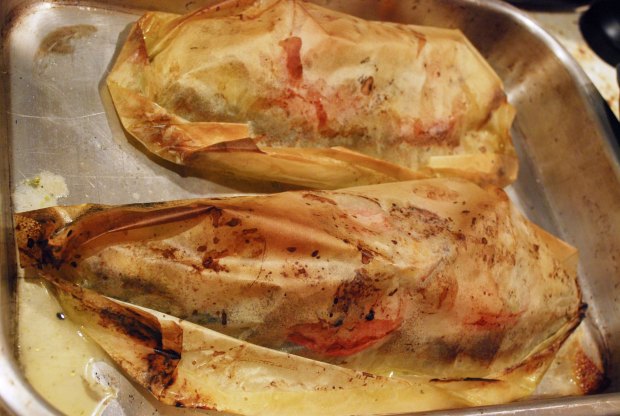
Next step: put a large baking sheet into a pre-heated 500 degree (F) oven for 5 minutes.  Pull it out, and put the fish packages on the hot baking sheet.  Bake for 10 minutes or so (depending on the thickness of the fish you’re using – mine was about an inch of thick halibut and was perfect after 11 minutes) at 500 degrees, then pull out of the oven.  Opening up the package after this is a real treat – the steam whooshes out in an aromatic burst, and one is astonished to find all the vegetables and fish cooked perfectly and in pristine shape and full color.

Papillote

This technique, cooking ‘en papillote’, is wonderful for several reasons.  1) It is very forgiving, as the steam from the vegetables and fish keeps everything pretty moist, even if you leave it a couple extra minutes in the oven.  2) It is quite healthy, seeing that you don’t need any butter or oil (though it is highly recommended to add butter or olive oil at the end as a finishing element) and you can pack the papillote full of veggies.  3) It is an impressive presentation if you put each portion in its own papillotte and serve your guests the package to open themselves at the table.  4) Finally, the technique is wildly versatile – perfect for summer improvisation!  The fish can be cod, snapper, bass, trout, or any number of varieties, and the toppings and aromatics inside could include any combination of herbs, oils, wine, fresh vegetables, cherry tomatoes, olives, citrus zest & juice, capers, spices, vinegar or greens that you like.  Try different pairings to find your favorite melange, or invite your guests to each assemble their own before dinner!