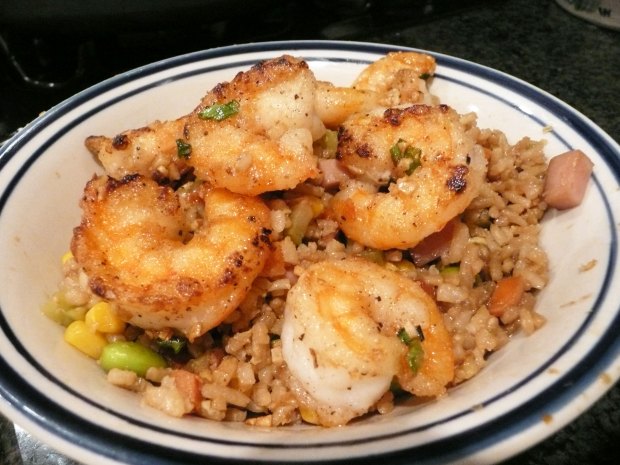
I would like to add to my previously mentioned list of food I usually purchase rather than attempt to cook. Asian food, though a broad category, should certainly be on that list. I just think that the professionals do a much better job than I ever could, for several reasons: 1) I don’t usually have the right ingredients and end up making odd substitutions like vermouth+sugar for mirin, barbecue sauce+teriyaki sauce+molasses for hoisin, and ground fennel seed for star anise. When I do buy the occasional jar of Thai fish sauce or black bean paste, it ends up sitting in my fridge for ages until eventually I throw it out. 2) Asian dishes usually (and admirably) involve lots of vegetables. This poses the recurring problem in my house. If I buy 5 different vegetables for a stir fry or something, then I use a tiny bit of each since I’m cooking for only one veggie-eater, I end up with a pile of leftover vegetables that I can barely begin to erode before they go bad. 3) I’m no Asian – I’m the whitest white girl eva… so I doubt I would ever make anything authentic or ground breaking in this arena. 4) It is fun to get takeout every once and a while – every cook needs a break!
Now you know all my pathetic reasons for not venturing into the culinary sphere of the Far East. Unassailable logic, no? Despite this, it took only one recipe to allay all my fears and negate all my excuses! I should say, actually, that it is two recipes – though one is decidedly more Asian than the other, they go together so well I am including them both here.
Funny that this ‘Asian’ recipe comes from another stark-white white girl: Ellie Krieger. As far as Food Network stars go, I would give Ellie a 5 out of 10. Not as funky/charismatic as Anne Burrell or cute as Danny Boome, but also not as annoying as Paula Deen or Rachael Ray. I never watch her show, cuz most of the food is whole grains and vegetables which don’t go over so well with RJ. So imagine my amazement when I see Ellie’s recipe for fried brown rice, chock full of colorful veggies, in my Fine Cooking. As some of you know, I’m doing the “Cook the Issue” challenge, whereby I have to cook every recipe in Issue #97 – see my work so far by clicking here. Before I post the recipe, let me tell you how Ellie, with this one dish, addressed all of my issues with both her cooking style and the making of Asian food in general:
1) The recipe does not include any exotic Asian condiments besides soy sauce, which hardly counts, and fresh ginger, which I sometimes buy and happened to have leftover from my marmalade. The shrimp, which I paired with this rice, required Chinese five-spice powder, but I can buy this in small quantities and not worry about having to toss it within 6 months.
2) Yes, this fried rice uses a lot of vegetables, but get this: it encourages the use of whatever leftover veggies you have lying around. Think baby carrots that are turning flakey and white on the outside, that random quarter of a red bell pepper you’ve had in a plastic bag since last week’s salad, and residual broccoli stalks. It also incorporates frozen vegetables like corn and edamame which can obviously keep a lot longer than fresh stuff.
3) I gained confidence starting my venture into Asian cuisine under the tutelage of a woman with skin paler even than my own.
4) Sure is fun getting takeout, but it is also fun to save money and have fun cooking. I made the full yield of the recipe, and ate the rice for several lunches in the days that followed.
5) This recipe also helped me to get over the whole problem with whole grains in my house. It requires that the brown rice be cooked in advance and chilled in the fridge before frying. This means that I can actually justify cooking my brown rice for dinner one night (even though RJ won’t touch the stuff so I’ll have to make him a separate white rice serving) and saving the leftover rice for the next day’s cooking.
Needless to say, the dish was a revelation. The shrimp, which comes from the same Fine Cooking issue, was simple to make alongside the fried rice. They tasted wonderful together! And I did most of the prep work for both recipes well ahead of time, making the assembly all the easier. I highly recommend this dinner and the inevitable lunches that will follow unless you have 4 people who love fried rice like you do!
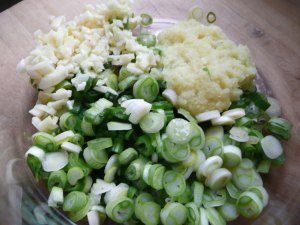 Five-Treasure Fried Rice, by Ellie Krieger in Fine Cooking issue #97 (serves 4+)
“I first created this recipe as a destination for leftover broccoli stalks, but its easily adaptable, so feel free to substitute other vegetables you might have in the fridge—asparagus, zucchini, peas, mushrooms, bok choy, bean sprouts, and jícama are all possibilities. I love the nutty taste and chewiness of brown rice, and you just can’t argue with its antioxidant power and fiber. My favorite route to brown rice is to order it with Chinese food, but you can certainly cook some up yourself. Either way, bear in mind that the rice has to be well chilled so the starch hardens and makes it fry-able. Use fresh rice and you wind up with a gummy mess.”
 2 Tbs. canola oil
1 cup peeled, finely diced broccoli stems (from about 1-1/4 lb. broccoli)
3/4 cup finely diced carrots
3/4 cup finely diced red bell pepper
3/4 cup frozen shelled edamame
3/4 cup corn kernels, fresh or frozen
4 scallions (both white and green parts), thinly sliced
2 Tbs. finely grated fresh ginger
2 large cloves garlic, minced
4 cups very cold cooked brown rice
3/4 cup finely diced Canadian bacon (4 oz.)
2 large eggs, lightly beaten
1/4 cup lower-sodium soy sauce
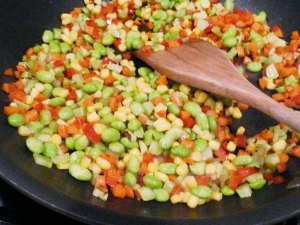 Heat all but 1 tsp. of the oil in a large nonstick skillet or stir-fry pan over medium-high heat. Add the broccoli stems, carrots, and bell pepper and cook, stirring frequently, until the vegetables begin to soften, 3 to 5 minutes. Add the edamame and corn and cook until the edamame is thawed, about 1 minute. Add the scallion, ginger, and garlic and cook, stirring, until the raw garlic aroma subsides, about 1 minute. Add the rice and Canadian bacon and cook, stirring, until heated through, 3 to 5 minutes.
Make a 3-inch well in the center of the rice mixture. Add the remaining 1 tsp. oil, then the eggs, and cook, stirring, until the eggs are almost fully scrambled. Stir the eggs into the rice mixture. Stir in the soy sauce and serve.
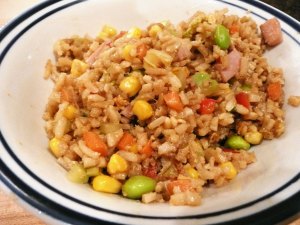
Salt-and-Pepper Shrimp with Garlic and Chile, from Fine Cooking issue #97 (serves 4)
Using easy-peel shrimp will speed prep because the shells are slit open and they’ve been deveined. [This recipe can be prepared as a meal or as a fun appetizer]
 2 Tbs. cornstarch
1 tsp. granulated sugar
Pinch of Chinese five-spice powder
Kosher salt and freshly ground black pepper
5 large cloves garlic, finely chopped
1 serrano chile, thinly sliced into rounds
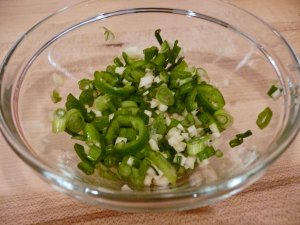
4 large scallions (green parts only), sliced 1/4 inch thick
1-1/2 lb. large shrimp (26 to 30 per lb.), peeled and deveined, tails left on
3-1/2 Tbs. peanut or canola oil
1 small lime, cut into 4 wedges
In a large bowl, mix the cornstarch, sugar, five-spice powder, 1 tsp. salt, and 1 tsp. pepper. In a small bowl, mix the garlic, chile, and scallions; set aside.
Pat the shrimp dry with paper towels. Line a small baking sheet or large plate with a double layer of paper towels. Add the shrimp to the cornstarch mixture and toss until evenly and thoroughly coated.
 In a heavy-duty 12-inch nonstick skillet, heat 1-1/2 Tbs. of the oil over medium-high heat until very hot. Add half of the shrimp in a single layer. Cook without disturbing until deep golden and spotty brown on one side, about 2 minutes. Using tongs, quickly flip each shrimp and continue to cook until the second sides are spotty golden brown, about 1 minute longer. (The shrimp may not be cooked through at this point.) Transfer the shrimp to the prepared sheet. Add another 1 Tbs. of the oil to the skillet and repeat with the remaining shrimp, transferring them to the sheet when done.
Reduce the heat to medium and add the remaining 1 Tbs. oil to the skillet. Add the garlic mixture and cook, stirring constantly, until the chile and scallions are softened andthe garlic is golden and smells toasted, about 1 minute. Return the shrimp to the pan and stir to combine. Serve immediately, with the lime wedges.

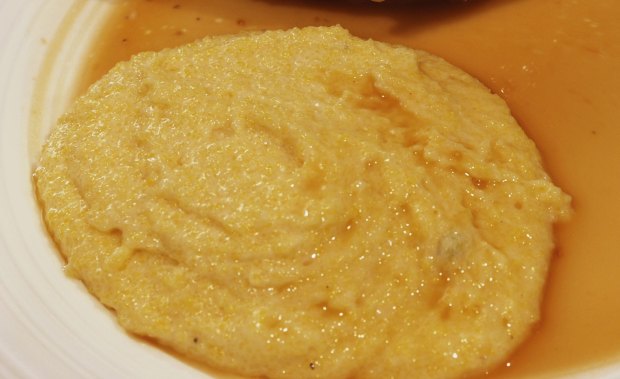 RJ and I served this with a simple pan-roasted chicken breast and these caramelized shallots and it was all divine. I can see this as a special occasion side dish (too rich for every day, but quick and easy enough to do on a weeknight for guests) to accompany braised meats, or with a mix grill of sorts. Just be warned about two things: 1) this is not a light and airy side dish – it is silky smooth but also dense with cheese and 2) use the best ingredients you can find – homemade chicken stock (or really good store-bought


 (April/May 2009, issue 98)
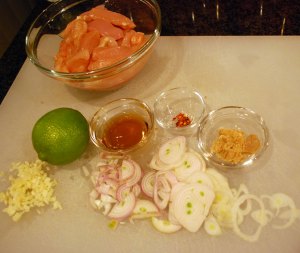 2 Tbs. vegetable oil
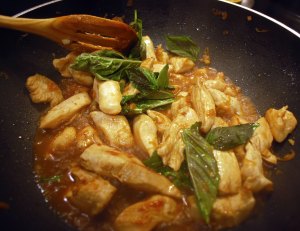 Heat the oil in a well-seasoned wok or a heavy-duty 12-inch skillet over medium-high heat until shimmering hot. Add the shallots, garlic, and red pepper flakes; cook, stirring frequently, until the shallots start to soften but not brown, 1 to 2 minutes. Add the chicken and cook, stirring, until it’s no longer pink and the shallots are beginning to brown, 2 to 3 minutes.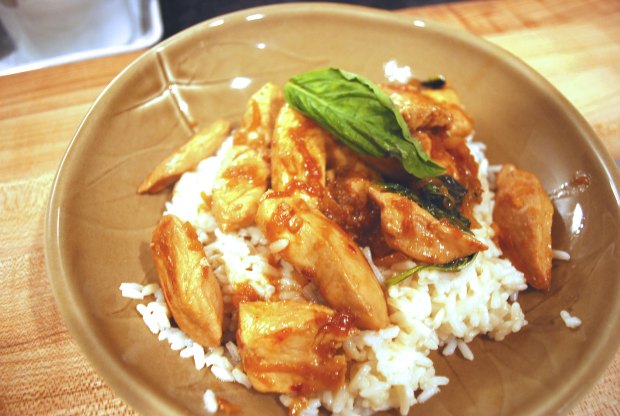


 From My Table...to Yours