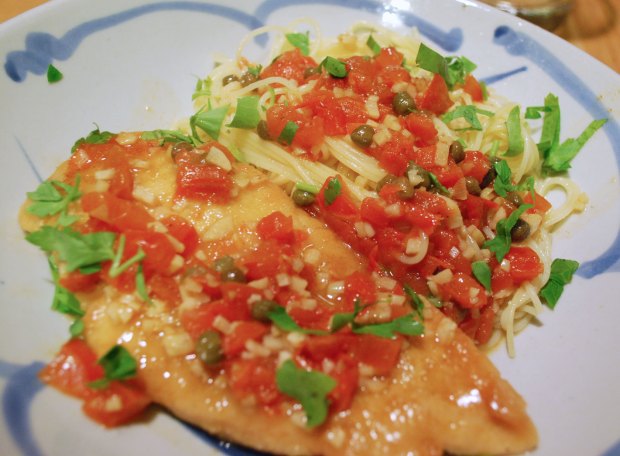
Best Ever Chicken Scallopine

Scallopine

It seems I am not the only one lax in my blogging duties.  Some of my favorite sites are on indefinite breaks.  Granted, I don’t have a truly good excuse, as I am not in the middle of opening my own restaurant, mourning the loss of my pet, or recovering from a difficult break-up.  I’m more in the same league with Katie of Chaos in the Kitchen, who just wants to hang out with her kids, since my reason is that I’m pouty about not having my own kitchen.  This, however, is all about to change!  Starting July 6th, my table — of “From My Table to Yours” fame — will be relocated to Beacon Hill in Boston, MA.  From those heights overlooking the historic city, the dirty river Charles, and the ivory towers of Cambridge, I hope to bring my cooking to a whole new level.  Think: exotic cheeses from Formaggio Kitchen, game meats from Savenor’s, and guess what — a Whole Foods only a couple blocks from my front door!  If I can just manage to keep my graduate student homework to a minimum, I can really get something accomplished here!

So, unlike my compatriots listed above I am not on a break from posting, I simply need another week to gather myself together and get back into the swing of things.  To tide you over, I have a great recipe to share though I do need to make a confession.  While my Cookbook Challenge was conceived with the absolute best intentions, I always suspected it might come back to bite me in the arse.  The mission was to work my way through the massive collection of cookbooks I own so that I could at least say that I had tried several recipes from each one (and thus justify their purchase).  Yet deep down I knew that I had a dark secret — I buy books faster than I can cook from them.  Since the start of the challenge at the end of April, I have added five cookbooks to my collection, or seven if you count Ratio and The Flavor Bible in the count!  No matter — I won’t let my own weakness for shiny hardcovers and glossy photographs lessen my dedication to (or enjoyment of) the Sisyphean task of the Cookbook Challenge!

Next up: Sweet Basil by David Becker.  This book is particularly close to my heart since the restaurant Sweet Basil is located in my hometown of Needham, MA and is a favorite of mine.  Inside the small establishment, corrugated tin walls flank an open kitchen from which steam clouds billow and giant white bowls of pasta emerge.  Outside, crowds gather to await their tables, each couple sharing the burden of a mysterious brown paper bag.  Those in the know, of course, are aware that the bags contain wine and beer, since part of the charm of Sweet Basil is their BYOB policy.  And as Dave Becker confesses in the book, he’s seen wine harvested during the Reagan administration sitting on one table, with Schlitz in a can holding court at the adjacent one.  It’s just that kind of place.

What I loved most about this first recipe is that it came out tasting just like it does at the restaurant.  The characteristic flavors of bright lemon juice, pungent garlic and, yes, sweet basil, were all present and accounted for.  Each bite came alive in my mouth – and each tastebud was singing in chorus: salt! sweet! sour! umami!  (it’s true – it’s from the parmesan cheese).  I would not call this recipe the “Best” unless it really was extremely good and the best I’ve tasted.  Please make this.  Go.  Now.  Cook!  Or if you don’t cook, get yourself over to Sweet Basil on Great Plain Ave in Needham.

Chicken Scallopini with Lemon, Capers, and Tomatoes, from Sweet Basil the Cookbook [Printable Recipe]
(Serves 4)

4 skinless, boneless chicken breast halves
All-purpose flour
Kosher salt and cracked black pepper
3 Tbs. olive oil
3 Tbs. unsalted butter
8 cloves garlic, minced (about 1/2 cup – don’t skimp too much!)
1/2 c. white wine
Juice of 2 lemons
2 c. chicken stock
2 plum tomatoes, diced (about 1 cup)
2 Tbs. salted capers, rinsed (I used the capers in brine)
1/4 c. chopped fresh parsley
1/4 c. chopped fresh basil
1/2 c. grated Parmigiano-reggiano cheese

Cooked angel hair pasta for serving
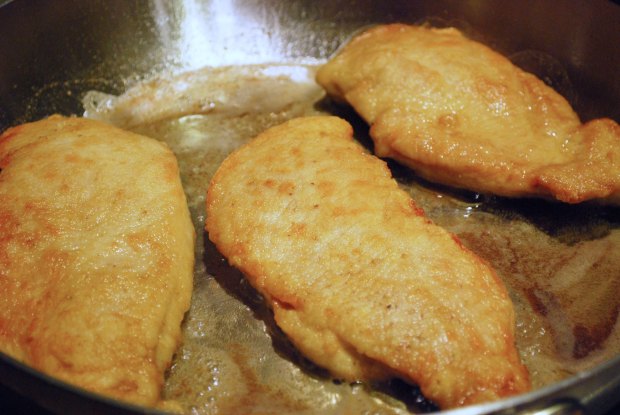
scallopine-chickenPlace the chicken breasts, two at a time, between 2 sheets of plastic wrap [or in a gallon-size Ziploc bag]. Use the smooth side of a meat mallet [or a rolling pin] to pound them to about 1/2 inch thickness. Arrange the flour in a shallow bowl. Season the chicken with a pinch each of salt and pepper, and then dredge generously with flour, coating both sides. Shake off the excess and set aside.

In a large skillet, heat the olive oil over medium-high heat. Add 1 Tbs. of the butter. When the butter melts, place the chicken in the skillet. Cook for 4-5 minutes, until golden brown on the bottom. Turn over and cook for 2 more minutes. Transfer the chicken to a plate (it is not cooked through at this point).
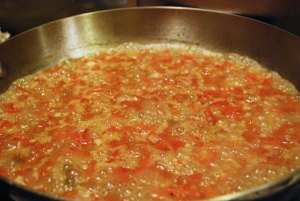
chicken scallopini sauceAdd the garlic to the pan and cook, stirring, for 30 seconds. Add the white wine and the lemon juice. Simmer, scraping up the browned bits on the bottom of the pan for a few minutes until almost all the liquid is gone. Add the chicken stock, tomatoes, and capers. Increase the heat to high, and bring the liquid to a boil. Simmer for 6 minutes, or until the liquid is decreased by about one-third.

Stir in the remaining 2 Tbs. of butter. Return the chicken to the pan and simmer for 2 minutes, or until the sauce thickens slightly and the chicken is cooked through. Season to taste with salt and pepper. Garnish with the herbs [and cheese] and serve immediately.

Simple Roast Salmon

Unfortunately I had little success with my third recipe from Nina Simonds’ cookbook Spices of Life.  I wanted all three recipes to showcase the strengths of the cookbook – Kung Pao Chicken gives an easy method for making a favorite Chinese takeout dish at home and Doctored-up Ramen demonstrates a healthy, inexpensive and fun version of a nostalgic noodle – but I also intend for my Cookbook Challenge to be representative.  In the week I dedicated to the cookbook, I had two great successes (already mentioned) and a bunch of not-so-good results.  First, the cardamom asparagus which were not spectacular:
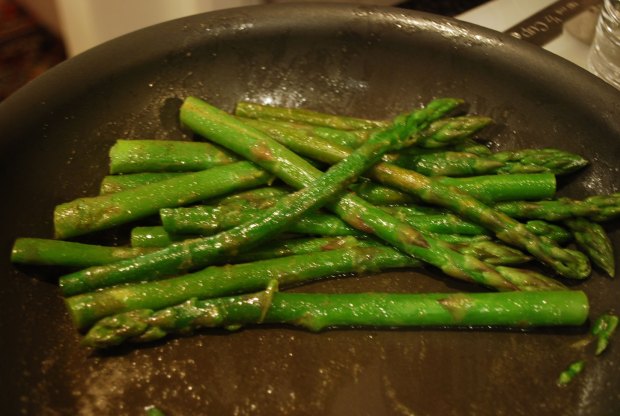
Cardamom AsparagusThen a strawberry-rhubarb crumble that had the weakest, least flavorful topping I’ve ever tasted (what a waste!):
rhubarb-crumble

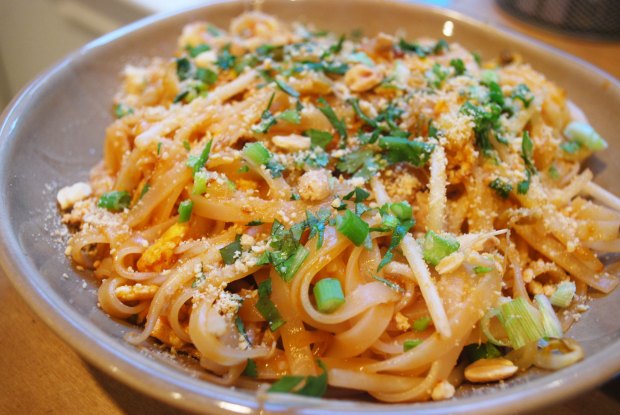
and finally, a Pad Thai that truly disappointed.  Though I really LOVE pad thai, this make-at-home version was horrific.  I would ascribe the off flavor to the ketchup (!) in the recipe — no amount of fresh lime juice or peanuts could save it.  But the pictures came out well:

pad-thai-3

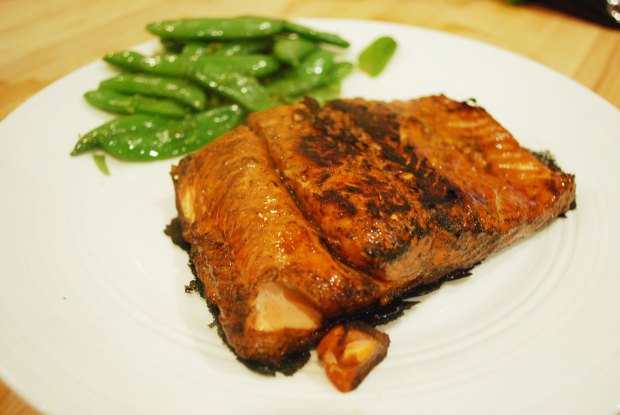
The above recipes really aren’t worth repeating here, so I won’t!  The below recipe is pretty simple, and while I wasn’t totally blown away by it, I think part of the problem might have been human error.  I overcooked the salmon slightly (by following the times in the directions, I might add) and I am unsure how (given the balsamic and soy sauce in the marinade) anyone could achieve the light pink result pictured in the book:

Simonds Salmon

As for the snap peas, I thought they tasted very light and refreshing — perfect for a hot summer lunch, picnic or potluck.  I am not convinced that the cold minty snap peas are a good pairing with the salty warm salmon.  In fact, I really didn’t like the two of them together.  I feel like I gave the cookbook ample opportunity to give me a winner third recipe, but instead I give you two recipes that were decent on their own, and very simple to make, but which do not have my wholehearted endorsement.

Pan-Roasted Salmon Served with Minty Snap Peas, from Nina Simonds’ Spices of Life

(Serves 6)

“The ginger–soy–balsamic marinade gives the seared salmon a lovely flavor and color and the simple mint dressing is a light and refreshing complement to snap peas. Nina likes to serve this dish hot, or at room temperature with rice pilaf for a festive buffet.” [she says to serve this dish hot, meaning (I suppose) the salmon, since the snap peas are ‘refreshed in cold water’ before being added to the mint dressing]

salmon-marinade6 pieces salmon fillets with skin on, each weighing about 6 ounces
For salmon marinade
2 tablespoons minced fresh ginger
3 tablespoons low-sodium soy sauce
3 tablespoons balsamic vinegar

1½ pounds snap peas

For mint dressing
3 tablespoons fruity extra-virgin olive oil
2 tablespoons lemon juice, or to taste
4 to 5 tablespoons chopped mint
½ teaspoon salt
½ teaspoon freshly ground black pepper
2 tablespoons virgin olive oil

Make the marinade: Mix the ginger, soy sauce, and balsamic vinegar in a small bowl. Put the salmon in a deep dish. Pour in the marinade and toss lightly to coat. Let the salmon sit at room temperature while cooking the snap peas.

Bring 2 quarts of water to a boil in a saucepan and add the snap peas. Cook for 2 minutes, or until they are crisp tender. Drain in a colander and refresh in cold water. Drain again and blot dry on paper towels.

Whisk the mint dressing ingredients together in a mixing bowl. Add the snap peas and toss lightly to coat. Taste for seasoning, adjusting if necessary.

Heat the 2 tablespoons of olive oil in a large frying pan over high heat until very hot. Place the salmon steaks with their coating, skin side down, in the pan, partially cover, and fry about 5 to 6 minutes covered over high heat (depending on the thickness) until the skin is crisp and the salmon meat has started becoming opaque. Carefully flip over with a spatula and cook for another 3 to 4 minutes, or until just cooked.

Arrange the salmon fillets on a serving platter and spoon the snap peas around and on top. Serve with steamed brown rice.

Calories: 370 ⁄ Protein: 34 g ⁄ Carbohydrate: 11 g ⁄ Fiber: 3 g⁄ Sodium: 570 mg
Saturated fat: 3 g ⁄ Polyunsaturated fat: 5 g ⁄ Monounsaturated fat: 11 g
Trans fat: 0 g ⁄ Cholesterol: 85 mg

salmon-final

Doctored-up Ramen

Ramen Noodles

A cookbook author and an editor/correspondent for Gourmet, Nina Simonds has shared her philosophy about Asian cooking and ingredients widely.  One of her methods for spreading the word is through her “Dinner Doctor” character, who goes around solving common challenges to making delicious, healthy dinners.  She can be seen on Oprah and her own website breaking down people’s extensive excuses – I am too tired at the end of the day, I don’t know how, it’s too expensive to buy groceries, I have to eat takeout to get to my fortune cookie, etc…

My second foray into Nina’s book, Spices of Life, is a healthful twist on doctored-up ramen.  Ramen noodles, the staple of college dorm rooms everywhere, answer almost all of the above excuses (you’ll still have to get your own fortune cookie – sorry – but Confucious says necessity is the mother of invention).  Ramen are super easy and low effort (add water and stir) and cost about 20 cents a package.  Granted, this dinner-doctored version is a bit more high maintenance, but it is also far FAR better tasting.  Toss out your “flavor pak” and check this recipe out:

Stir-Fried Ramen Noodles with Vegetables, from Nina Simonds’ Spices of Life

(serves 6)

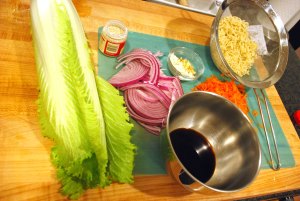
ramen-mise3/4 lb. fine dried Japanese ramen, Chinese egg noodles or angel hair pasta
1/2 small head Chinese (Napa) cabbage (about 3/4 pound)
2 Tbs. virgin olive oil
2 Tbs. minced fresh ginger
1 tsp. dried chile flakes, or to taste
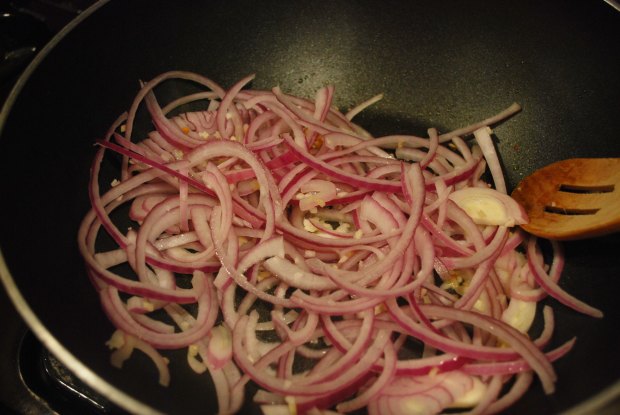
2 medium red onions, peeled and cut into thin slices (about 2 1/2 cups)
2 carrots, peeled, ends trimmed and grated
2 Tbs. rice wine or sake

Noodle Sauce (mixed together):
5 Tbs. soy sauce
2 Tbs. mirin (or 2 Tbs. rice wine or sake plus 1 1/2 Tbs. sugar)
1 1/2 Tbs. Worcestershire sauce
3 Tbs. soy sauce

2 Tbs. toasted sesame seeds

Bring 3 quarts of water to a boil in a large pot. Drop the noodles into the water and stir to prevent them from sticking together. Bring the water again to a boil and cook 4 1/2 to 5 minutes, or until the noodles are just cooked. (Since the cooking time varies with the type of noodles, refer to the package for the recommended time.) Drain the noodles in a colander and rinse under warm running water. Drain again and set aside.

ramen-onions

Cut the cabbage leaves from the stem. Trim the leafy tip ends and discard. Rinse the leaves thoroughly and drain. Cut them into julienne strips about 1/4 inch wide, separating the stem sections from the leafy sections.

ramen-cabbage

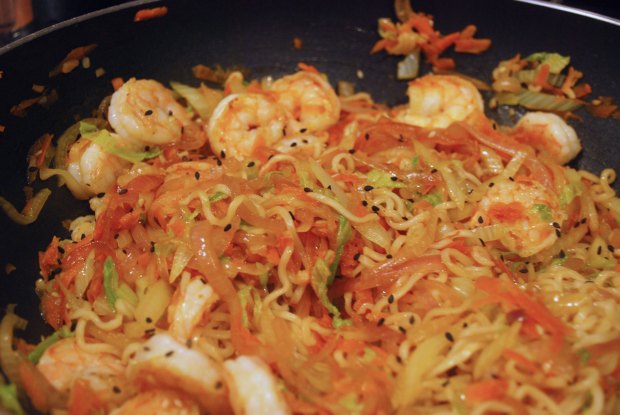
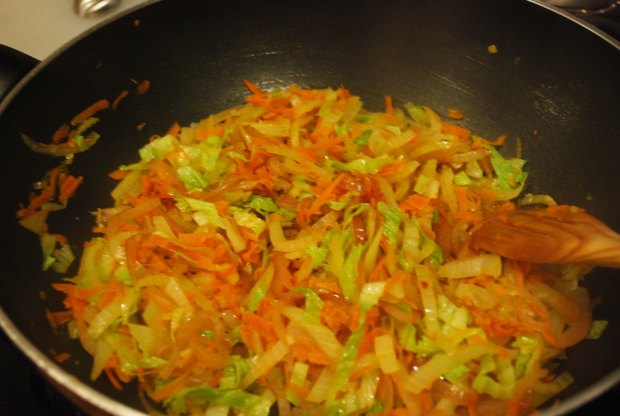
Heat a wok or a heavy skillet, pour in the oil, and heat over medium-high heat until hot. Add the ginger, garlic, chile flakes, and onions, and stir-fry for about a minute. Cover and cook for several minutes, until the onions are soft. Add the cabbage stem shreds, carrots, and rice wine. Stir-fry lightly, cover, and cook for about 1 1/2 minutes, until almost tender. Add the leafy cabbage shreds, toss, cover, and cook for a minute or two. Pour in the Noodle Sauce, bring to a boil, and add the noodles and the sesame seeds. Toss lightly to coat the noodles and vegetables and spoon onto a serving platter. Serve immediately.

Fancy Ramen Noodles

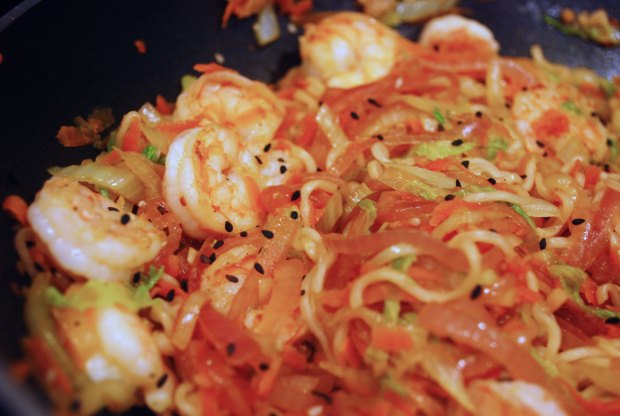
(As you can see from the pictures, I sauteed some shrimp to mix in, but as-is it is a vegetarian main course.)

Kung Pow! Chicken

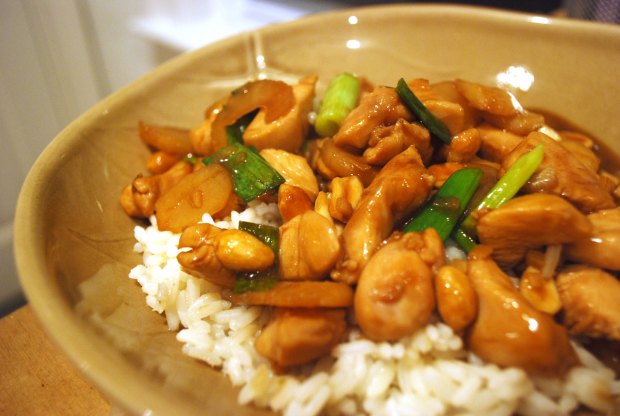
Kung-Pao-FinalAs they say, “when the cat’s away, the mice will play.”  Though I’m not sure it’s the perfect analogy, I must say I did feel a rush of culinary freedom when I found out I was going to have a weekend in the kitchen without my husband around.  Of course, of course, I miss him terribly.  However, the thought of being able to cook any combination of fish, vegetables, or ethnic food I can dream up is nearly intoxicating.
I took RJ’s absence as an opportunity to tackle a second book in my cookbook challenge, and I picked one I knew he wouldn’t enjoy – Spices of Life: Simple and Delicious Recipes for Great Health by Nina Simonds.  While many of the books in my cookbook collection were gifts, and even more were bookstore (or Costco) purchases, this one has more of a story.  I currently work at an art museum and design programming to attract new members and donors.  Last spring, I invited Nina Simonds to speak at the museum for a lecture and luncheon event.  I used her appearance as an excuse to purchase her most recent cookbook, Spices of Life — for research of course!

She brought with her baskets and baskets of spices — assorted seed pods, gigantic rolled cinnamon sticks, peppercorns of all colors.  The guests at the museum loved being able to handle each of these, and breathe in the varied aromas, both familiar and exotic.  While some of us are more adventurous than others when it comes to spices and strange flavors, few of us can describe the plant that produces sesame seeds, or have handled all of the different components of a garam masala.  It was a true treat to have Nina, such a well-traveled food writer and cook, share these things with us.

Nina’s approach to cooking emphasizes the use of healthful ingredients and she describes throughout the book the restorative powers of specific herbs, vegetables and spices.  The concept is a great one — incorporate these health-giving (not to mention delicious!) ingredients into your cooking on a regular basis, and improve your body’s form and function.  Nina’s other website actually supplies a great list of spices and produce items along with their nutrients and perceived healthful properties, though the book is far more comprehensive.

I quickly realized that working with this book was going to take a bit of pantry makeover.  Ingredients such as rice wine vinegar, mirin, and oyster sauce are not part of my everyday mise en place, but I am always happy to expand!  The first recipe I tried was Kung Pao Chicken, served alongside her Asparagus with Cardamom Butter.  The prep work for the chicken was pretty intensive, but I attribute that primarily to my unfamiliarity with the ingredients.  When I get to the point of ‘a splash here’, ‘a handful of that’, ‘a dash of this’, I think that I can minimize my time spent and the amount of measuring cups and tablespoons I dirty up!  I also think there’s a more efficient method for making the marinade and sauce mixtures, since they are quite similar at the base.

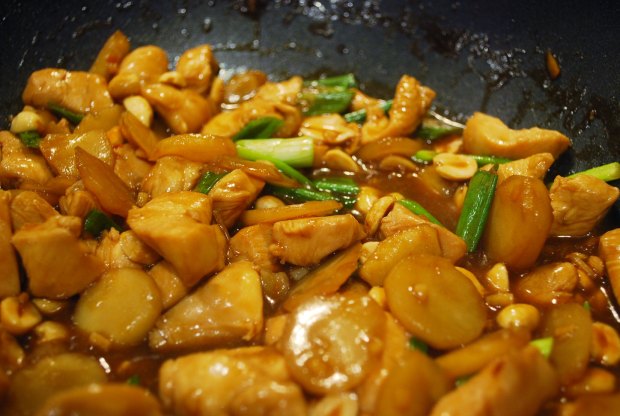
I really liked the comforting Asian flavors of the chicken dish – the salty soy sauce, spicy ginger, and nutty sesame oil mingled together nicely – but the texture was the most fun.  Between the tender bites of chicken, the light snap of the water chestnuts, and the firm crunch of the peanuts, this recipe provided really exciting variety and no two bites were the same.  I also thought it was great that the whole scallion was used (I hate ditching the green tops), especially since the onion provided a nice contrast, both visually and flavor-wise, to the rich brown sauce.  This recipe is definitely worth a try!

As for the asparagus…  I am glad to know that by including the cardamom my digestive system is better off and my ‘spasms’ may now be under control, but the flavor just wasn’t for me.  Give me lemon juice, parmesan cheese, or balsamic vinegar any day — the cardamom was just too out there.  I am sure I could get used to it, of course, but I think that unless I need to quell a bout of belching, I will stick to what I love.

Kung Pao Chicken, slightly adapted from Nina Simonds’ Spices of Life

(Serves 6)

12 ounces skinless chicken breast

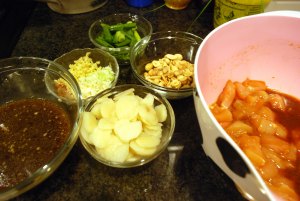
Marinade:kung-pao-mise
2 Tbs. light soy sauce
2 Tbs. Shaoxing rice wine
1 tsp. roasted sesame oil
2 tsp. cornstarch

3/4 cup peeled water chestnuts
2 Tbs. oil
2 garlic cloves, finely chopped
3/4 c. unsalted peanuts, dry roasted
1 spring onion (scallion), finely chopped white parts, green parts chopped into 1 inch pieces
1 tablespoon finely chopped ginger
1/4 to 1 teaspoon red chili flakes (to taste)

Sauce (mixed together):
1 Tbs. soy sauce
1 Tbs. rice wine
1 tsp. roasted sesame oil
1 tsp. cornstarch
1 tablespoon sugar
1 teaspoon Worcestershire sauce
1/4 cup chicken stock

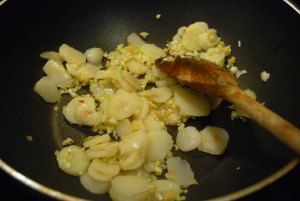
kung-pao-sauteDirections:

Cut the chicken into 1 inch cubes. Mix together the marinade ingredients, and place the cubes in a bowl; toss lightly. Marinate in the fridge for at least 20 minutes. Blanch the water chestnuts in a pan of boiling water, then refresh in cold water. Drain, pat dry, and cut into thick slices.

Heat a wok over high heat, add 1 tablespoon of the oil, and heat until very hot. Stir-fry half the chicken pieces, turning constantly, until the meat is cooked. Remove with a wire sieve or slotted spoon and drain in a colander. Repeat with 1 tablespoon of oil and the remaining chicken. Wipe out the pan.

Reheat the wok over high heat, add the remaining oil, and heat until very hot. Stir-fry the spring onion white parts, ginger, garlic, and the chili flakes for 10 seconds, or until fragrant. Add the sliced water chestnuts and stir-fry for 15 seconds, or until heated through. Pour in the mixed-together sauce ingredients and scallion greens and simmer until thickened. Add the cooked chicken and the peanuts. Toss lightly to coat with the sauce and serve over rice.

kung-pao-mixed-good