
Speaking of birthday dinners, as I did in my last post, we just had another birthday around here and boy, was it a biggie! RJ turned 30 this past weekend, and what did I get my dear husband who eats nothing but meat? A pig roast! To be specific, 62 pounds of dressed pork, turning slowly over a low charcoal fire for over 6 hours.
Words can hardly express how phenomenal the entire experience was. RJ had no idea what I had been planning for the past 3 months, and with some wonderful subterfuge his friends and I managed to get him to his mother’s beach house with narry a clue! His face as he came in the driveway was priceless — astonishment, pleasure and a bit of embarrassment at the number of people we gathered together for the big day.
Though the span of the afternoon is a story in itself — torrential downpours, epic tournament of cornhole, and finally fireworks on the beach — for the purposes of the food blog I’ll stick to the pig.
The pig arrived at around 2 o’clock, dressed (meaning that her internal organs had been removed). Dave, of The Pig Kahuna, rinsed her thoroughly with fresh water, and inserted the rotisserie spit into the mouth and out the…uh…well, use your imagination. A couple extra rods were inserted laterally for stability as well — and the pig doesn’t look happy about it! The final preparation step was to sew her back together and to tie her legs around the spit.

The “Oinkmaster 8000”, Dave’s glorious roasting contraption, was loaded with charcoal and lit. We waited until the coals were at a low burn, measured only by feel. Dave said that if he couldn’t hold his hand over the fire at the level of the pig for 6 seconds, then the coals were too hot. Soon, dear Arnold (our name for the pig, which soon became Arnoldine when we found out she was a Miss Piggy) was mounted on the rotisserie and began her slow roasting.
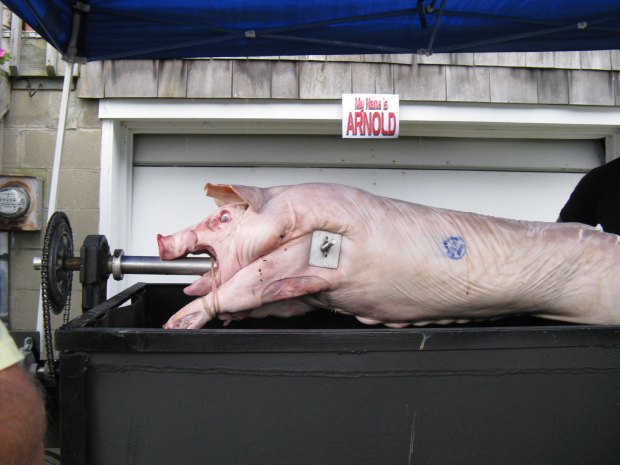
For the six hours she turned, the pig was regularly spritzed with white vinegar. Though Dave has experimented with cider vinegar and even balsamic, he has found that 6 hours of cooking makes cider vinegar bitter and balsamic vinegar black. After an hour and a half on the spit, Arnoldine began to self-baste, releasing delicious juices that dripped down over her shoulders and legs.

In three hours, her skin started to get golden, and we watched as it bubbled over the heat of the coals. With more time, the leg joints began to loosen and the skin split in several places — the beginnings of tenderization. Somewhere around 4 1/2 or 5 hours in, my brother dared my sister to eat one of the eyeballs, and she did. She advised that the pig needed more time…

Finally, after six hours, Dave began the final process — the trick to a perfect roast pig. The motor that had kept Arnoldine on a steady rotation was stopped and the crowds gathered around to watch Dave crisp the skin. He added more charcoal to the fire and the flames began to rise up a couple inches from the coals. Making quarter-turns of the spit, he let each side of the pig sit over the fire for a decent interval. We saw the skin crisping and crackling, with the juices dripping into the fire creating an atmospheric hiss for the dramatic final moments.
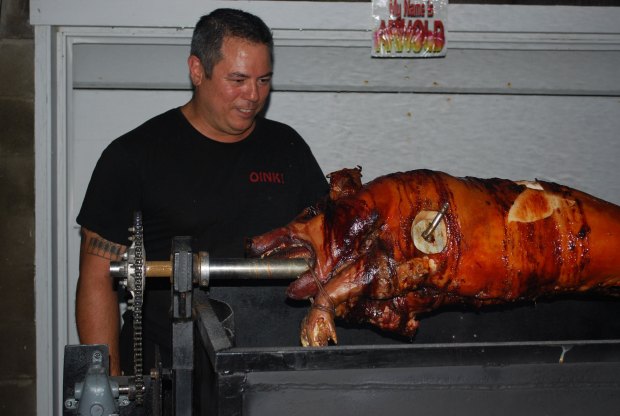
When the pork ready to serve, Dave asked RJ to aid in the dismounting. They each took one end of the spit in their bare hands (the low heat left the ends of the spit at only 75 degrees or so), and moved a mahogany-toned Arnoldine to the serving table. Freed of her metal trappings, the pig nearly fell into perfect serving pieces right in front of us. Dave offered us bites of the tenderloin (smoky from the more direct fire), the shoulder (nearly white and completely juicy), and the belly (from whence the bacon comes…) to compare the various cuts. We also sampled the pig skin, which crunched like savory candy. By now, the crowds were getting rowdy, and everybody’s mouths were watering.
The pork was delectable — succulent and rich when unadorned, and tangy and spicy when doused with Dave’s special barbecue sauce. Though we had about 65 guests, the pig carried over into lunch for 10 the next day. As the birthday boy’s wife and party hostess, I was also designated the “keeper of the head”. Those in the know, Dave said, always go for the pig cheeks — I guess now I’m in the know! I think I gave my mother-in-law a heart attack, however, when she opened the fridge to find a whole pig’s head staring out at her (with one eye, no less).
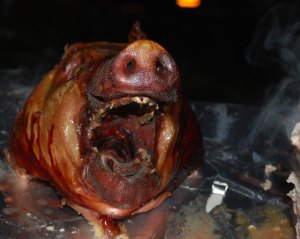
All I can say is “wow”. RJ had a wonderful birthday, complete with (an excess of) meat on a stick, and all of our guests enjoyed watching Arnoldine turn and learning from Dave, the Pig Kahuna himself. The question is, what can top RJ’s 30th birthday when he turns 40? Perhaps we’ll have to look into a cow…


 , consisted of french fries, charcuterie (cured meats, salami, and pork rillettes), sweetbreads with bacon and fava beans, and crispy pork belly with apple sauce. It was not to be believed. Of course, the entire meal is paired with excellent wines by the course, and a copy of the cookbook is yours to keep. I left Stir that night with a smile from ear to ear and a book called Meat under my arm.
 , named for the famed
 Best of all, however, is the staff. In June, we met Molly, the executive sous chef at Stir, and Jericha, one of the butchers at the
  . While I haven’t seen it, I would bet the farm that it is fabulous, and will be appearing soon on the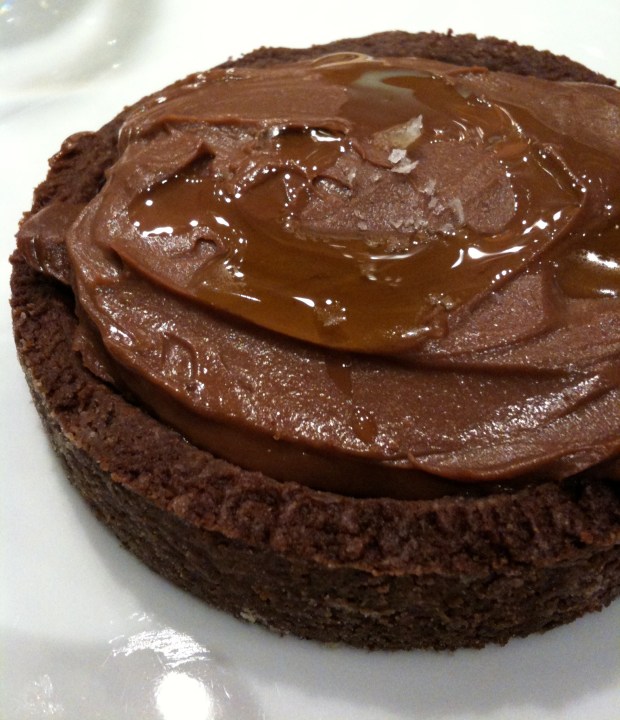
 . I wanted all three recipes to showcase the strengths of the cookbook –
 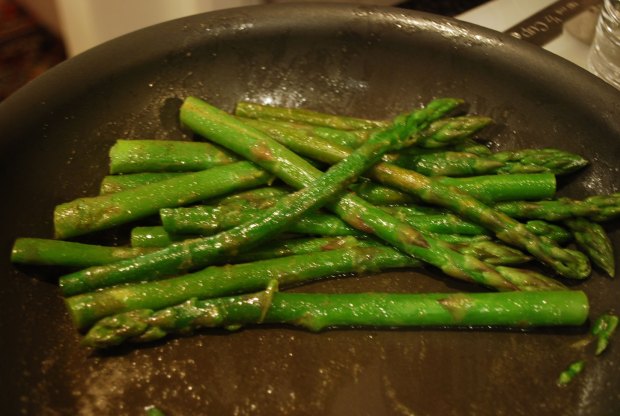 Then a strawberry-rhubarb crumble that had the weakest, least flavorful topping I’ve ever tasted (what a waste!):

 6 pieces salmon fillets with skin on, each weighing about 6 ounces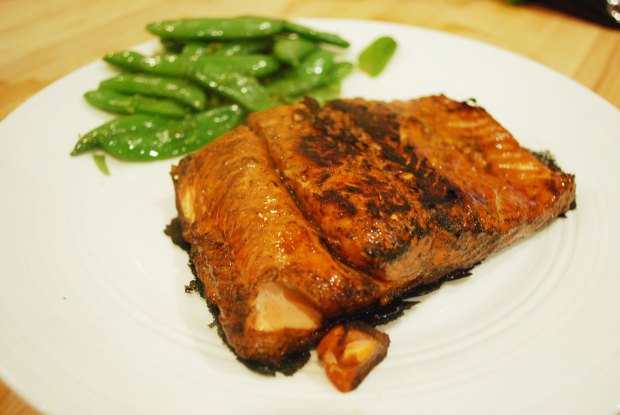


 is my first indulgence (and you never forget your first, I’m told). This novel, the author’s debut, is exceptionally crafted. Bauermeister sculpts each character with rich language and heartfelt empathy, revealing them slowly through their most intimate histories – an elderly couple’s crisis of infidelity and eventual reparation, a young man’s heartbreak over the death of his wife, a new mother’s conflicted self-perception – and then bringing them all together around the counter at the cooking school named in the title.
 , a memoir by Kathleen Flinn. Also about a cooking school, specifically Le Cordon Bleu, Flinn’s writing lacks all of the elegance and expert pacing of Bauermeister’s. Admittedly, Flinn is a trained journalist and is writing non-fiction. Nevertheless, the reader could have been, but is not, transported by her book. I don’t fall in love with her husband-to-be along with her. I do not feel her frustration or her intense determination — I just hear it. Does that make sense? I recall the most basic lesson of college-level creative (and academic) writing — Show Don’t Tell. Flinn’s book was more of a telling. As
  This is not to say I didn’t enjoy the book at all. I did. As did many other
  From My Table...to Yours