Magazine Review: “Gourmet” and Pumpkin Souffles

Pumpkin Souffle This is the third installment of my series of Thanksgiving magazine reviews.  You can see my evaluative criteria here.  Today’s review is of GOURMET — a venerable publication directed by non other than Ruth Reichl.  For years I have avoided Gourmet, thinking of it as the imperious matriarch lording over its more accessible and friendly sister magazine, Bon Appetit.  My impression was that the recipes were too esoteric for me, the ingredients too rarified.   Below, I take another look.

  • 180 pages total : 80 pages of ads (44%)
  • 73 Recipes (interesting that a misleading heading on the cover of the magazine claims: “212 recipes, wines, tips, complete menus, and techniques”)
  • News-stand price: $4.50
  • Price per recipe: $0.06
  • # of ads pretending to be articles: HA!    Hahahaha!  I found 13!  I think that Conde Nast, who publishes Gourmet and Bon Appetit, invented the concept.  One of these “special advertising sections” even carries the title “The Good Life”, adapted from (and in the same font as) a Gourmet regular section “Good Living”
  • Recipe Index? One index at the back of the magazine sorts the recipes by course (Appetizer, Main Course, Side Dishes) and separates out a list of Vegetarian and Quick recipes.  I did not find the index particularly helpful here, and I still don’t understand why the Cauliflower Risotto was listed under “Main Course: Vegetarian”, but not under “Vegetarian Dishes” when many other recipes were double-listed.

Photos: Right proper food porn, if you ask me.  In the special Thanksgiving section, the photos are in a group, followed by the recipes, so you can drool and then get down to business.  Definitely could benefit from more pictures, though.  Gimme more, I need my fix!

Best Sections:
• Good Living: Kitchen.  I am not sure if this is a regular section of the magazine (as I said, I don’t pick this one up often), but I love looking into gorgeous kitchens.  I have a major jones for a two-oven kitchen with a substantial butcher-block island in the middle.
• Cookbook Club — If you are like me and you have a serious cookbook addiction, this is just bad for you.
• In theory, “One or Two for Dinner” is perfect for me.  I’m always working to scale-down recipes to accommodate the fact that RJ and I are having dinner, just the two of us, 90% of the time.

Best Features:
• Many recipes include a “Cook’s Note” which refers readers to the web to find out how to make use of leftovers.  I, for one, don’t love having a half-head of cabbage rotting in my crisper drawer for weeks after making a special dish.  “Cook’s notes” also let readers know what aspects of a recipe, if any, can be made ahead.
• Each of the 4 (!!) Thanksgiving menu sections includes a “Game Plan” outlining the dishes, or aspects of dishes, that can be done ahead, and in what order they should be tackled.

Thanksgiving at the Gourmet house:
•Four separate versions of the Thanksgiving feast are provided.  “Over the Top” is just that, and very typical of most Gourmet issues: Foie Gras Toasts with Sauternes Gelee; Smoked-Sable Tartare with Beets and Watercress; Seckel Pear Tart with Poire William Cream.  “Come Together” gives a Latino version of Thanksgiving: Clementine Jicama Salad, Adobo Turkey with Red Chile Gravy; Sweet-Potato Coconut Puree.  “Four Hour Feast” attempts a ‘faster’ Thanksgiving (what’s the point of that?!?): Cranberry Tangerine Conserve; Roasted Potatoes and Shallots; Cider-Poached Apples with Candied Walnuts, Rum Cream, and Cider Syrup.  Finally, “Harvest’s Home” – a vegetarian version of the holiday: Mushroom and Farro Pie; Moscatel-Glazed Parsnips; Artichokes Braised in Lemon and Olive Oil.  Ruling?  Not your grandmother’s Thanksgiving.

Particularly Unappetizing:
• Celery Apple Granita (ew!)
• Pumpkin and Cod Fritters with Creole Sauce (double, nay, triple ew!)
• Sauteed Lemon Maple Frisee
• Mango Pomegranate Guacamole (I like all three separately, but together?)

I’m looking forward to cooking:
• Roast Pumpkin with Cheese Fondue (I’m not the only one!)
• Haricots Verts with Bacon and Chestnuts
• Roasted Sweet Potato Rounds with Garlic Oil and Fried Sage
• *Spiced-Pumpkin Souffles with Bourbon Molasses Sauce
• Parsnip Puree with Sauteed Brussels Sprouts Leaves

Gourmet is analogous, in a way, to Vanity Fair – it looks like an easy, fun read from the outside (who doesn’t like Nicole Kidman or roast turkey?) but ends up requiring a lot more brainpower than you expected.  I am not in any way against revving up the ol’ gray matter – I love spending a few hours with the New Yorker or the Times on a Sunday – but when I pick up a food magazine, or a fashion magazine for that matter, I am looking for instant satisfaction.  The articles in Gourmet are long and wordy, without many pictures.  I am constantly skimming and thinking “blah, blah, blah.”  This is a good magazine for those who want to bring a stand-out, crowd-awing dish to a Thanksgiving party, or for someone who has a pretty established and fixed family menu and wants to offer a fancy alternative to one of the ho-hum annual dishes.  Also good for vegetarians, obviously, or maybe a gourmande group cooking club.  I cannot, however, see how it would be possible for one, or even two cooks to pull together any of these elaborate menus on Thanksgiving day.

I also think that in most circles, if you tried to put on a ‘Latino Thanksgiving’ with hot spices and tropical fruits in every dish, you would experience mass revolt.  The realities of Thanksgiving, at least as I have experienced it, is that you have a lot of people, of all ages, gathered together for one meal after not having seen each other for some time.  That means varied diets, preoccupied moms and dads, family catch-up talks, and very busy kitchens.  Timing and assembling 8 or more individual pumpkin souffles for Thanksgiving dessert seems unlikely and unnecessarily difficult.  My past Thanksgivings have involved several aunts hocking their various pie specialties (or purchases) and me and my cousins trying to convince our parents that four 1-inch slices of different pies is equal to one normal-sized slice of a single pie.  However, I am well aware that Thanksgiving can go down any number of ways.  If you have the time for these elaborate and very Gourmet menus, I would like an invitation for next year.

*Spiced-Pumpkin Souffles with Bourbon Molasses Sauce  [
printable recipe]
1/2 c. whole milksouffle-in-ramekin
1 Tbs. cornstarch
1/4 tsp. grated nutmeg
1/4 tsp. ground cinnamon
1/8 tsp. ground allspice
pinch of ground cloves
3/4 c. plus 1 Tbs. granulated sugar, divided, plus additional for coating ramekins
3/4 c. canned pure pumpkin (from a 15 oz. can, not pie filling)
10 large egg whites
1/4 tsp. salt

Whisk together milk, cornstarch, spices, and 1 Tbs. granulated sugar in a small heavy saucepan.  Bring to a boil over medium heat, whisking, then simmer, whisking, 2 minutes. souffle-bitten Remove from heat and whisk in pumpkin.  Transfer to a large bowl and cool to room temperature.  (can be made ahead to this point and chilled for up to 1 day)
Preheat oven to 400 degrees F with rack in lower third.  Butter ramekins and coat with granulated sugar, knocking out excess, then put in a large shallow baking pan.
Beat egg whites with salt in another large bowl using an electric mixer until they hold soft peaks. Add remaining 3/4 c. granulated sugar a little at a time, beating, then beat until whites hold stiff, glossy peaks, 1-2 minutes more.  Fold one third of the whites into cooled pumpkin mixture to lighten, then fold in remaining whites gently but thoroughly.  Divide mixture among ramekins, mounding it.
Bake souffles until puffed and golden, 18-20 minutes.  Dust with confectioners sugar and serve immediately.

Bourbon Molasses Sauce (in case you are wondering, this is NOT OPTIONAL – it makes the dessert!)

3/4 c. sugarsouffle-caramel
1/4 c. plus 2 Tbs. water, divided
3 Tbs. bourbon
3 Tbs. unsalted butter
1 1/2 Tbs. molasses (not blackstrap or robust)
1/4 tsp. salt

Bring sugar and 2 Tbs. water to a boil in a small heavy saucepan over medium heat, stirring until sugar has dissolved, then wash down any sugar crystals from the side of the pan with a pastry brush dipped in cold water.  Boil, without stirring, swirling pan occasionally so caramel colors evenly, until caramel is dark amber.  Remove from heat and stir in remaining 1/4 c. water, then stir in bourbon, butter, molasses, and salt.  Return to heat and simmer, stirring, to dissolve any hardened caramel if necessary.  Sauce can be made one day ahead and chilled.  Reheat in a microwave or double boiler until liquefied.

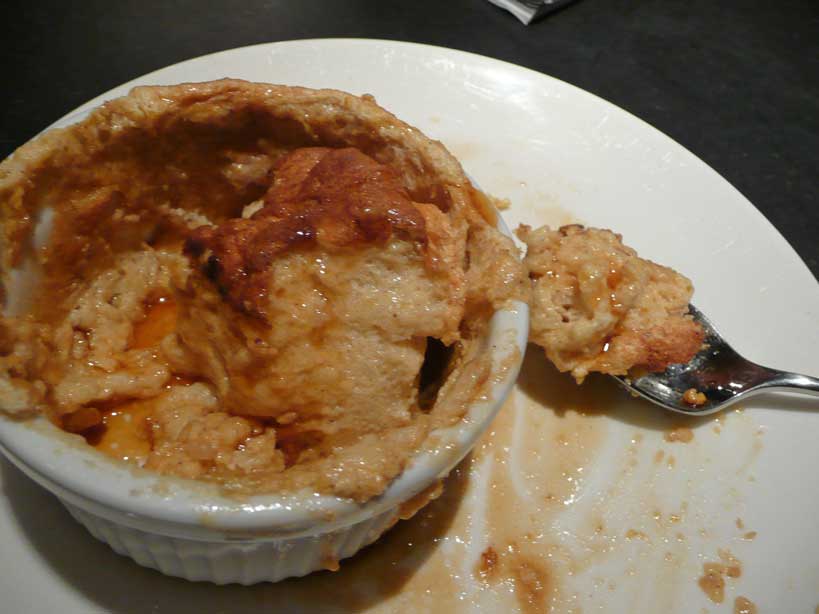
souffle-butter-sauceResults:  Oh, how I love Gourmet magazine.  To anyone who doubts the supremacy of this magazine, including whatever whack-job wrote the above review, please have a bite of this souffle.  This was absolutely divine.  The souffle was light and fluffy – perfect after a full meal.  It puffed up over the rim of the ramekin nearly doubling in size – a beautiful presentation.  Plus, the sauce was truly magical – I would drench ice cream or pumpkin pie or cheesecake with this.  I would take a bath in it.  As RJ says, “if they made it a toothpaste, I’d brush my teeth with it.”  I’m still not sure you could make a souffle on Thanksgiving day, despite the fact that the sauce and part of the pumpkin mixture can be done ahead of time, but please remember: the fall season lasts for three months!
Roast Chicken

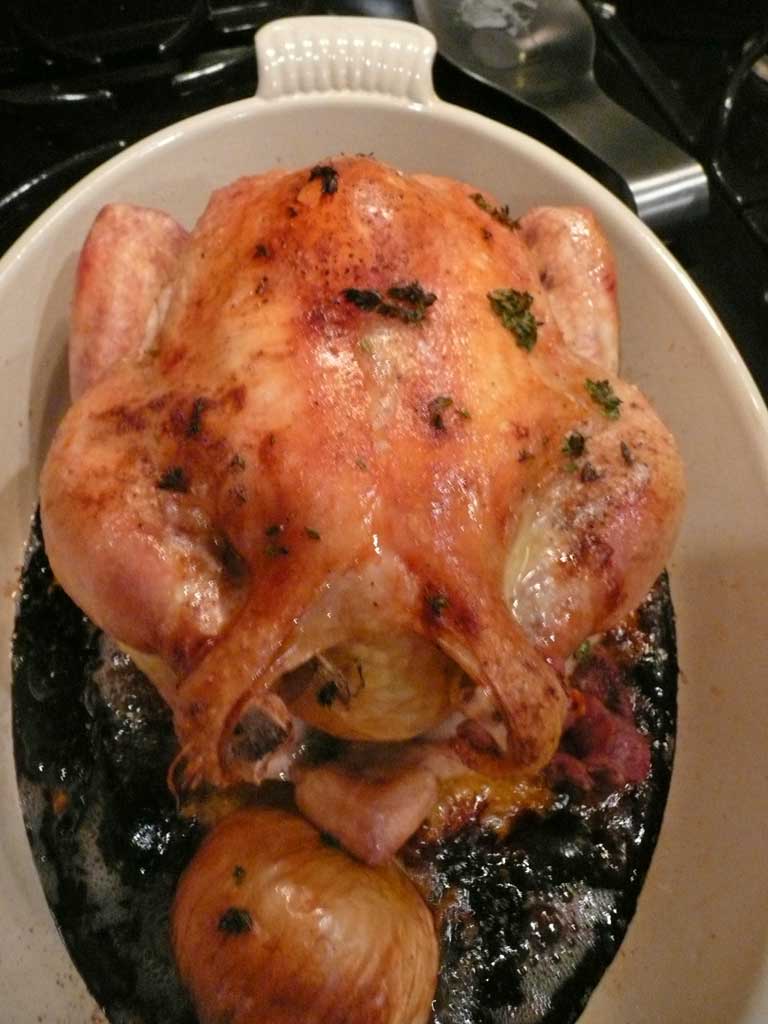
chickenForgive me yet another roasting post.  I henceforth declare (retroactively) this past week Roasting Week, in homage to all the crispy, browned, concentrated flavors that dry oven heat bestows upon us.  This does not count as a real post, I know.  I don’t have any teaser images or elaborate descriptions.  I just have something so delicious and essential that it must be added to the blog.  This ‘recipe’, if you can even call it that, serves so many purposes I simply have to share it.  For one, it looks great and is perfect for entertaining.  Second, it is quite adaptable to all manner of taste and preference.  Third, it leaves you with some great leftovers (which I will be dealing with in a future post).  In any case, read the post through before you start cooking so you can understand the whole concept…

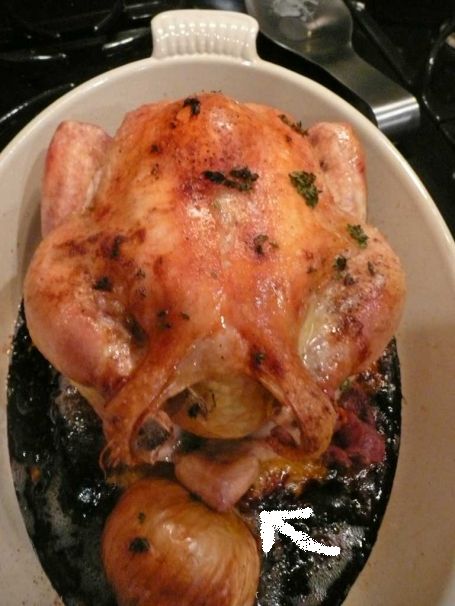
The method is as follows: buy yourself a whole roasting chicken and get a good one (read: free range preferable, super-market bird less than acceptable).  I describe my bad experience with a not-so-special bird here, so try not to make the same mistake I did – I promise it makes a difference!  Rinse the bird with cold water inside and out, then pat dry.  Remove excess fat from the outside and inside of the bird.  Personally, I keep the “pope’s nose” (the fatty flap at the opening of the bird’s cavity) intact ‘cuz my Gammy likes it, but if your grandmother isn’t around, ditch it with the rest.  Salt and pepper the inside and outside of the bird to your own taste.

Now is your chance to improvise.  You want to stuff the bird with some aromatics, which can include any combination of the following: a halved onion; a halved head of garlic; a halved lemon; sprigs of thyme, rosemary and/or sage.  You want to fill the cavity without ramming junk in there to the breaking point.  

Depending on what you put inside the bird, you want to mix your basting butter accordingly.  If my bird is stuffed with herbs, I might make a minced shallot butter.  If I stuff with lemon, then parsley and tarragon butter tastes delicious.  Mix and match to your delight!  You will want your basting butter to be a mixture of 1 tablespoon of butter per pound of chicken plus some combination of chopped herbs, lemon juice, minced shallots or garlic.

Once the chicken is stuffed, tie the legs together with twine, or, as in the picture above, cut small holes in the skin of the bird below the leg and near to the cavity, then shove the ends of the legs into them.  This will ensure that the legs of the bird stay close to the breast.  Put the bird in a 425 degree oven for 20 minutes.  At the end of the 20 minutes, baste the bird with your melted butter mixture.  Turn the oven heat down to 375.  Cook for a total time (including the first 20 minutes) of 15-20 minutes per pound.  Every 15 minutes or so, baste with the flavored butter mixture.

When the time’s up, remove the chicken from the oven.  If you’re worried about done-ness, prick the thigh of the chicken (below the leg) with the tip of a knife and take a peek at the juices that come out.  If they’re red or pink, you want to put it back in the oven for a bit.  If they’re clear, let the chicken rest on a cutting board for 10 minutes to let the juices redistribute.  Carve and serve!

Now – you may be asking yourselves why it looks like the juices around my chicken are black in the pan.  For one thing, they were not actually black.  They were very dark brown.  And they looked that way because I modified my traditional prep (above) to add in tips from Anthony Bourdain‘s Les Halles Cookbook.  I put the giblets and half an onion on a pan and rested the raw chicken body on top of all of them.  Then I poured about a cup of white wine around the bottom of the pan and followed my own directions, above, for roasting the chicken.  This allowed me a great base for a pan sauce – I just had to put the chicken and other solids on a cutting board then mix some beurre manie and chicken stock into the pan to scrape up the fond (leftover roasted chicken bits) from the bottom of the pan.  This will result in a yummy chicken-y sauce which you can use just as is, or you can add a couple teaspoons of balsamic vinegar and cook a few minutes before pouring into a gravy dish.

Enjoy my mom’s chicken recipe – it’s no family secret or anything, but it’s a family classic.

Update: Since there seems to be some confusion about the issue, please see below picture of “The Pope’s Nose”pope2

Roasting in all its Simplicity

Roasted Onions

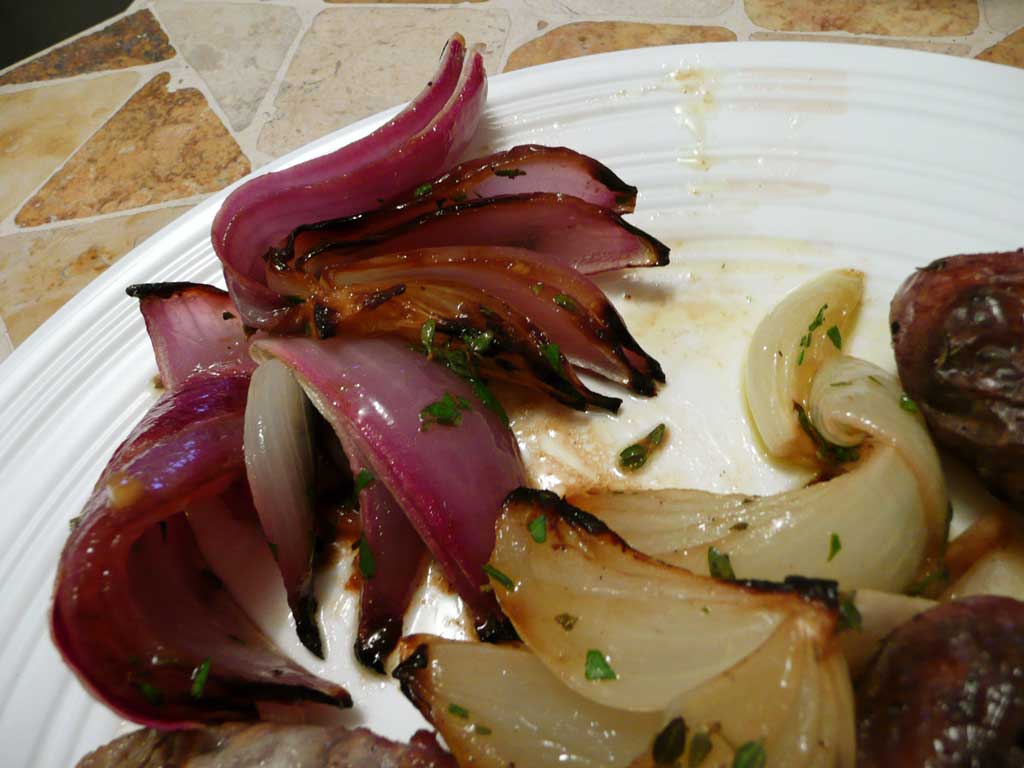
So today marks my first official contribution to the “Barefoot Bloggers” – a group of people who share of love of Ina Garten’s Barefoot Contessa cookbooks and cook their way through them, assigning a new recipe every two weeks.  How kind of them to select a supremely un-intimidating recipe to ease my entry to the fold!  Actually, Kelly who chose this recipe most likely picked it because she likes onions.  And I hope she likes mustard, too, because whoo-eee this recipe has a strong mustard flavor to it.  The components here are extremely simple – some onions, a nice mustard-herb dressing, salt and pepper.  However, unlike many roasted veggie side dishes, you will not overlook this one!  As I said, the mustard flavor is pungent (and delicious) but more importantly, the final product is gorgeous.  By keeping the root intact, the onions stay in their wedges, but they tend to separate at the layers, fanning out into tender, aromatic petals which gather the dressing in their folds.

By necessity (I only had one red onion on hand) my final product has reversed the ratio of red onions to yellow, a mistake I won’t make again.  Something about the way a red onion deepens in color and develops its blackened crust, curling up a bit at the edges – they are just so festive!  Not to mention the fact that they make for much better photos.  I would also have cut my wedges a bit thinner.  Ina did not specify how many wedges to make out of an onion, but I would suggest 8-12, depending on the size of your onions.  If the wedges are too thick, they will need more cooking time – you want to get all of the raw out of those puppies!  Of course, you could add other vegetables to your pan here – peppers, potatoes, brussel sprouts, parsnips to name a few – but the power of the Barefoot Contessa recipe is really in the simplicity.

So give this dish a try as is, then adjust to your liking – it really is infinitely adaptable.  I’m thinking my next version will incorporate some tarragon in the dressing, or maybe a drizzle of a balsamic syrup right at the end.  This could definitely be a great addition to your Thanksgiving table as well, I might add.

Roasted Onions Roasted Onions
2 red onions
1 yellow onion
2 Tbs. freshly squeezed lemon juice
1 tsp. Dijon mustard
1 tsp. minced garlic
1/2 Tbs. minced fresh thyme leaves
3/4 tsp. kosher salt
1/4 tsp. freshly ground black pepper
1/4 c. good olive oil
1/2 Tbs. minced fresh parsley leaves

Preheat the oven to 400 degrees F.

Remove the stem end of each onion and carefully slice off the brown part of the root end, leaving the root intact. Peel the onion. Stand each onion root end up on a cutting board and cut the onion in wedges through the root. Place the wedges in a bowl.
Roasted onions and vinaigrette
For the dressing, combine the lemon juice, mustard, garlic, thyme, salt, and pepper in a large bowl. Slowly whisk in the olive oil. Pour the dressing over the onions and toss well.

With a slotted spoon, transfer the onions to a sheet pan, reserving the vinaigrette that remains in the bowl. Bake the onions for 30 to 45 minutes, until tender and browned. Toss the onions once during cooking. Remove from the oven, and drizzle with the reserved dressing. Sprinkle with parsley, season to taste and serve warm or at room temperature. Roasted onions

Magazine Review: “Saveur” and Roasted Cranberry Sauce

roasted cranberry sauceThis is the second installment of my series of Thanksgiving magazine reviews.  You can see my evaluative criteria here.  My second food magazine review is of SAVEUR — a publication I became aware of through the Orangette blog, where several great recipes from Saveur have been featured.

112 pages total : 37 pages of ads (33%)
32 Recipes
News-stand price: $5.00
Price per recipe: $0.16
# of ads pretending to be articles: only one, and it’s very hard to spot.  It has the heading “The Saveur Chef Series” and includes a recipe for cauliflower with pine nut and current bread crumbs.  But for the miniscule “Advertisement” written across the top of the page, I would not have known it was advertising anything.  Come to think of it, I still am not quite sure what it is an ad for, except perhaps Bill Telepan’s eponymous NYC restaurant.
Recipe Index? Two indexes are provided – one, at the beginning, lists the recipes by article; the second lists them by category.  Both are ‘blink-and-you’ll-miss-em’ small.

Photos: Good, large pictures are scattered throughout the magazine, but are not labeled by recipe and are often separated by a page or two from the recipe they depict.  That’s fine for green beans with hazelnuts, but not so good when it comes to Kasespatzle.

Best Sections:
• The pantry – This section gives you resources to locate the esoteric ingredients used in some of the recipes.  Perfect for all of those “wait, where do I find Thai palm sugar?” moments.
• Source – a short feature story on a specific retailer or product.  This month it was Happy Girl Kitchen Co.’s pickled vegetables, including carrots, squash, and Italian beans – I am intrigued…
• In the Saveur Kitchen – “Discoveries and Techniques from our Favorite Room in the House”, including unusual uses of common ingredients and illustrated technique lessons.

Best Features:
• Within certain articles a little call-out box refers the reader to the web for more ways to use a specific ingredient or for similar or complementary recipes.
• This magazine’s content centers around articles on specific cuisines and their locales, always giving a list of “where to stay”, “where to eat” and “what to do” if you decide to follow in their footsteps.  This issue alone featured New Orleans, the Auvergne region of France, and Laos.
• Rather than always publishing in the traditional recipe format of serving size, ingredient list, then instructions, throughout the magazine you will find short blurbs called “Methods” which condense a recipe into a short prose paragraph – very much like your mom would relay Grandma’s Apple Pie to you over the phone.  The overall impression given is that you can adjust any of the methods to your own taste preference.

Thanksgiving at the Saveur house:
•Two separate sections deal with Thanksgiving – one about classic side dishes, and a second about how the holiday is celebrated in Louisiana.  Sweet Potato Casserole, Oyster Stuffing, Whipped Mashed Potatoes with Celery Root, Oyster stew, Leah Chase’s Roasted Turkey.  Ruling?  Very traditional.

Particularly Unappetizing:
• Traditional Mincemeat Pie (dried and fresh fruit plus rum and beef fat – shudder!!)
• Steamed Fish Mousse
• Pounti (Auvergne-style meatloaf with prunes)

I’m looking forward to cooking:
• *Roasted Cranberry Sauce
• Spinach and Artichoke Dip
• Brussel Sprouts Salad

In Summary, Saveur is a very interesting mixed bag.  The list of recipes, at least in this issue, ranged from a Chile con Queso dip made with Velveeta, canned Ro-Tel tomatoes and Corona beer, to Laap Moo (a Laotian minced pork salad) with chopped fresh galangal, toasted rice powder, kaffir lime leaves and lemongrass.  I recommend this magazine for the adventurous and ambitious chefs of this world – those who want to experience unique flavors from around the world or who want to teach themselves the authentic techniques of food preparation before the advent of the microwave or ready-made pie dough.

Make cranberry sauce*Roasted Cranberry Sauce, cited from Saveur No. 115

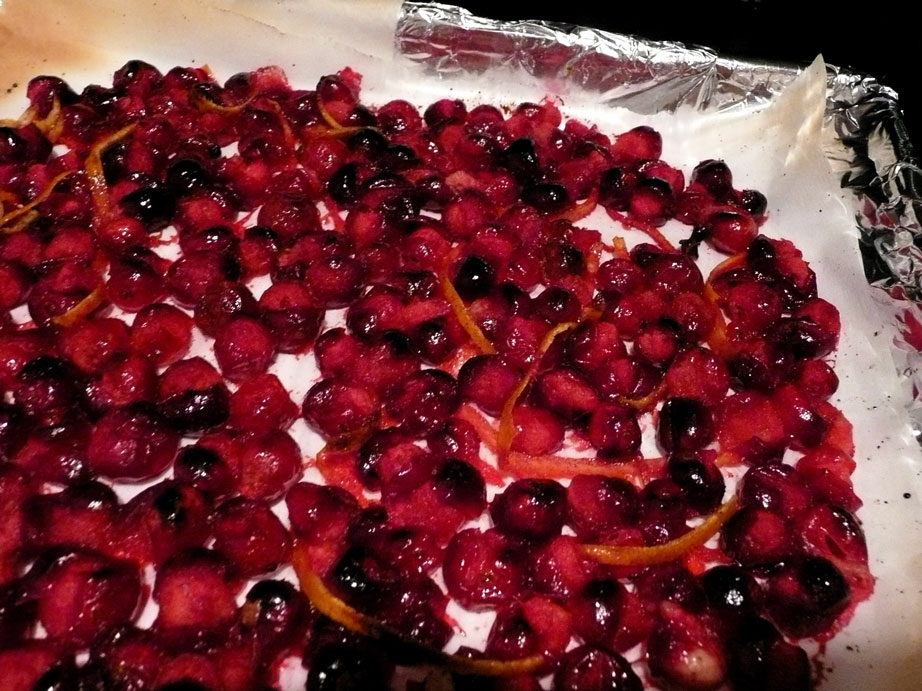
Heat oven to 450 degrees.  Using a peeler, remove peel from one orange, taking off as little of the white pith as possible.  Cut peel into very thin strips about 1 1/2 inches long.  Squeeze juice from orange; strain and reserve 1 Tbs. of the juice.  In a bowl, combine peel, 1 lb. fresh or thawed cranberries, 1 cup sugar, 2 Tbs. extra-virgin olive oil, 1 tsp. kosher salt, 4 smashed green cardamom pods, 4 whole cloves, 2 sticks cinnamon, and 1 small stemmed and thinly sliced jalapeno. Toss and transfer to a parchment paper-lined baking sheet.

Roast until cranberrries begin to burst and release their juices, 10-15 minutes.  Transfer cranberry mixture to a bowl; stir in reserved orange juice and 1 1/2 Tbs. of port.  Let sit for at least 1 hour so that hte flavors meld.  Remove and discard cardamom, cloves, and cinnamon before serving.  Makes 2 cups.

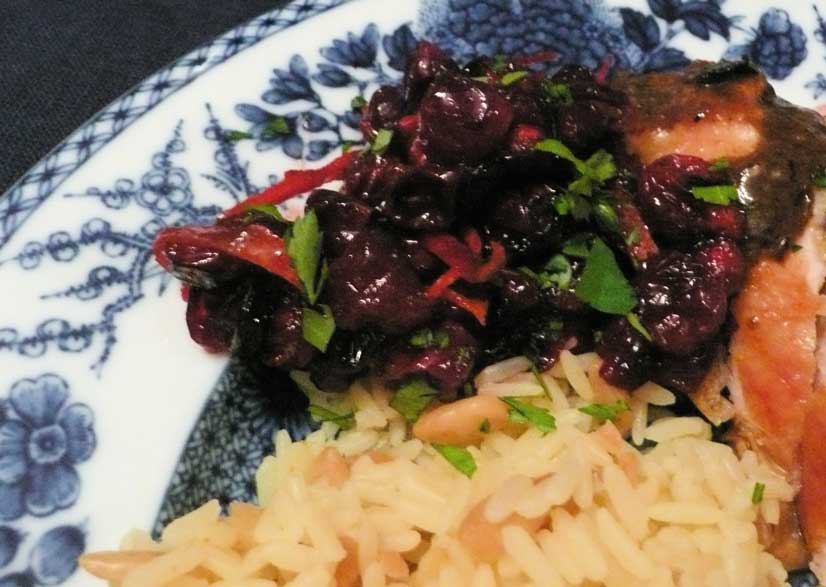
Plated cranberry sauceResults:  I don’t know about your feeling on this, but I found the prose-recipe method really frustrating.  I didn’t see that I needed a jalapeno until too late (so I left it out), and I had to keep rereading the whole recipe over and over to make sure that I only needed to save 1 Tbs. of the orange juice.  Though I know I’m supposed to follow these test recipes exactly, I used ground cardamom and ground cinnamon and omitted the jalapeno.  The results, however, were absolutely delicious.  The sauce was quite tart, which I liked, and the port gave it such a wonderful flavor without making it taste ‘alcoholic’ at all.  The texture was like a thick and chunky chutney, so if you like a more saucey version, this is not the recipe for you.  For me?  Yum yum yum!  This might become an annual feature of my holiday table!