A Tart for the Holidays


tart-final

This year I had two Thanksgivings – the formal one, on Turkey day, with my husband’s family, and a second one with my family over the following weekend.  As this is the first year RJ and I are going into the holidays as a married couple, there have been many discussions about how best to handle the division of our time and pay proper homage to each family.  Our solution involves a lot of shuttling around the greater Boston area, but we think we have found a good balance of time spent, meals shared, and presents exchanged. 

A colleague said to me last week that Thanksgiving is what Christmas should be – a day of fun feasting, collaborative cooking, and quality family time without the stress of holiday shopping and credit card debt.  RJ loves Thanksgiving but dreads Christmas for all the aforementioned schlepping to fit everything into the 2-day window of official Christmas.  It was nice to see that we could do a second (smaller) Thanksgiving on Saturday, November 29th without a loss of sincere holiday feeling.  Plus we had twice the turkey, twice the pies, and twice the family face time.  Perfect!  I think for once we made it through a holiday with everyone happy!

I had such a great time on (proper) Thanksgiving, cooking with my mother-in-law at her house.  When the boys went to sit in the freezing cold at a high school football game they were sure to lose, we basted the turkey, prepped the vegetables, and armed ourselves for the onslaught of relatives that would come through the door at 2.  Unfortunately, as I’ve already confessed, we did not take photos on that day, and I regret that.  Thankfully the internet has provided many of them for us, as you can see here.  On Saturday, however, I remembered to pull out the trusty Panasonic and snap away, bringing you the beauty that is the “Festive Cranberry-Pear Tart.”  I would very highly recommend this delicious tart for your next holiday meal or potluck party.  It was a huge hit, and tastes just as good at breakfast as it does for dessert.  Then again, I’m a pie-for-breakfast kind of girl.

Festive Cranberry-Pear Tart in a Walnut Shortbread Crust, from Fine Cooking Issue No. 74

For the Shortbread Crust:Shortbread tart crust

1 large egg yolk
1 Tbs. half and half
1/2 tsp. pure vanilla extract
1 1/2 c. unbleached all-purpose flour
3 Tbs. granulated sugar
1/2 tsp. table salt
1/4 lb. (1 stick) cold unsalted butter, cut into 1/2 inch dice
1/3 c. walnuts, toasted and finely chopped 

For the Cranberry-Pear Filling:
3 large ripe pears, like Anjou or Bartlett
2 c. fresh cranberries, picked through and rinsedRaw Cranberry Pear Tart
1 Tbs. brandy
2/3 c. granulated sugar
2 tsp. unbleached all-purpose flour
1/2 tsp. ground cardamom
1/2 tsp. ground ginger 1/4 tsp. ground cinnamon
1/8 tsp. ground allspice
1/8 tsp. table salt

For the Buttery Brown Sugar Streusel:
1/3 c. plus 1 Tbs. unbleached all purpose flour
1/4 c. packed light brown sugar
1/8 tsp. table salt
2 Tbs. unsalted butter, melted
1/4 tsp. pure vanilla extract

Make the crust: Position a rack near the center of the oven and heat the oven to 400 degrees F.  In a small bowl, mix the egg yolk, half and half, and vanilla.  Put the flour, sugar, and salt in a food processor; pulse until combined.  Add the butter and pulse until the butter pieces are no longer visible.  With the processor running, add the yolk mixture in a steady stream and then pulse until the moisture is fairly evenly dispersed, 10 to 20 seconds.  Transfer the mixture to a bowl.  Using your hands, mix in the chopped walnuts to distribute them evenly.  The dough will be a mealy, crumbly mass.
Cranberry-Pear Tart

Pour the crumb mixture into a 9 1/2 in. round fluted tart pan with removable bottom.  Starting with the sides of the pan, firmly press the crumbs against the pan to create a crust about 1/4 inch thick.  Press the remaining crumbs evenly against the bottom of the pan.  Prick the bottom of the crust all over with a fork and freeze for 10 minutes.  Bake until the sides just begin to darken and the bottom is set, 15 min.  Transfer to a cooling rack.  Reduce the oven temperature to 350 degrees.

Make the filling: Peel the pears, quarter them lengthwise, core, and cut crosswise into 1/4 inch thick slices.  In a food processor, coarsely chop the cranberries.  In a medium bowl, mix the pears, cranberries, and brandy.  In a small bowl, mix the sugar, flour, cardamom, ginger, cinnamon, allspice, and salt; add to the cranberry-pear mixture, tossing to combine.  Spoon the filling into the par-baked crust, leveling the filling and packing it down slightly with the back of a spoon.
Streusel

Make the streusel and bake: In a small bowl, mix the flour, brown sugar, and salt.  Add the melted butter and vanilla.  Combine with your fingers until the mixture begins to clump together in small pieces when pressed.  Sprinkle the streusel over the filling, breaking it into smaller pieces if necessary.  

Bake at 350 degrees F until the fruit is tender when pierced with a fork and the streusel and the edges of the crust are golden brown, about 50 minutes.  If the tart begins to get overly brown at the edges, cover with foil.  Let the tart cool on a rack until it’s just barely warm before serving.  The tart will keep, covered and at room temperature, for two to three days.

**The issue from which I pulled this recipe, the October/November 2005 issue, is a very strong one – it contains one of my favorite cookie recipes (white chocolate, cranberry and oatmeal), a great pot roast recipe, and a mushroom soup with sherry that I love!  You can buy back issues of Fine Cooking here.

Cranberry Pear Compote

Making this recipe I had plenty of leftover cranberries in the bag, as well as leftover spiced pear-cranberry mixture.  I put both of these, maybe 1 1/2 c. of fruit total, in a small saucepan and added about a 1/2 c. of water and 1/2 c. of ruby port.  I cooked the fruit over medium-low heat until all of the cranberries had popped and the pears were tender.  The final product was sweet and flavorful – I can see it would be good over ice cream, but we used it as a second cranberry sauce with our turkey.
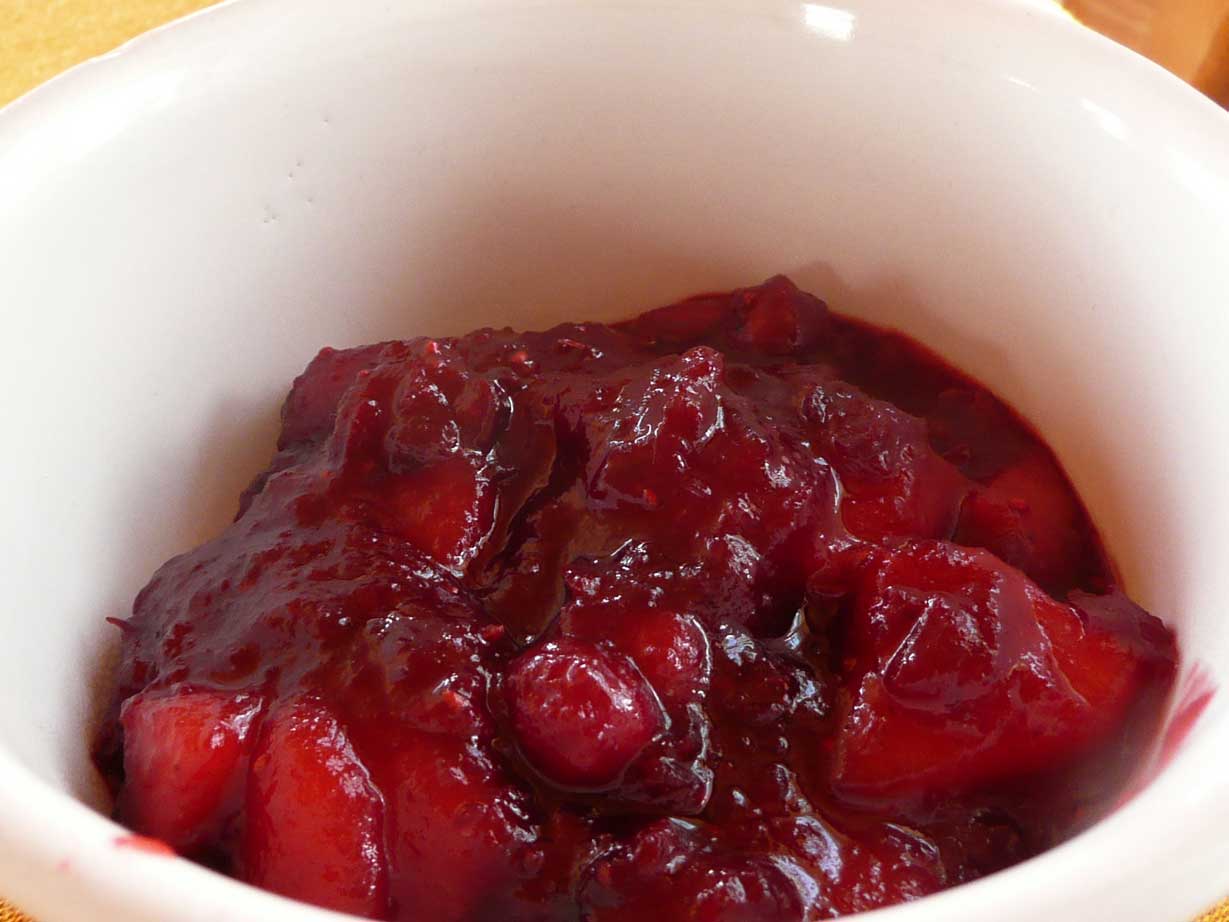
Cranberry Pear compote

Mexican Chicken (or Turkey) Soup

Tortilla Soup

Happy Thanksgiving to everyone!  I hope that this post finds you well, and FULL!  This Thursday’s Barefoot Bloggers recipe is pretty simple (more so if you have leftover chicken from this recipe) – a twist on a classic.  Start with your average, basic chicken soup with celery, carrots and onions, but add tomatoes and jalapenos for kick.  Those were nice additions, I thought, but the true revelation of the recipe was the tortillas.  Having never made a mexican soup before, I was skeptical about putting strips of corn tortillas into the pot.  Were they meant to act as thick Mexican-style noodles?  What would they taste like in my mouth?  I was imagining the texture of thick, soggy bread strips and I almost gagged.

To my surprise, the effect of adding the corn tortilla strips is to thicken the soup in a most delightful way.  The strips disolve into the broth, giving it a stew-like texture that was unexpected and quite pleasing.  When I brought this soup into the lunchroom the next afternoon, my colleagues ooh-ed and ahh-ed at the smell and the look of it.  And I didn’t even go all out with avocado garnish!  I imagine that if you are left with several pounds of cooked turkey after today, as I inevitably will be, you could easily use it to make this soup.  And while everyone else will be eating their third day of turkey with cranberry sauce, or their twelfth bowl of turkey noodle soup, you will be the envy of the Thanksgiving-leftover-lunchroom.  I would bet that some black beans in this soup would probably make you forget you were even eating leftovers.  Enjoy!

Mexican Chicken Soup, from Barefoot Contessa at Home

2 split (1 whole) chicken breasts, bone in, skin onchicken-shred
Good olive oil
Kosher salt and freshly ground black pepper
1 c. chopped onions (1 onions)
1/2 c. chopped celery (1 stalks)
1 c. chopped carrots (2 carrots)
2 large cloves garlic, chopped
1 1/4 quarts chicken stock, preferably homemade
1/2 of a 28-ounce can whole tomatoes in puree, crushed*
1 jalapeno pepper, seeded and minced
1/2 tsp. ground cumin
1/2 tsp. ground coriander seed
2-3 Tbs.chopped fresh cilantro leaves, optional
3 (6-inch) fresh white corn tortillas

For serving: sliced avocado, sour cream, grated Cheddar cheese, and tortilla chipstortillas

Preheat the oven to 350 degrees F. Place the chicken breasts skin side up on a sheet pan. Rub with olive oil, sprinkle with salt and pepper, and roast for 35 to 40 minutes, until done. When the chicken is cool enough to handle, discard the skin and bones, and shred the meat. Cover and set aside.

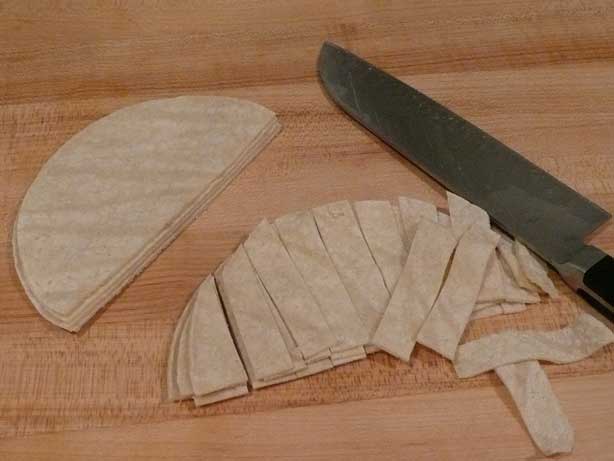
Meanwhile, heat 1 1/2 Tbs. of olive oil in a large pot or Dutch oven. Add the onions, celery, and carrots and cook over medium-low heat for 10 minutes, or until the onions start to brown. Add the garlic and cook for 30 seconds. Add the chicken stock, tomatoes with their puree, jalapenos, cumin, coriander, 1 1/2 tsp. salt (depending on the saltiness of the chicken stock), 1/2 tsp. pepper, and the cilantro, if using. Cut the tortillas in 1/2, then cut them crosswise into 1/2-inch strips and add to the soup. Bring the soup to a boil, then lower the heat and simmer for 25 minutes. Add the shredded chicken and season to taste. Serve the soup hot topped with sliced avocado, a dollop of sour cream, grated Cheddar cheese, and broken tortilla chips.Chicken soup tortillas

* I halved this recipe, so I only used 1/2 a can of whole tomatoes.  The other half I used for a quick pasta sauce the next night – very easy.  Just make sure you don’t store the unused tomatoes in the can.  I think that it gives them a weird flavor.

Magazine Review: “Food & Wine” and Sweet Potato Gratin

Sweet Potato Gratin

This is the fifth (and final) installment of my series of Thanksgiving magazine reviews.  You can see my evaluative criteria here.  When I first decided what publications I wanted to review, I was going to keep FOOD & WINE off the list.  My reasoning was that half of Food & Wine is, well, wine and I didn’t think it would be fair to pit it against the other magazines, which were all food-centric.  However, I think it stacks up quite nicely, in fact.

  • 214 pages total : 95 pages of ads (44%)
  • 76 Recipes
  • News-stand price: $4.50
  • Price per recipe: $0.06
  • # of ads pretending to be articles: 5.
  • Recipe Index? Right after the table of contents, at the front of the magazine, Food & Wine offers two indexes – one listing the recipes in the issue, and another listing the wines.  The first groups recipes by category (Soups & Starters, Fish & Shellfish, Pasta & Rice, etc.) and supplies a color coded system to let readers know which are Fast, Healthy, Make Ahead, Vegetarian, and “Staff Favorites”.  The wine index lists all the wines
Photos: Food porn is not the reason to buy this magazine.  The pictures provided are nice but are often quite small (usually about a quarter of a page) as compared to those seen in the other magazines I’ve reviewed.  F&W also displays far fewer images than the others.

Best Sections:
• Equipment – This month the “Equipment” section tested skillets, comparing the pros and cons of cast iron, stainless steel, and nonstick versions.  I found this to be very helpful and interesting, including the brand recommendations.
• Master Cook – A great monthly column highlighting one master technique and how to use it in the home kitchen.  This month it is making your own ricotta cheese – brilliant!
• Wine-Tasting Room – A true advantage of this food magazine is the great wine advice.  This section highlights yummy wines with a focus on affordable and everyday ones.

Best Features:
• Each recipe clearly displays the active cooking time and the total cooking time.  Very helpful for those of us (ahem! me! ahem!) who tend to find themselves in the middle of preparation at 7:00 only to realize that the recipe requires 2 1/2 hours of braising time.
• Excellent layout and design.  I find this magazine to be one of the easiest to read and work with.
• Wine suggestions with many of the recipes, shedding light on the esoteric and impenetrable art of food and wine pairing.

Thanksgiving at the Food & Wine house:
The F&W “Thanksgiving Planner” is wonderfully organized and clear and the theme is “delicious and stress-free”.  Each recipe is marked with a symbol, letting the reader know if the dish can be made ahead, made way ahead, cooked on the grill or stovetop rather than the oven, or if you can finish it in the oven after the turkey comes out.  The dishes are grouped into three suggested menus with a wine pairing, but swapping is encouraged!  The ‘out-there’ factor is at mid range: goat cheese-edamame dip with spiced pepitas; creamed spinach and parsnips; grilled butterflied turkey; fennel, red onion and focaccia stuffing.   Ruling?  Choose wisely, my friend.

Particularly Unappetizing:
• Caraway-Ancho Chile Gravy
• Cream and Lemon Braised Pork Shoulders
• Giant Lima Beans with Stewed Tomatoes (sounds like images from my fifth grade nightmares…)

I’m looking forward to cooking:
• Cassoulet with Duck Confit
• Butternut Squash Turnovers
• *Sweet Potato Gratin with Chile-Spiced Pecans
• Cranberry-Pomegranate Sauce
• Creamed Spinach and Parsnips

*Sweet Potato Gratin with Chile-Spiced Pecans, from F&W November 2008.

5 lbs. sweet potatoespecans-4-web
4 Tbs. unsalted butter
2 c. pecans
2 Tbs. sugar
1 tsp. chipotle chile powder
kosher salt
1/4 c. honey
1/2 tsp. cinnamon
1/4 tsp. ground allspice
1/8 tsp. ground cloves
1/2 c. heavy cream
freshly ground pepper
2 c. mini marshmallows

Preheat the oven to 375 degrees.  Roast the sweet potatoes on a large baking sheet for about 1 hour and 10 minutes, until tender.  Meanwhile, in a skillet, melt the butter.  Add the pecans, sugar, and chipotle powder and cook over moderate heat, stirring, until sugar starts to caramelize and the pecans are well coated, 8 minutes.  Spread the pecans on a parchment-lined baking sheet, sprinkle with salt and let cool.  Cut the potatoes in half lengthwise and scoop the flesh into the bowl of a food processor; discard the skins.  Add the honey, cinnamon, allspice and cloves to the processor and puree.  Season with salt and pepper.Sweet Potato Puree

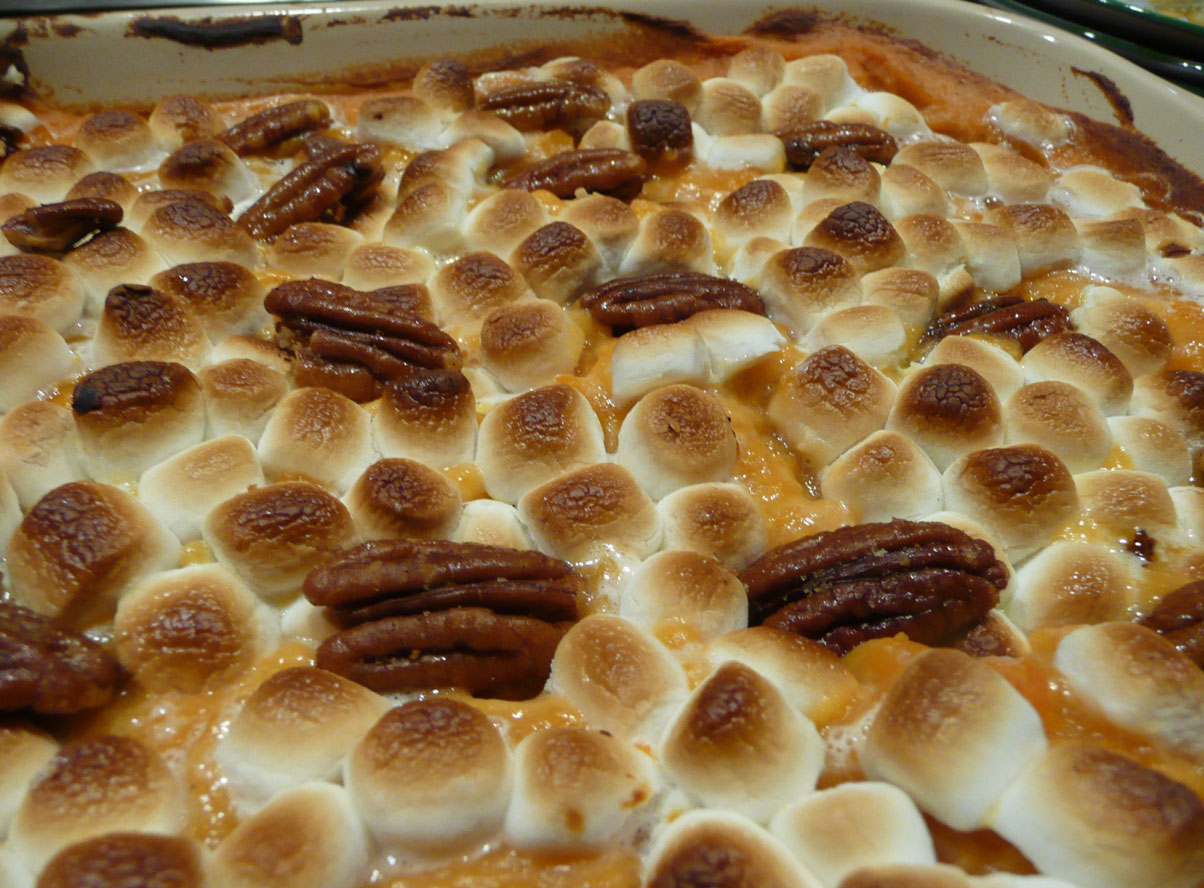
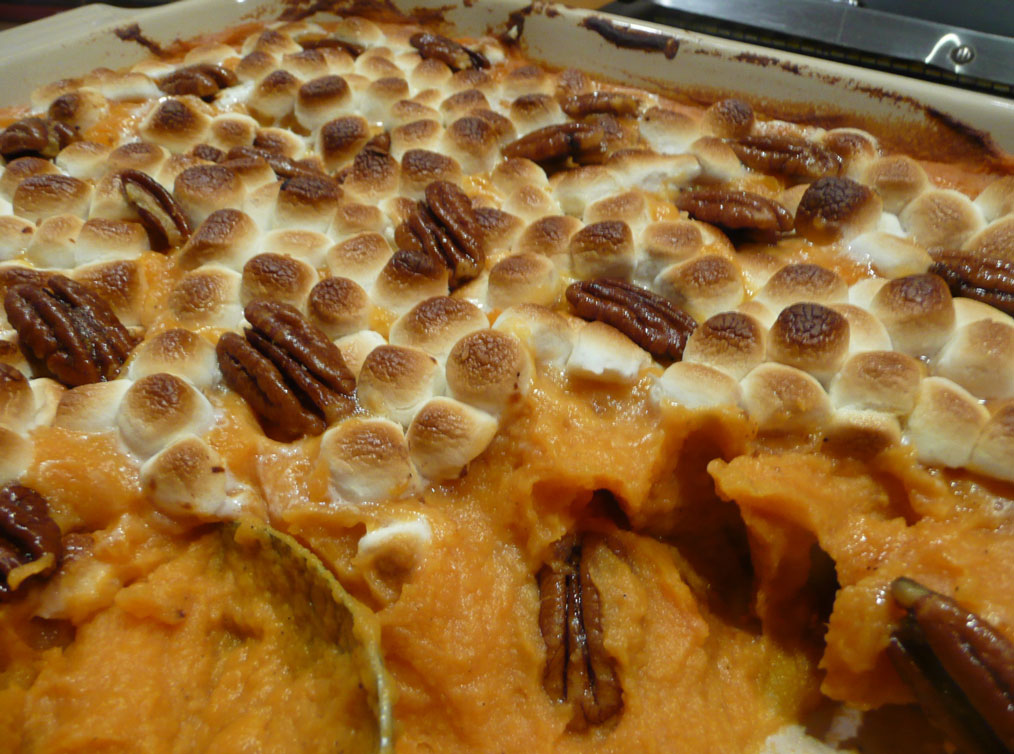
Scrape the potatoes into a 9×13 inch baking dish; scatter the marshmallows are golden.  Sprinkle with the pecans and serve.  MAKE AHEAD: The sweet potato puree can be refrigerated overnight.  Bring to room temperature and top with the marshmallows bfore baking.  The spiced nuts can be stored in an airtight container for up to 3 days. Makes 12 servings.

Results: So delicious!  We could really taste the warm spices in the puree, and the crunch of the pecans was a welcome addition to this traditional dish.  I would absolutely cook this for Thanksgiving or any fall meal.  The leftover pecans (of which there were many!) went into my spinach, pecorino, and prosciutto salad for lunch, and they were perfect!  Sweet Potatoes and MarshmallowsThey could also be a good accompaniment to a Thanksgiving cheese plate. I think that F&W does a wonderful job blending traditional recipes (cassoulet) and innovative techniques (homemade ricotta), not to mention providing great wine recommendations and pairing advice.  If I could spare the shelf space, I would certainly add this publication to my subscriptions!  I can’t end this post without pointing out that the recipe I tested is clearly NOT a gratin as I understand it – gratins have melted cheese or buttered and browned breadcrumbs on top, not kraft mini marshmallows.

The Mother of all Sauces

hollandaise sauce for broccoli

This post will be a quickie, but if you know what is good for you, you’ll bookmark it or print it or just emblazon the recipe in your memory.  Today I am imparting to you a sauce that has been handed down to me from my father.  My dad was never the cook of the family, though he was, and is, the unchallenged executive chef in charge of the grill, the pancakes and the hollandaise sauce.

Hollandaise is part of a group of 5 recipes called the Mother Sauces, including Veloute, Bechamel, Espagnole (or Brown Sauce), and Tomato.  From these basic recipes, you can modify and tweak your sauces to your own taste preference and delightful concord with your main dish.

Now, Antonin Careme and Escoffier may differ slightly with my dad about how to proceed with this dish, but I can tell you that my ratios are easy to remember, there’s no clarifying of butter required, and the end results are sublime.  Lemony hollandaise draped over steamed asparagus, eggs benedict, or roasted salmon is a true treat on an Easter morning or for an elegant Sunday Brunch.  Modified slightly into bearnaise sauce, you have the perfect accompaniment to any type of dry-cooked beef – roasted, grilled, or pan seared – and an excellent dipping sauce for french fries.

Hollandaise SauceMaster Sauce – Hollandaise

1 stick of butter
2 egg yolks
juice of 1 lemon

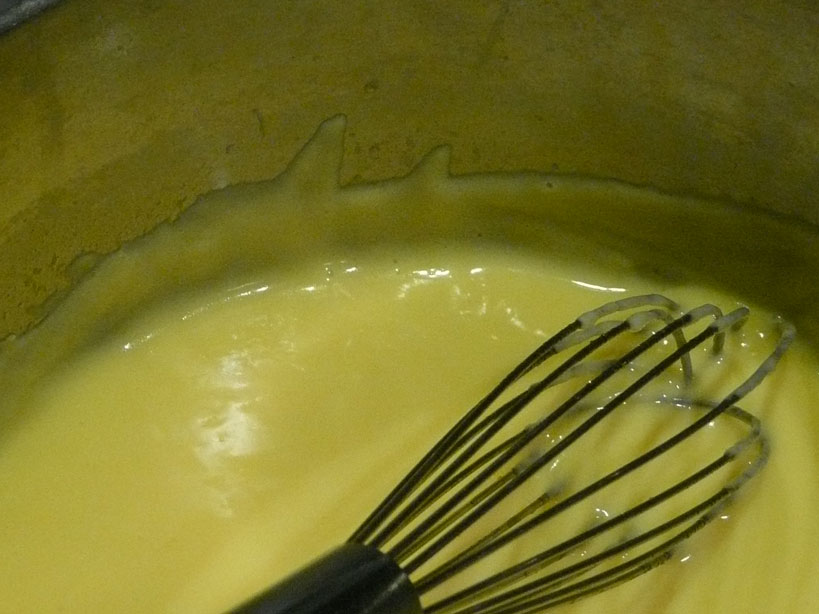
Melt the stick of butter in a small, heavy-bottomed sauce pan.  Set aside to cool slightly.  In a small bowl, whisk together the egg yolks and lemon juice until fully blended.  Set the butter over a medium-low burner and, while whisking the butter constantly, pour the egg yolk mixture into the pan slowly.  Your whisking should stay constant and should try to cover the whole bottom surface of the pan so that no part of the sauce cooks more quickly than any other.  Keep cooking and stirring until you begin to feel and see the sauce thickening up.  Remove the pan from the heat and continue to whisk for another minute or two.  Pour the sauce into a warmed gravy boat or creamer.  If at any point the sauce begins to separate, this means the sauce has gotten too hot.  Immediately remove it from the stove and whisk to see if you can bring it back together.  If it isn’t working within 30 seconds or so, put an icecube into the pan and whisk until the sauce cools and comes back together.  Then remove the ice cube.  Once the sauce has separated once, it is much more fragile than before and you should not attempt to thicken the sauce further.  Once you get the hang of the process, it is actually quite easy.  Some results will be thicker or thinner depending on how much liquid your lemon produces and the size of your yolks, but you will eventually develop an instinct for the correct proportions.

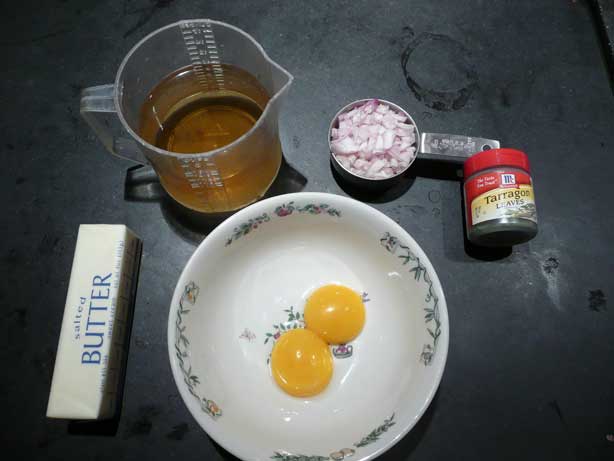
To make Bearnaise:bearnaise sauce ingredients

Bearnaise is very similar to hollandaise in method, but the flavor is very different.  Rather than using the juice of a lemon, you will make a flavorful reduction.

1/3 c. finely diced shallots
1/2 c. tarragon vinegar, champagne vinegar, or white wine vinegar
1/2 c. white wine
1-2 Tbs. chopped fresh tarragon or 1-2 tsp. dried tarragon, plus more for finishing.

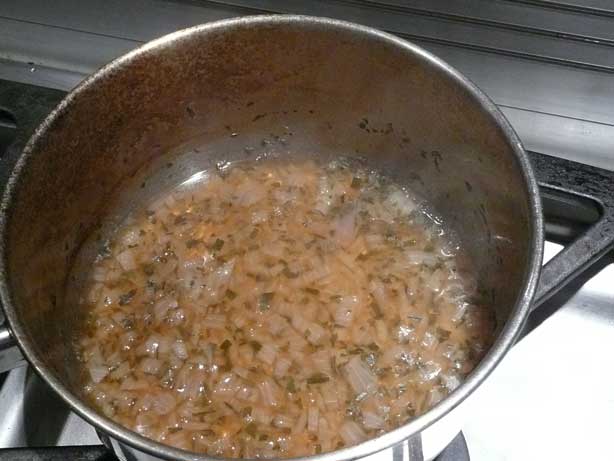
Pour the above ingredients into a small sauce pan.  Bring to boil, then simmer over low heat to reduce the liquids to a scant 2 Tablespoons, approximately 5 minutes.  bearnaise sauce reductionRemember that the solids take up a lot of room in the pan, so eye-ball accordingly – you want the liquid, strained of all solids, to equal just less than 2 Tablespoons.  Proceed with the Hollandaise recipe above, replacing your reduction liquid for the lemon juice.  When the sauce is finished, stir in a couple of teaspoons of fresh tarragon (or a 1/2 tsp. of dried) for color.

With bearnaise, you want to make sure you get the tarragon flavor correct.  If you use tarragon vinegar, use the low-end amount of fresh or dried tarragon.  Taste the sauce before you stir in the tarragon garnish, and adjust your amount accordingly.