Weeknight Enchiladas

enchilada-sunny-finalAs promised, below is my favorite recipe for leftover chicken.  Truth be told, however, RJ and I often go to the grocery store and buy a rotisserie chicken for the sole purpose of making these enchiladas.  They are fast to come together, delicious, and they work well for lunch the next day too.  Making your own enchilada sauce is optional, but the El Paso stuff in the can is nowhere near as flavorful or satisfying as the homemade.  It doesn’t add too much time to your prep either.  I, too, will be brief today, and just let the recipe speak for itself.

Quick Enchiladas, copied from The Best 30-Minute Recipe
quick enchiladas

2 c. finely shredded chicken, beef or pork
3/4 c. refried beans
1 1/2 c. enchilada sauce (either from the can or see the recipe below)
2 oz. canned chopped green chiles (optional)
1/2 c. chopped cilantro
3 c. shredded cheddar cheese
pack of 8 inch corn or flour tortillas

Preheat oven to 450 degrees.  Lightly spray 13×9 in baking dish with vegetable oil spray and set aside.

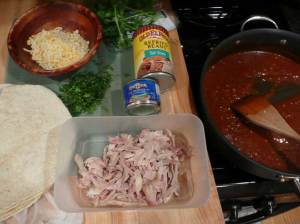
Combine the meat, refried beans, 1/2 cup of the enchilada sauce, and – if using – 2 oz. chopped green chiles in a microwave-safe bowl and cover with plastic wrap.  Microwave on high until hot, 1-3 minutes.  Stir cilantro and 1 1/2 cups of the cheddar cheese into chicken mixture and set aside.enchilada-mix

Microwave your tortillas until warm and pliable, about 40-60 seconds.  Arrange warm tortillas on clean work surface.  Divide meat mixture evenly among tortillas, about 1/4 cup filling per enchilada, and spread evenly down center of each.  Tightly roll tortilla around filling.  Place seam-side down in baking dish.

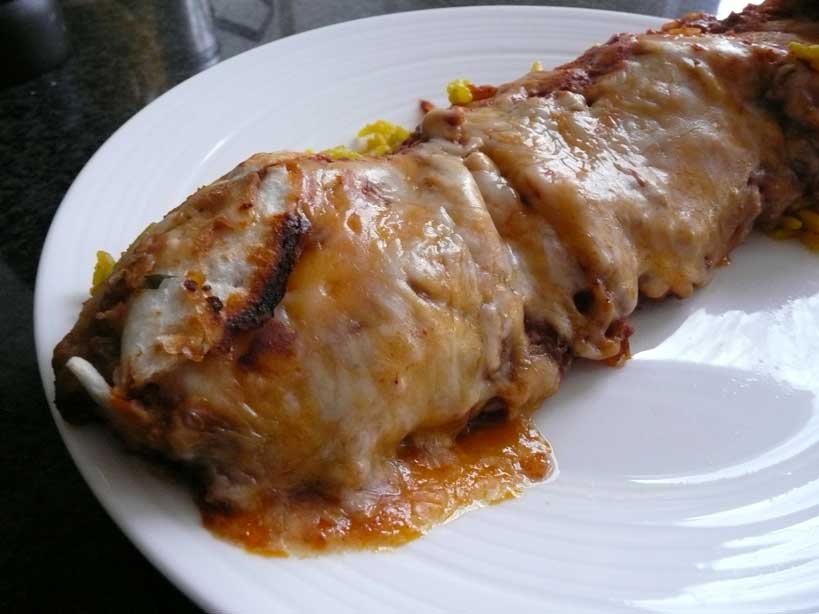
Lightly spray enchiladas with vegetable oil spray. Pour 1 c. enchilada sauce over enchiladas to coat.  Sprinkle 1 1/2 shredded cheese over enchiladas.  Cover baking dish with foil and bake until enchiladas are heated through, 10 minutes.  Remove foil and continue to bake until cheese is completely melted, about 5 minutes longer.  Serve with sour cream and (optional) warmed enchilada sauce.

Fast Enchilada Sauce

enchilada-sauce
1 Tbs. vegetable oil
1 onion, minced
Salt and pepper
3 garlic cloves, minced
3 Tbs. chili powder
2 tsp. ground cumin
2 tsp. sugar
2 (8 oz.) cans tomato sauce
1/2 c. water

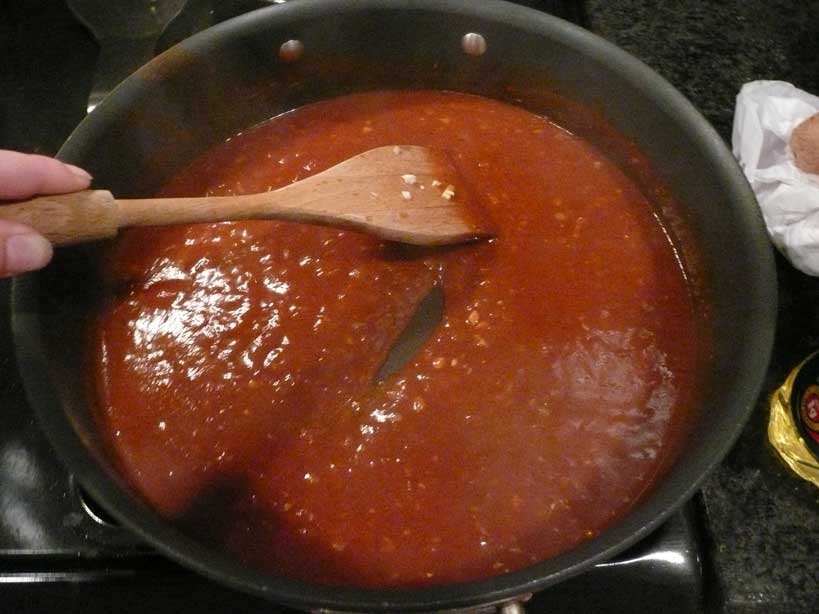
Heat oil in a 12-inch skillet over medium heat until very hot.  Add minced onion and 1/2 tsp. salt and cook until onions soften, about 5 min.  Stir in garlic, chili powder, cumin and sugar.  Cook until fragrant, about 30 seconds.  Stir in tomato sauce and water.  Bring to simmer and cook until slightly thickened (see picture) about 5 minutes.  Season with salt and pepper to taste.  If you like a smoother sauce, strain through a fine-mesh strainer.

Roast Chicken

chickenForgive me yet another roasting post.  I henceforth declare (retroactively) this past week Roasting Week, in homage to all the crispy, browned, concentrated flavors that dry oven heat bestows upon us.  This does not count as a real post, I know.  I don’t have any teaser images or elaborate descriptions.  I just have something so delicious and essential that it must be added to the blog.  This ‘recipe’, if you can even call it that, serves so many purposes I simply have to share it.  For one, it looks great and is perfect for entertaining.  Second, it is quite adaptable to all manner of taste and preference.  Third, it leaves you with some great leftovers (which I will be dealing with in a future post).  In any case, read the post through before you start cooking so you can understand the whole concept…

The method is as follows: buy yourself a whole roasting chicken and get a good one (read: free range preferable, super-market bird less than acceptable).  I describe my bad experience with a not-so-special bird here, so try not to make the same mistake I did – I promise it makes a difference!  Rinse the bird with cold water inside and out, then pat dry.  Remove excess fat from the outside and inside of the bird.  Personally, I keep the “pope’s nose” (the fatty flap at the opening of the bird’s cavity) intact ‘cuz my Gammy likes it, but if your grandmother isn’t around, ditch it with the rest.  Salt and pepper the inside and outside of the bird to your own taste.

Now is your chance to improvise.  You want to stuff the bird with some aromatics, which can include any combination of the following: a halved onion; a halved head of garlic; a halved lemon; sprigs of thyme, rosemary and/or sage.  You want to fill the cavity without ramming junk in there to the breaking point.  

Depending on what you put inside the bird, you want to mix your basting butter accordingly.  If my bird is stuffed with herbs, I might make a minced shallot butter.  If I stuff with lemon, then parsley and tarragon butter tastes delicious.  Mix and match to your delight!  You will want your basting butter to be a mixture of 1 tablespoon of butter per pound of chicken plus some combination of chopped herbs, lemon juice, minced shallots or garlic.

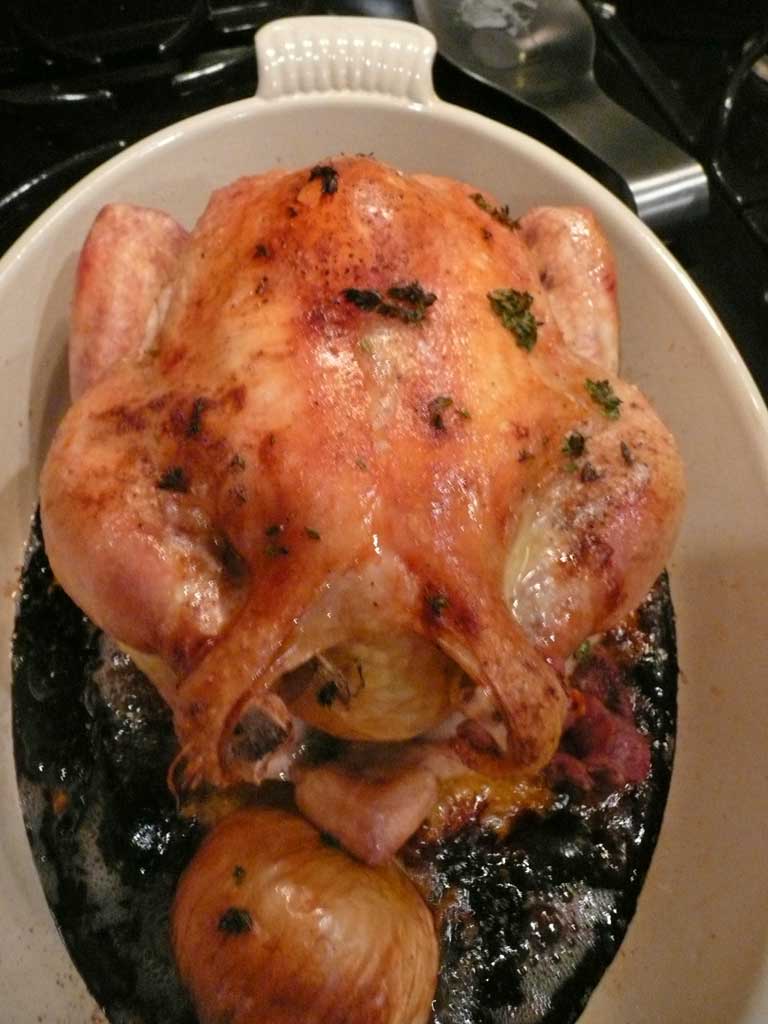
Once the chicken is stuffed, tie the legs together with twine, or, as in the picture above, cut small holes in the skin of the bird below the leg and near to the cavity, then shove the ends of the legs into them.  This will ensure that the legs of the bird stay close to the breast.  Put the bird in a 425 degree oven for 20 minutes.  At the end of the 20 minutes, baste the bird with your melted butter mixture.  Turn the oven heat down to 375.  Cook for a total time (including the first 20 minutes) of 15-20 minutes per pound.  Every 15 minutes or so, baste with the flavored butter mixture.

When the time’s up, remove the chicken from the oven.  If you’re worried about done-ness, prick the thigh of the chicken (below the leg) with the tip of a knife and take a peek at the juices that come out.  If they’re red or pink, you want to put it back in the oven for a bit.  If they’re clear, let the chicken rest on a cutting board for 10 minutes to let the juices redistribute.  Carve and serve!

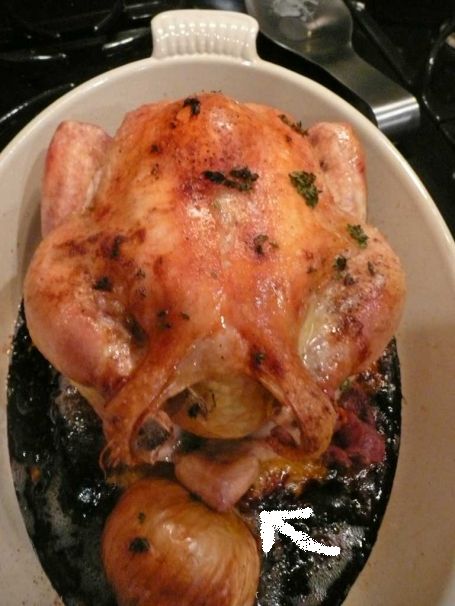
Now – you may be asking yourselves why it looks like the juices around my chicken are black in the pan.  For one thing, they were not actually black.  They were very dark brown.  And they looked that way because I modified my traditional prep (above) to add in tips from Anthony Bourdain‘s Les Halles Cookbook.  I put the giblets and half an onion on a pan and rested the raw chicken body on top of all of them.  Then I poured about a cup of white wine around the bottom of the pan and followed my own directions, above, for roasting the chicken.  This allowed me a great base for a pan sauce – I just had to put the chicken and other solids on a cutting board then mix some beurre manie and chicken stock into the pan to scrape up the fond (leftover roasted chicken bits) from the bottom of the pan.  This will result in a yummy chicken-y sauce which you can use just as is, or you can add a couple teaspoons of balsamic vinegar and cook a few minutes before pouring into a gravy dish.

Enjoy my mom’s chicken recipe – it’s no family secret or anything, but it’s a family classic.

Update: Since there seems to be some confusion about the issue, please see below picture of “The Pope’s Nose”pope2

Another Braise…Italian Style

final-buco

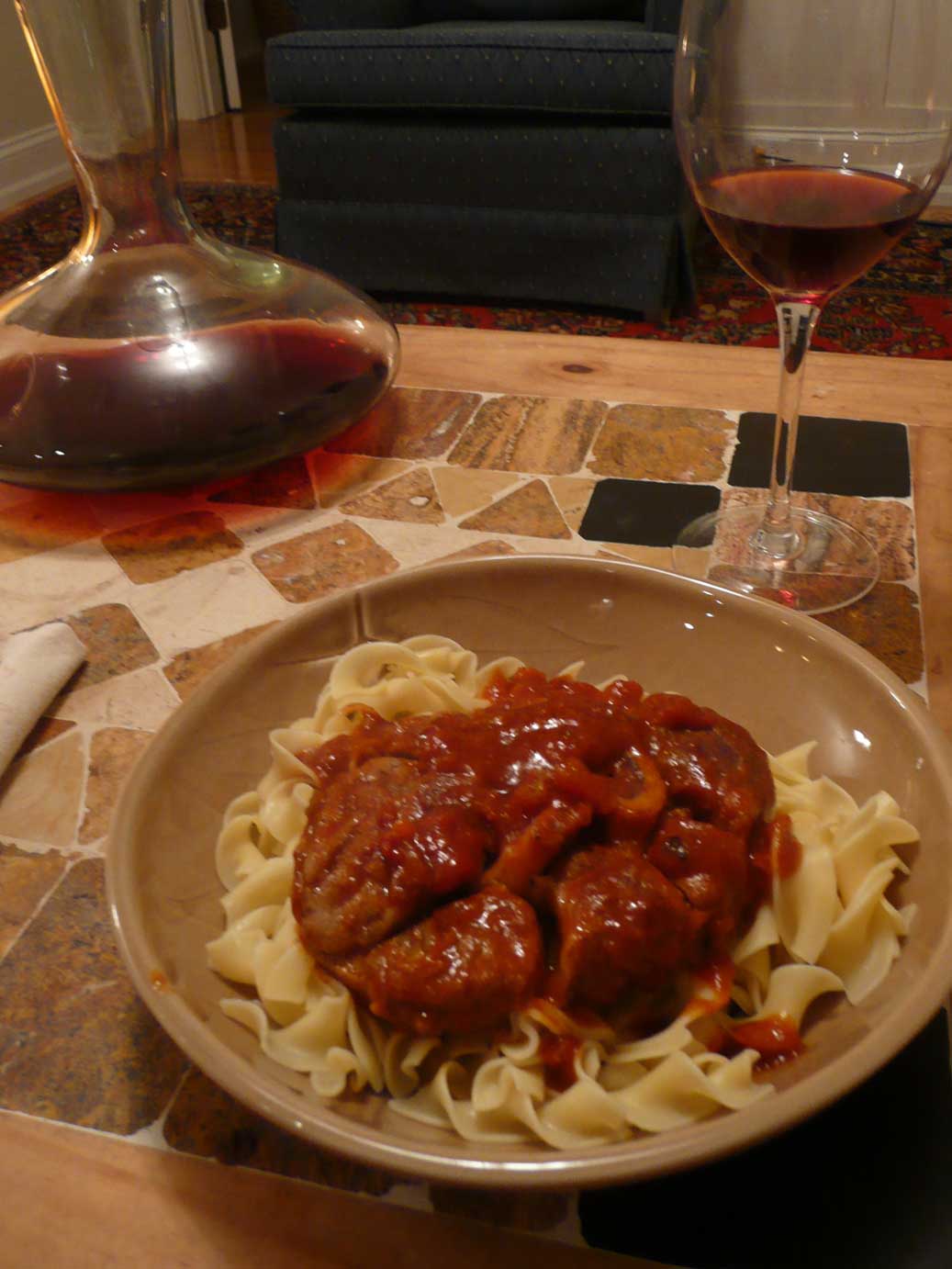
I would normally apologize for giving you yet another slow braise, right on the heels of my pork stew, but this Osso Buco really couldn’t wait.  Though I didn’t use a slow cooker, this could be easily modified to work in one.  Myself, I just received a super-cool Le Creuset braiser, which I am ecstatic about, and couldn’t wait to give it a proper baptism in oil.  I actually first saw this type of pan on Giada DeLaurentiis’ show when she was making Osso Buco, but it will be excellent for paella, chicken braises, large amounts of risotto and more.  Eeeeeeeeee – Le Creuset makes me a bit giddy, I can’t help it.

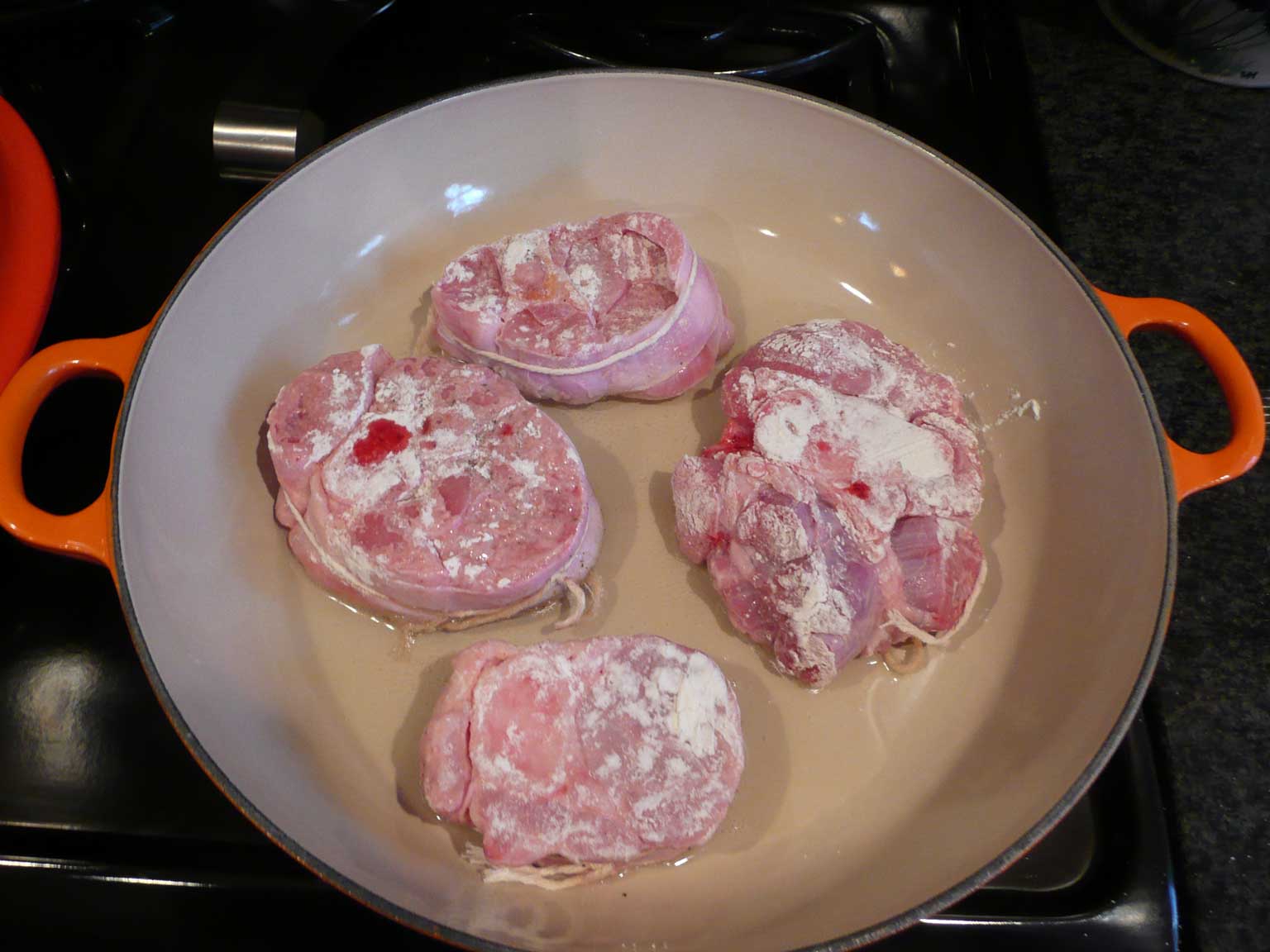
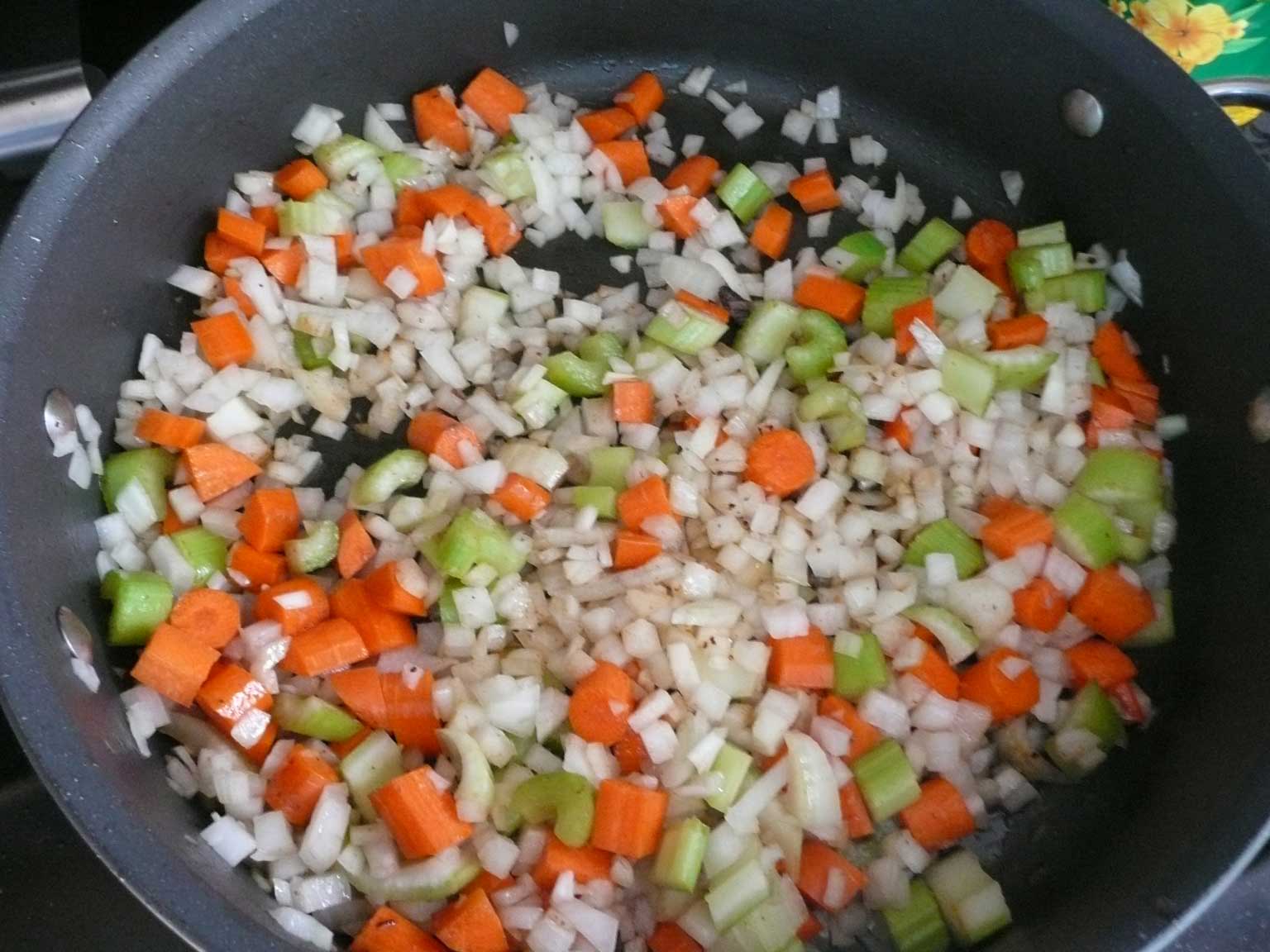
raw-vealOsso buco, or ‘bone with a hole’, is named for the central ingredient: veal shanks with marrow bone.  Traditionally, osso buco is made by braising the shanks in a mixture of white wine and warm spices like cinnamon and allspice then topping it all with a lemon, parsley and garlic “gremolata”.  More modern preparations involve tomatoes and mirepoix (a small dice of onion, carrot, and celery), as well as a creamy Risotto Milanese accompaniment.

I wanted to go with Giada’s version, since I associate her with both the dish and the braiser pan, but hers was bianco with only a small amount of tomato paste and no real tomatoes.  It is definitely a recipe worth trying, but I was in the mood for a rich red sauce.  I perused a couple of other clippings I had on hand, and settled on the below as my final composition.  RJ and I were both extremely happy with the way this turned out, though the egg noodles were nowhere near as yummy as the risotto would have been.  Well, there’s always next time!

Osso Buco

2 Tbs. vegetable or olive oilvegetables

4 veal shanks, at least 1 1/2 in. thick
All-purpose flour
1 small onion, in small dice
2 carrots, 1/2 inch dice
2 celery stalks, 1/2 inch dice
1 Tbs. tomato paste
1 c. dry white wine
24 oz. can of whole plum tomatoes, chopped with juices reserved
2 c. chicken stock
1 sprig thyme
1 sprig rosemary

Preheat oven to 350 degrees.  Heat oil over medium-high heat in a large oven-proof saute pan or dutch oven.  Tie veal shanks around the circumference with kitchen twine.  Salt and pepper, then dredge in light coating of flour on both sides.  Brown veal shanks on all sides, approximately 4 minutes per side.   finished-veal-in-potRemove shanks to separate plate.  Use same pan as the veal to cook the vegetables (season with salt and pepper to taste) over medium heat until softened, about 8 minutes.

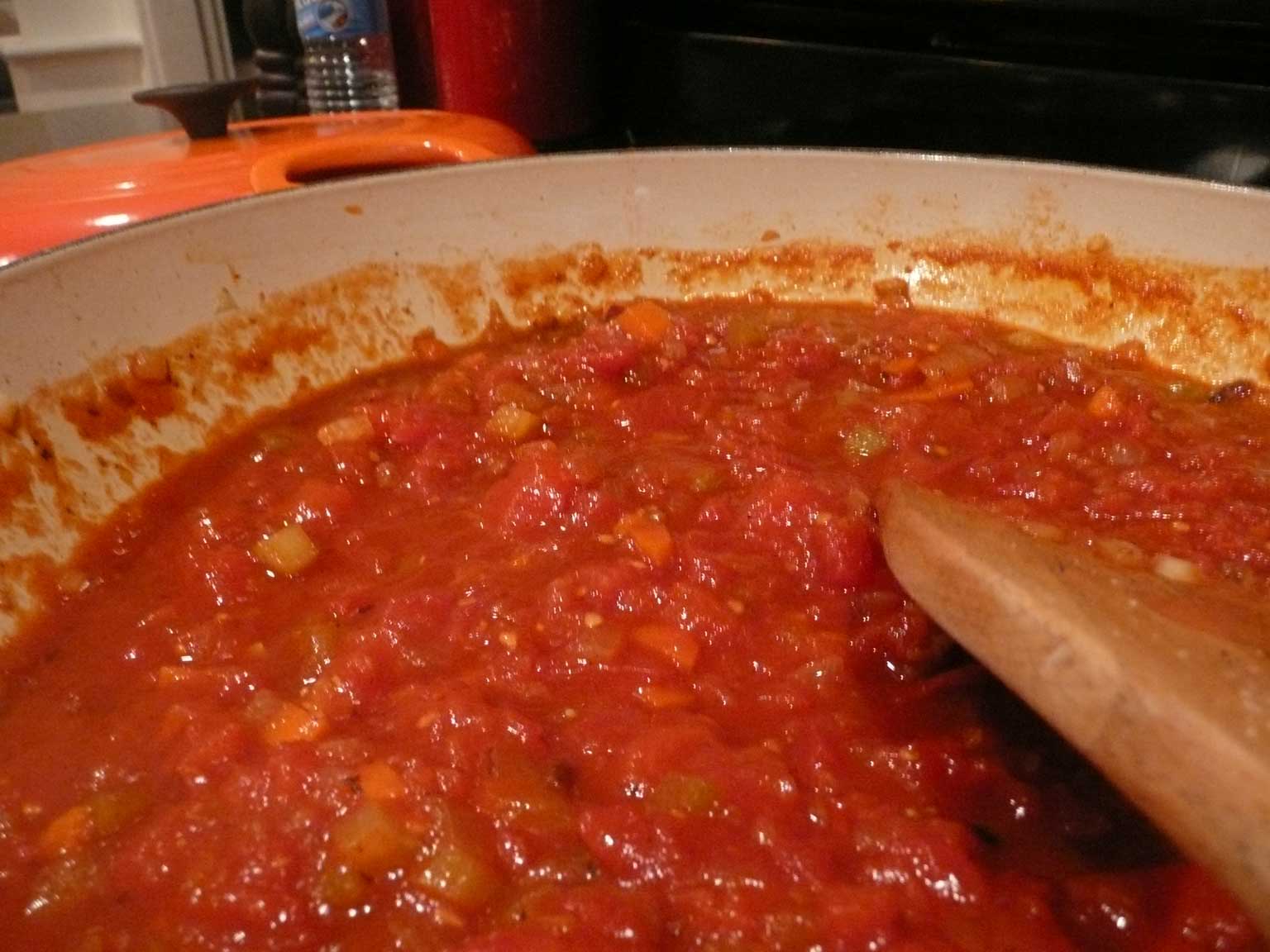
Add the tomato paste and stir to coat the vegetables.  Cook 1 minute.  Add white wine and cook, stirring, until reduced by half.  Stir in tomatoes, chicken stock and reserved juices and bring to a boil.  Add veal shanks and settle the meat and herb sprigs within the liquids.

Put the covered pan or dutch oven into the heated oven and set the timer for 1 1/2 hours.  Flip the shanks every 30 minutes.

When the shanks are easily falling off the bone, remove the shanks from the liquid to a plate and cut off the kitchen twine.  Strain the liquid through a seive, pressing on the solids to extract the flavorful liquid, and put the strained liquid back into the cooking pan.  Bring to a simmer and put the shanks back in the liquid to reheat.  Serve over risotto or egg noodles.osso buco and noodles

A New Stew for the Repertoire

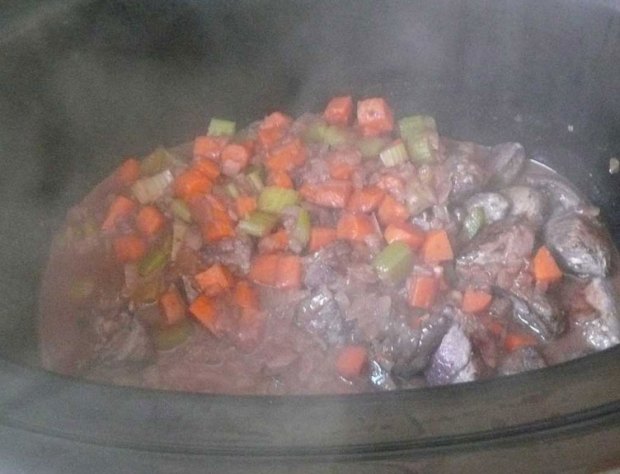
steamy-pot1

I’m really not sure how I feel about the final picture I took to illustrate the delicious stew I made this weekend. The one above comes from about halfway through the process.  In general, it is hard to photograph an enticing picture of stew, since it is typically so brown and lumpy. Besides, what really makes stew wonderful is not the look of it but the rich and hearty aromas as they fill your house, the feel of the steam rising up from the bowl, and the warmth it generates as you swallow. So…I am saving the “results” picture for the end of the post, when you’ll (hopefully) be sufficiently hooked and convinced into making this stew yourself.

Though not my first stew of the fall, this is my first stew ever made with pork. I was a bit skeptical at first, but all of my willing guinea pigs agreed that this stew tasted like beef but without being as heavy and overly filling. The dumplings were another welcome addition, replacing large chunks of potatoes with a light and fluffy topping. I whole-heartedly recommend this to you for a Sunday dinner or even a weeknight meal, though the marinating step does require a bit more prep time than the usual slow cooker recipe.

This is not my first post extolling the virtues of the slow cooker, either. To recap: slow cookers are excellent because you can do the prep work ahead of time and all of the cooking takes place when you are busy doing other things (like working, running errands, or watching an entire James Bond marathon on the USA Network). The quality of the slow cooker’s results are directly related to the caliber of ingredients you use (i.e. no Campbell’s soup allowed), but a little fresh vegetable chopping or meat browning in the morning can make your evening homecoming heavenly. They are also very forgiving machines – if you have a good one, and fill the stoneware to the recommended capacity, you can really leave them on quite a bit longer than the recipe requires without much negative impact on the dish.

For this specific recipe, here is the schedule I recommend, based on whether you’re cooking for a busy weekday or a leisurely Sunday:

Weekday: The night before you want to serve the stew, prepare the marinade and put in the pork. Chop the onions, carrots and celery and store them together in a plastic bag or a container in your fridge. Refrigerate all overnight. The next morning, brown the meat and cook the veggies (approx. 20-25 minutes overall), put everything in the slow cooker and set it on low for the rest of the day. You could also blend the wet ingredients for the dumplings and store it in a jar in your fridge.

Weekend: Wake up late on Sunday. Eat a danish. Marinate the pork for an hour at room temperature while you chop all the vegetables. When you get around to it, brown the pork and veggies as directed and start the slow cooker on High for 4-5 hours.

mise1

Pork Stew with Sage and Onion Dumplings, adapted from The 150 Best Slow Cooker Recipes by Judith Finlayson

1 1/2 c. dry red wine
4 cloves garlic, minced
1 tsp. dried thyme leaves
1/2 tsp. cracked black peppercorns
2 lbs. boneless pork shoulder cut into 2 inch cubes
(whoops – mine were 1 inch cubes…If I had done 2 inch cubes I might have been out of the kitchen faster…)
1 Tbs. vegetable oil
2 onions, finely chopped
3 carrots, peeled and cut into 1/2 inch cubes
3 stalks celery, peeled and cut into 1/2 inch cubes
2 Tbs. all purpose flour
1 Tbs. tomato paste
1 cup chicken broth
1 tsp. salt
1 bay leaf
2 cups of thawed frozen peas (I omitted the peas due to my husband’s allergy to all things green, but I think it would have brought a bit of brightness to the finished stew)

Raw Dumplings

Dumplings:
1 1/2 c. all purpose flour
1 Tbs. baking powder
1 tsp. salt
1/2 c. milk
1 egg
6 green onions, white part only, roughly chopped
6 fresh sage leaves or 1/2 tsp. dried sage

Mix the red wine, thyme, garlic and cracked black pepper in a large mixing bowl. Add the cubed pork shoulder. Pork shoulder, if you haven’t seen it before, is usually packaged in stretchy netting before being shrink-wrapped. It is easy to work with but is quite fatty. I recommend trimming the excess fat off the meat before adding the pork cubes to the marinade. Let pork marinate for at least 1 hour at room temperature or up to 12 hours in the fridge.

Browned meat for pork stew

Remove the pork from the marinade and pat the meat dry with paper towels, reserving the wine mixture. Heat the oil in a large skillet over medium-high heat, then brown the pork cubes on all sides, working in batches to ensure the meat is not crowded in the pan. Once browned, move the cubes to the slow cooker insert.
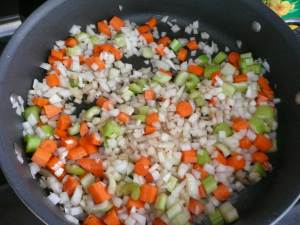
mirepoix1

In the same pan you used to brown the pork, place the onion, carrots and

celery. Stir to release some of the brown bits of pork on the surface of the pan, then cover and cook over medium-low heat for 8 minutes or until vegetables have begun to soften. Add the flour and stir to coat. Cook 1 minute, then stir in the tomato paste. Pour in the chicken broth, reserved wine marinade and salt – cook, stirring occasionally until the mixture thickens slightly, about 2-3 minutes. Pour the liquid and veggies over the meat in the slow cooker insert; tuck the bay leaf into the liquid.

Cook stew for 8-10 hours on low or 4-5 hours on high. Just before your time is up, start to make the dumplings. In a large bowl, mix the flour, baking powder and salt. In a blender or food processor, blend the milk, egg, green onions, and sage until very smooth.

When the slow cooker time is up, stir in the green peas if using. Turn the dial to High. Mix the wet ingredients for the dumplings into the bowl with the dry ingredients. Stir to blend. The batter will be very light and airy. Drop it in large spoonfuls onto the surface of the stew, leaving over an inch between the dumplings so they don’t meld into one big dumpling like mine did (see above)… Cover the slow cooker and cook on high undisturbed (don’t lift the lid!) for another 30 to 40 minutes or until a toothpick inserted into the dumpling comes out clean. Serve with bread or rolls for dipping and a nice simple salad for a great fall meal.

Without further ado…here’s my final picture. Let me know what you think: does it look appetizing at all? Are you glad I left it to the end? Would you prefer it at the start of the post? Do you want it taken out immediately? Let me know!
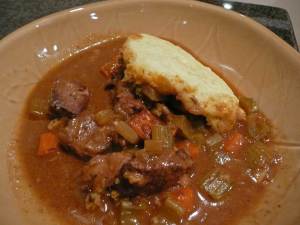
Pork stew with dumplings