Kung Pow! Chicken

Kung-Pao-FinalAs they say, “when the cat’s away, the mice will play.”  Though I’m not sure it’s the perfect analogy, I must say I did feel a rush of culinary freedom when I found out I was going to have a weekend in the kitchen without my husband around.  Of course, of course, I miss him terribly.  However, the thought of being able to cook any combination of fish, vegetables, or ethnic food I can dream up is nearly intoxicating.

I took RJ’s absence as an opportunity to tackle a second book in my cookbook challenge, and I picked one I knew he wouldn’t enjoy – Spices of Life: Simple and Delicious Recipes for Great Health by Nina Simonds.  While many of the books in my cookbook collection were gifts, and even more were bookstore (or Costco) purchases, this one has more of a story.  I currently work at an art museum and design programming to attract new members and donors.  Last spring, I invited Nina Simonds to speak at the museum for a lecture and luncheon event.  I used her appearance as an excuse to purchase her most recent cookbook, Spices of Life — for research of course!

She brought with her baskets and baskets of spices — assorted seed pods, gigantic rolled cinnamon sticks, peppercorns of all colors.  The guests at the museum loved being able to handle each of these, and breathe in the varied aromas, both familiar and exotic.  While some of us are more adventurous than others when it comes to spices and strange flavors, few of us can describe the plant that produces sesame seeds, or have handled all of the different components of a garam masala.  It was a true treat to have Nina, such a well-traveled food writer and cook, share these things with us.

Nina’s approach to cooking emphasizes the use of healthful ingredients and she describes throughout the book the restorative powers of specific herbs, vegetables and spices.  The concept is a great one — incorporate these health-giving (not to mention delicious!) ingredients into your cooking on a regular basis, and improve your body’s form and function.  Nina’s other website actually supplies a great list of spices and produce items along with their nutrients and perceived healthful properties, though the book is far more comprehensive.

I quickly realized that working with this book was going to take a bit of pantry makeover.  Ingredients such as rice wine vinegar, mirin, and oyster sauce are not part of my everyday mise en place, but I am always happy to expand!  The first recipe I tried was Kung Pao Chicken, served alongside her Asparagus with Cardamom Butter.  The prep work for the chicken was pretty intensive, but I attribute that primarily to my unfamiliarity with the ingredients.  When I get to the point of ‘a splash here’, ‘a handful of that’, ‘a dash of this’, I think that I can minimize my time spent and the amount of measuring cups and tablespoons I dirty up!  I also think there’s a more efficient method for making the marinade and sauce mixtures, since they are quite similar at the base.

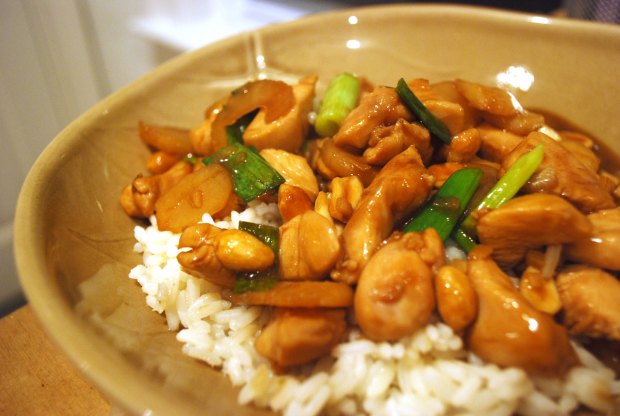
I really liked the comforting Asian flavors of the chicken dish – the salty soy sauce, spicy ginger, and nutty sesame oil mingled together nicely – but the texture was the most fun.  Between the tender bites of chicken, the light snap of the water chestnuts, and the firm crunch of the peanuts, this recipe provided really exciting variety and no two bites were the same.  I also thought it was great that the whole scallion was used (I hate ditching the green tops), especially since the onion provided a nice contrast, both visually and flavor-wise, to the rich brown sauce.  This recipe is definitely worth a try!

As for the asparagus…  I am glad to know that by including the cardamom my digestive system is better off and my ‘spasms’ may now be under control, but the flavor just wasn’t for me.  Give me lemon juice, parmesan cheese, or balsamic vinegar any day — the cardamom was just too out there.  I am sure I could get used to it, of course, but I think that unless I need to quell a bout of belching, I will stick to what I love.

Kung Pao Chicken, slightly adapted from Nina Simonds’ Spices of Life

(Serves 6)

12 ounces skinless chicken breast

Marinade:kung-pao-mise
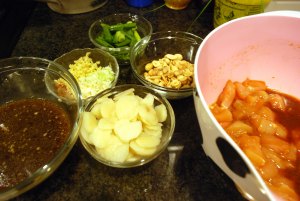
2 Tbs. light soy sauce
2 Tbs. Shaoxing rice wine
1 tsp. roasted sesame oil
2 tsp. cornstarch

3/4 cup peeled water chestnuts
2 Tbs. oil
2 garlic cloves, finely chopped
3/4 c. unsalted peanuts, dry roasted
1 spring onion (scallion), finely chopped white parts, green parts chopped into 1 inch pieces
1 tablespoon finely chopped ginger
1/4 to 1 teaspoon red chili flakes (to taste)

Sauce (mixed together):
1 Tbs. soy sauce
1 Tbs. rice wine
1 tsp. roasted sesame oil
1 tsp. cornstarch
1 tablespoon sugar
1 teaspoon Worcestershire sauce
1/4 cup chicken stock
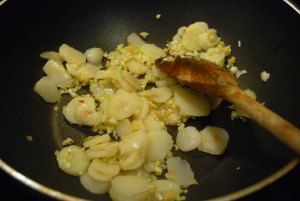
kung-pao-sauteDirections:

Cut the chicken into 1 inch cubes. Mix together the marinade ingredients, and place the cubes in a bowl; toss lightly. Marinate in the fridge for at least 20 minutes. Blanch the water chestnuts in a pan of boiling water, then refresh in cold water. Drain, pat dry, and cut into thick slices.

Heat a wok over high heat, add 1 tablespoon of the oil, and heat until very hot. Stir-fry half the chicken pieces, turning constantly, until the meat is cooked. Remove with a wire sieve or slotted spoon and drain in a colander. Repeat with 1 tablespoon of oil and the remaining chicken. Wipe out the pan.

Reheat the wok over high heat, add the remaining oil, and heat until very hot. Stir-fry the spring onion white parts, ginger, garlic, and the chili flakes for 10 seconds, or until fragrant. Add the sliced water chestnuts and stir-fry for 15 seconds, or until heated through. Pour in the mixed-together sauce ingredients and scallion greens and simmer until thickened. Add the cooked chicken and the peanuts. Toss lightly to coat with the sauce and serve over rice.
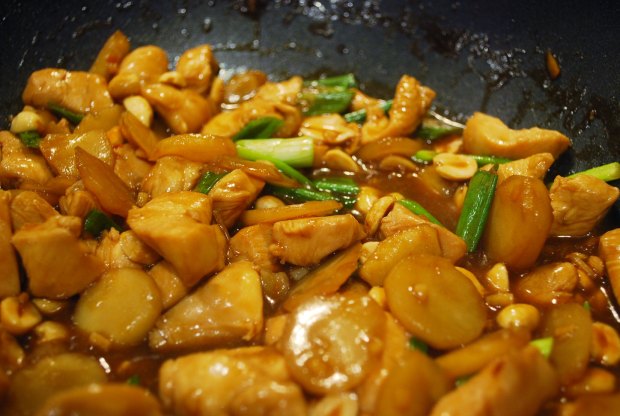
kung-pao-mixed-good

Evening with Le Cordon Bleu

Rabbit Stew

After my quasi-review of Kathleen Flinn’s The Sharper Your Knife, the Less You Cry, I thought that I would be remiss if I didn’t at least try one of the recipes included at the end of every chapter in the book.  What review could be complete without an attempt to walk in Kathleen’s footsteps and master a dish from her famed alma mater?

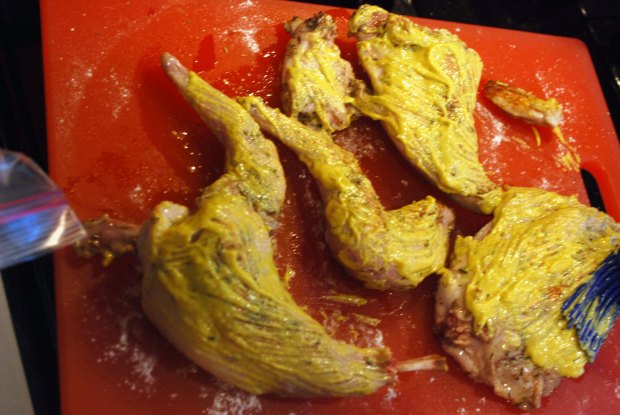
I decided to try the most Cordon Bleu-y dish in the book — Lapin a la Moutard, a.k.a. Rabbit in Mustard Sauce.  Not something found in the average home cook’s repertoire, rabbit is nevertheless quite easy to work with.  It has been compared in flavor to dark-meat chicken, but I find that it is far less greasy than a drumstick or thigh tends to be.  The rabbit I purchased at my local grocery store (I know – can you believe it?) was skinned, gutted and beheaded, but otherwise whole.

rabbit-carcass

I invited my two most adventurous fellow chefs/dining companions — my mother and grandmother — to help me prepare and eat the little beast.  We began with butchering, which wasn’t really so hard — again, much like chicken — except for the fact that I didn’t really know what to do after I had separated off the legs.  Was the breast/torso supposed to be left whole?  The meat there was pretty thin, so I didn’t want to take it off the bone…  I could have used one of my reference manuals — The Joy of Cooking, The Way to Cook, Jacques Pepin’s Techniques — which may or may not have given me a diagram to follow, but I ended up winging it.  The result looked a lot like what Elise came up with here, so I feel pretty good about it!

rabbit-butchered

After all was said and done, the rabbit was served and deemed…DELICIOUS.  The dominant flavor of the mustard was mellowed perfectly by the addition of a splash of cream.  I neglected to strain the solids out of the sauce, as directed, but the minced shallots and garlic added to the texture of the dish.  If you are going for a more refined-looking plate, though, just follow the recipe.  Though only a 1/4 cup of sauce was left over after we’d eaten our fill, the family matriarchs forced me to save it in a plastic container since it was so good and “could be used to enhance another sauce.”

After eating this dish, my estimation of Flinn’s book has certainly risen.  I’m glad to have a good go-to rabbit recipe for the evenings when my husband’s away and the girls are in town!

Lapin (ou Poulet – chicken may be substituted for the faint of heart) a la Moutarde, from The Sharper Your Knife, the Less You Cry
Serves 6

2 1/2 lbs. rabbit pieces or chicken thighs
Coarse salt and freshly ground pepper
1 Tbs. dried thyme
All-purpose flour
3 Tbs. olive oil
4 Tbs. + 2 Tbs. Dijon mustard, separated
1 Tbs. butter
3 shallots, finely chopped (about 1/4 cup)
1 large onion, finely chopped (about 1/4 cup)
2 cloves garlic, chopped
1/3 cup brandy (we substituted sherry)
2/3 cup chicken stock
Bouquet garni (parsley, bay leaf tied with twine)
4-5 sprigs fresh rosemary or 1 tsp. dried
2/3 cup heavy cream (optional – I used about 1/3 cup)

Preheat the oven to 350 degrees F. Sprinkle the meat with salt, pepper, and dried thyme. Dredge lightly in flour, shaking off excess. In a Dutch oven large enough to hold all the ingredients comfortably, heat the oil over medium-high heat. Brown pieces on all sides, in batches if necessary. Remove meat from the pan and drain the oil. Using a pastry brush or the back of a spoon, apply a generous coat of mustard to each piece; set aside.

rabbit-mustard

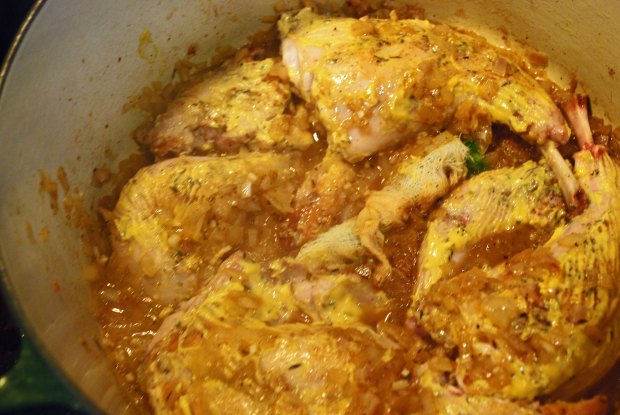
Over medium heat in the same pan, melt the butter. Add the shallots and onions and cook until translucent. Stir in garlic. Add the brandy and chicken stock, and simmer until slightly reduced. Add the bouquet garni and rosemary. Return the chicken or rabbit pieces to the pan. Cover and cook in the oven for about forty-five minutes, or until an instant-read thermometer reads 160 degrees F. Remove the meat and cover loosely with foil to keep warm.

rabbit-stew

Put the pan on medium heat and bring the pan juices to a simmer for about five minutes, until slightly reduced, skimming off any fat from the surface. (Rabbit is oilier than chicken and will require significant skimming.) Add the remaining two tablespoons of mustard and the cream (if using) and let simmer for seven to ten minutes, until the sauce thickens enough to coat the back of a spoon.

Once it has thickened, pour sauce through a fine-meshed sieve, pressing it through with a spatula. Check seasonings and adjust, adding salt and pepper to taste. Spoon the sauce over the chicken or rabbit pieces.

rabbit-final

Ropa Vieja

I have some great news to share — my brother-in-law is engaged!!  RJ’s younger brother popped the question in the middle of the Brooklyn Bridge after a twilight helicopter ride over Manhattan.  A far cry from the low-key proposal I remember not so long ago, but equally momentous.

In general, it can be very hard to passively observe your siblings in their relationship cycles, watching good ones and not-so-good ones get away, knowing that you have no say whatsoever in the girl they pick as “the one” (a.k.a. “the one” you have to live with at every holiday and family vacation for the rest of your life!).  Yet both RJ and I squealed when we heard the news, as Erica is just who we would have picked for Brian if anyone cared about our opinion.  She is kind and sweet and beautiful and, as RJ says, she’s great for Brian.  More importantly, when she comes to visit she almost always brings cake with her from all the fabulous NYC bakeries I dream about…

Brian and Erica are Engaged!

So today I’m featuring a recipe for a dish that I know Erica would love, since she introduced it to me (the first of many family recipe exchanges I’m sure!).  The last time she was at our house, she and I got into a big love-fest conversation about the slow cooker.  She and Brian live and work in the Big Bad City, and often don’t have time to cook a dinner when they get home (though their kitchen, I must say, is the biggest one I’ve ever seen in New York).  To avoid takeout all the time (this is what my brother does) she often does fun dinners in the slow cooker.  I have about 6 different slow cooker cookbooks in my house, but really only rotate through a couple recipes – pulled pork, beef stew, pork stew, and chili.  I know it is far more versatile, but the old standbys are really good!

Erica told me about one that she really likes, Ropa Vieja, and I was intrigued.  She said it was Cuban in origin and was a different flavor than the standard beef-and-wine stew.  It also had lots of peppers in it, since her husband-to-be loves them (let it not be said that RJ’s limited appetite is his the fault of his upbringing – his mom and brother both love vegetables!).  Literally two weeks later this recipe pops up in The Boston Globe Magazine.  I might have missed it if I had not been at my parents’ house, flipping through their Sunday paper.  I guess it was a sign that Erica – and this Ropa Vieja! – were destined to be in my life forever…

Ropa Vieja

Ropa Vieja, from The Boston Globe Magazine, Feb. 15, 2009
(Serves 6)

Traditionally, the beef is braised in a separate step, which I have eliminated. Flank steaks are rarely as large as 3 pounds; more likely you’ll find two 1½-pound steaks. Serve with yellow rice, lime wedges, and hot sauce.

Browned Round Steak2 tablespoons olive oil
3 pounds flank steak [I used round steak, which worked fine but wasn’t quite as stringy]
Salt and black pepper
2 large onions, thinly sliced (about 3 cups)
2 tablespoons flour
6 cloves garlic, minced
2 teaspoons ground cumin
1½ teaspoons ground cinnamon
1/8 teaspoon ground cloves
2/3 cup dry sherry
1 cup homemade or packaged low-sodium chicken broth
1 14½-ounce can diced tomatoes
4 bay leaves
2 medium red bell peppers, cored, seeded, and cut into ½-inch strips
1 cup green olives, pitted and sliced
1½ cups frozen peas, thawed
6 tablespoons chopped fresh parsley

Beef n' onionsHeat 1/2 tablespoon of oil in a large, heavy-bottomed Dutch oven over medium-high heat. Sprinkle meat with 2 teaspoons salt and 1 teaspoon black pepper, add 1 steak to pot, and cook without moving until deeply browned on bottom, about 4 1/2 minutes. Turn and cook without moving until second side is deeply browned, about 4 1/2 minutes. Transfer meat to a plate. Add 1/2 tablespoon of oil to the pot and repeat with remaining steak (reducing heat if drippings begin to burn); transfer to plate.
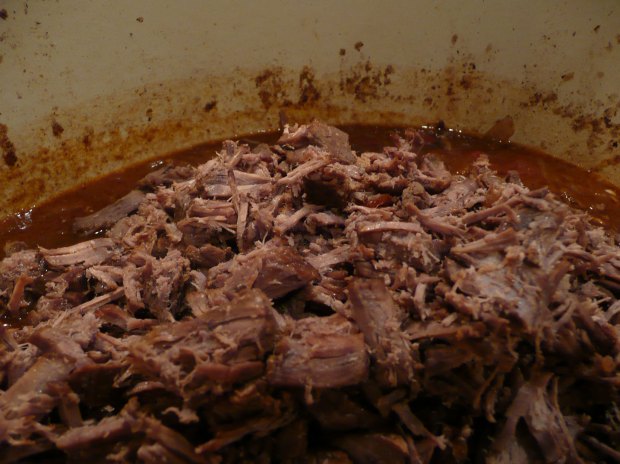
Reduce heat to medium, add remaining tablespoon of oil, allow it to heat for a moment, then add onions and 1/2 teaspoon of salt. Stir to coat and cook until onions just start to soften, about 2 minutes. Add flour, stir to mix, and cook, stirring constantly, for about 2 minutes. Add garlic, cumin, cinnamon, and cloves and cook, stirring constantly, until fragrant, about 40 seconds. Add sherry and chicken broth, increase heat to high, and use a wooden spoon to scrape up the brown film on bottom of pot until it is all dissolved, about 1 minute. Add tomatoes, bay leaves, and browned meat with accumulated juices, push it down into liquid, bring to a boil, reduce heat to very low, cover, and simmer until beef is tender, about 2 1/2 hours. [Though this recipe uses a dutch oven on the stove top, there’s no reason you couldn’t put the meat and liquids in the slow cooker for 8-10 hours on low.] Remove steaks and when cool enough to handle, cut in half across the grain. Use 2 forks to break down meat into thin shreds and return to pot.

Shredded beef

Add bell peppers to the pot, submerge them in liquid, cover, increase heat to medium, and cook until just tender, about 10 minutes. Remove bay leaves, add olives, peas, and 1/2 teaspoon each salt and black pepper, stir to mix, and cook until peas are heated through, about 5 minutes. Add 4 tablespoons of parsley, taste stew, and adjust seasoning with salt and black pepper, if necessary. Serve at once, sprinkling with remaining parsley.

Ropa Vieja

Green Peppercorn Sauce

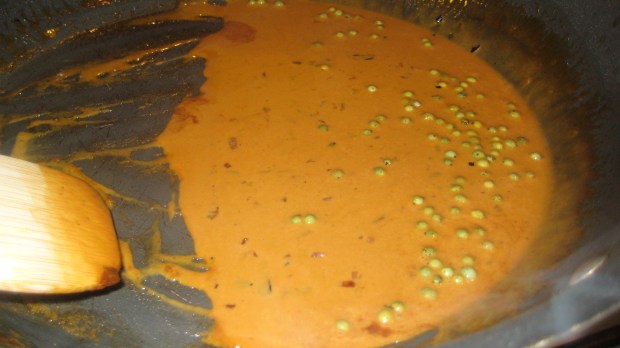
Peppercorn SauceA while back, I introduced you to the nouvelle cuisine of my father-in-law and his famous Chicken Marsala.  I have cooked that one over and over by now, adapted it for Veal with a couple of my own touches, and eaten the original chez Chip numerous times.  But I have not, until now, had the opportunity to taste the just-as-famous but considerably more elusive Green Peppercorn Sauce.

And wow, did this ever live up to its reputation!  A blanket of thick, rich, slightly tangy sauce, draped over a perfectly cooked filet mignon – I drool just writing about it.  Chip allowed me to photograph his process last night, but made me swear that I would give the recipe full credit to Williams-Sonoma, who included it on the tag that came with his jar of beef demi-glace.  This recipe is also a great way to use up some more of the green peppercorns called for in my last post!

Green Peppercorn and Cognac Sauce, from Williams-Sonoma recipe developers and product marketers

2 tablespoons clarified butterimg_0297
4 filet mignon, each 6 oz., 1 1/2 inches thick
1 shallot, minced
¼ cup cognac
 cup heavy cream
 cup beef demi-glace
1 tablespoon green peppercorns, well rinsed
3 tablespoons unsalted butter, room temp, cut into small pieces

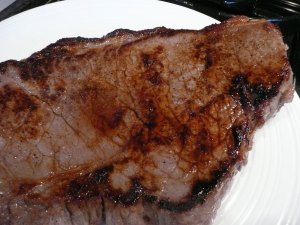
In a large saute pan over medium heat, warm the clarified butter until nearly smoking. Place the filets in the pan and sear until nicely browned underneath, about 5 minutes. Turn the filets over and continue cooking until nicely browned on the other side, about 5 minutes more for medium-rare, or until done to your liking. Transfer the filets to a warmed platter, season lightly with salt and pepper, and cover loosely with aluminum foil.

img_0313Pour off all but 1 Tbs. fat from the pan. Set the pan over medium heat, add the shallot and cook, stirring occasionally, until translucent, about 3 minutes. Off the heat, add the cognac. Return the pan to medium heat, bring to boil and cook until the cognac is almost evaporated, about 3 minutes. The cognac may ignite, but it will burn off. Add the demi-glace, cream and peppercorns and whisk to combine. Cook until the mixture is slightly thickened, 1 to 2 minutes. Add the butter and whisk until incorporated. Season with salt and pepper, and pass the sauce alongside the filets or pour over them just before serving. Serve immediately. Serves 4.
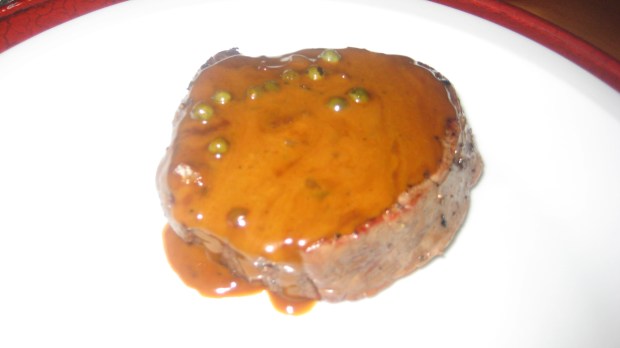
Filet with Peppercorn Sauce