This week is, by necessity, leftovers week. RJ and I are moving (!) and are packing up house, home, and pantry. Even if you aren’t moving, it isn’t a bad idea to do a similar fridge-clearing exercise every once and a while. The first step in the process is to take stock (as in inventory, not soup base) of what you need to use up. Our list contained a random assortment of freezer-bound meats (2 sausages, 5 skinless chicken breast halves, a balsamic-marinated flank steak, 1 duck breast, etc. etc.), the standard hodgepodge of hopeful fruits and vegetables (some fennel, a bunch of rhubarb, a pint of strawberries, half a red onion, a cut-into lime, 1 head of romaine, a bag of green beans), various condiments, and buttermilk. I groaned at that one.
Leftover from my Tiramisu Cake, the buttermilk sat untouched with the little toddler mascot staring at me everytime I opened the refrigerator door. I never know what to do with buttermilk, and every recipe I’ve made thus far that has required me to purchase it uses a 1/2 cup or so, leaving the better part of a quart behind to waste away (and rancid buttermilk is not a pleasant smell, trust me).
That leads me to my second step in the cleaning-out process — evaluate the inventory’s perishability and strategize approach accordingly. Obviously the two frozen sausages and the variable shapes of dried pasta you have on hand can wait a bit, whereas the strawberries, romaine, and buttermilk will need to be used immediately. If you can think of recipes that use more than one of your on-hand ingredients at the same time, all the better! I grabbed the rhubarb, the strawberries, and the buttermilk and set to work.
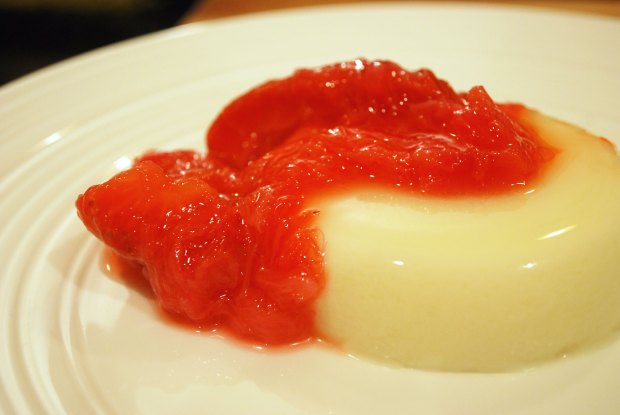
To really make a dent in the buttermilk container, I had to truly feature it in whatever I made. So I chose Buttermilk Panna Cotta. A quintessential summer dessert, panna cotta is cool and creamy with a consistency that falls somewhere between custard and jello. You can top it with fresh berries, mango puree, wine syrup, chocolate, or even bacon! Though out of season, pomegranate seeds might be nice too… kind of like my cheesecake topping from this past winter. Endlessly modifiable, panna cotta is a delicious and versatile way of using up buttermilk!
 Buttermilk Panna Cotta, adapted slightly from MarthaStewart.com
(Serves 6)
2 cups nonfat buttermilk
1 1/2 teaspoons powdered unflavored gelatin
2/3 cup heavy cream
1/2 cup sugar
3 stalks rhubarb
1/4 cup sugar
1 pint strawberries, hulled and quartered
1 Tbs. lemon juice
In the top of a double boiler (not over heat), sprinkle gelatin over 1 cup buttermilk; let stand to soften, about 5 minutes.
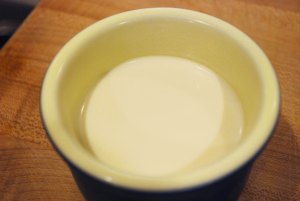 Meanwhile, bring cream and scant 1/2 cup sugar to a boil. Add to gelatin mixture. Place over simmering water; whisk until gelatin dissolves, 5 minutes. Stir in remaining cup buttermilk. Pass mixture through a cheesecloth-lined strainer. Divide among 6 four-ounce ramekins or small bowls on a baking sheet. Cover; refrigerate until set, 4 hours.
Meanwhile, place rhubarb in a small to medium sized saucepan with 2 tablespoons of water and 1/4 cup of sugar. Stir to combine and place over medium heat. When the mixture begins to boil, cover the pot and cook over low heat until the rhubarb is soft and begins to dissolve slightly, approximately 15 minutes. Stir in strawberries and lemon juice, then taste to see if you need more sugar.
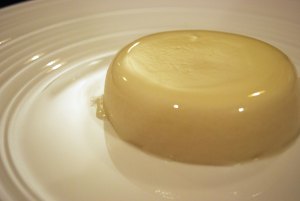 Unmold by dipping ramekins briefly into hot water and running tip of a knife around edges; invert onto plates, and serve with strawberries and their juice.
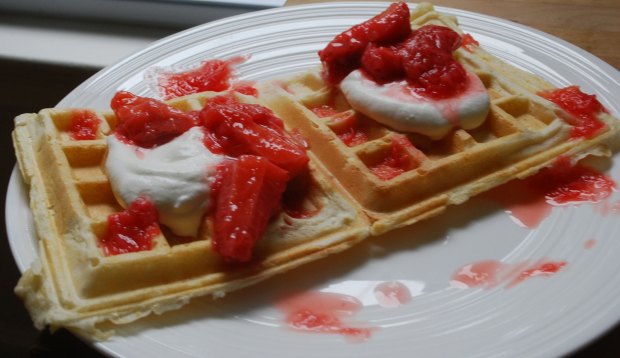
That definitely used up a bunch, but I still had over a cup of buttermilk sitting in the fridge. I decided, then, on Sunday morning to finish up the strawberry-rhubarb topping and the buttermilk in one fell swoop. I made waffles! Good belgian waffles are such a treat on a lazy morning – especially with fresh fruit and whipped cream.
Buttermilk Waffles, from Cook’s Illustrated The New Best Recipe

(Makes 3-4 waffles, depending on size of waffle maker)
1 cup (5 oz.) unbleached all-purpose flour
1 Tbs. cornmeal (optional – lends a nice crunch to the waffles)
1/2 tsp. salt
1/4 tsp. baking soda
1 large egg, separated
7/8 c. buttermilk
2 Tbs. unsalted butter, melted and cooled
Heat a waffle iron. Whisk the dry ingredients together in a medium bowl. Whisk the egg yolk with the buttermilk and melted butter.
Beat the egg white until it just holds a 2-inch peak.
Add the liquid ingredients to the dry ingredients in a thin, steady stream while mixing gently with a rubber spatula. (Do not add liquid faster than you can incorporate it into the batter). Toward the end of mixing, use a folding motion to incorporate the ingredients. Gently fold the egg white into the batter.
Spread an appropriate amount of batter onto the waffle iron. Following the manufacturer’s instructions, cook the waffle until golden brown, 2 to 5 minutes. Serve immediately. (In a pinch, you can keep waffles warm on a wire rack in a 200-degree oven for up to 5 minutes).
Make toaster waffles out of leftover batter – undercook the waffles a bit, cool them on a wire rack, wrap them in plastic wrap, and freeze.
Here are some other recipes using buttermilk – I wish you the best of luck getting rid of it in the most delicious of ways!
- 2 cups: Buttermilk Fried Chicken
- 1/2 cup: Buttermilk Salad Dressing
- 2 cups: Buttermilk Pudding
- 1 cup: Salt-Kissed Buttermilk Cake
- 2/3 cup: Buttermilk Cookies
- 1 1/2 cup: Low-Fat Buttermilk Bread Pudding
- 3/4 cup: Buttermilk Ice Cream
- 1/2 cup: Buttermilk Cranberry Scones
- 1/4-1/2 cup: Buttermilk Corn Fritters
- 2 cups: The Best Buttermilk Pancakes
- 1 cup: Buttermilk Pie (a Southern classic, I’m told)
- And of course, you can always use buttermilk in your mashed potatoes, a la Zuni Cafe.


 but boring and tasteless white cake.
 Generally I consider glazed fruit tarts to be a summer treat – something ideal for the back porch on a muggy evening after a meal of grilled meats and cold beer. Nothing beats the supple flavor of a juicy strawberry on a light lemon custard and buttery sablé crust after a hot day. Only in-season and perfectly ripe berries are worthy of such a spotlight: thus summer and fruit tarts are inextricably linked in my mind – so much so that the tart concept doesn’t even occur to me when I think about making a dessert in the months from October to May.
 Press the dough evenly into the bottom and sides of a 9-1/2-inch fluted tart pan with a removable bottom—the dough sides should be 1/4 to 3/8 inch thick. To smooth the bottom, cover with plastic wrap and press with a flat-bottom measuring cup or glass. Freeze the covered shell for 30 minutes. Meanwhile, position a rack in the center of the oven and heat the oven to 400°F.
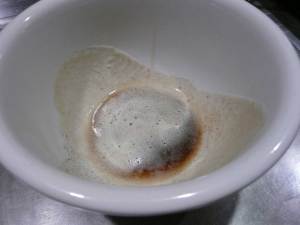 In a small saucepan, heat the butter over medium-high heat until it melts and the milk solids turn brown, swirling the pan occasionally for even browning, about 3 minutes. Immediately pour into a small heatproof bowl to stop the cooking.
 Spread the filling evenly in the tart shell and set aside at room temperature while you prepare the topping.
 On our recent trip to San Francisco, RJ and I learned first hand how much more friendly the people of California are as opposed to the crowds in Boston. Everywhere we went, people tried to convince us to move out West – whereas in New England you can hardly get a stranger to talk to you even if you’ve already moved there and just want to make a new friend! So many recent imports to Boston have told me that it is rather impossible to meet people here, since everyone who grew up around town or went to school in the city already knows each other, and no one is particularly welcoming or friendly. Cliquey, I think they called it. In San Francisco, Tahoe, and Napa RJ and I found ourselves chatting with people of all ages and originating from around the world, all settled in California and not planning to ever leave. One such man was sitting next to us as we sipped Irish Coffee at the
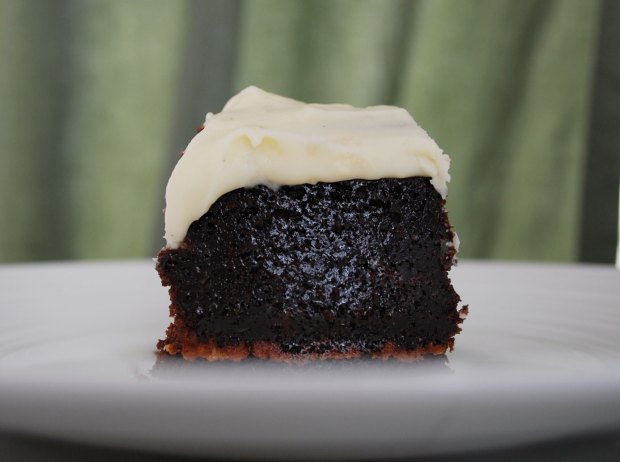
  For the cake:
 In a small bowl, combine sour cream, eggs and vanilla; mix well. Add to Guinness mixture. Add flour and baking soda, and whisk again until smooth. Pour into buttered pan, and bake until risen and firm, 45 minutes to one hour. Place pan on a wire rack and cool completely in pan.
 From My Table...to Yours