Panzanella Salad

panzanella

When I wrote my recent post about my “Hearty and Refreshing” Arugula Salad, I definitely struggled over the title.  Are “hearty” and “refreshing” oxymoronic?  And if so, how better to describe a salad which is at once light, zesty and supremely satisfying?  And now, I give you another data point to consider: a hearty salad with a cornucopia of flavors, all harmonizing beautifully, which both sates and invigorates.

Panzanella is a wonderful concept — using day-old or even stale bread to make a fantastic and substantial salad — and can be endlessly varied.  A former classmate of mine from Needham (another Sweet Basil adherent, perhaps?) offers both a traditional recipe and some ideas for variants on her blog, Two Blue Lemons.  As for me, I don’t see much need for tweaking with this recipe, which combines savory roasted garlic, tangy marinated onions, sweet mozzarella and lots of fresh herbs.  While both the garlic and the onions take their own time and instructions to make, I recommend making the full batches outlined below and saving any extras for future creations.

Panzanella, from The Sweet Basil Cookbook – [Printable Recipe]
(serves 4-6)

1 recipe balsamic vinaigrette


6 generous handfuls mixed greens
1 cup roasted garlic

2 (8 oz) balls fresh mozzarella cheese, diced
1 Tbs. marinated onions

2 vine-ripened tomatoes, wedged [I used cherry tomatoes]
2 roasted red peppers, sliced in 1/4 inch strips
1 c. kalamata olives, pitted
1 c. croutons

Fresh basil, chiffonade, for garnish
Fresh parsley, chiffonade, for garnish
Shaved cheese (such as Asiago or Parmesan) for garnish

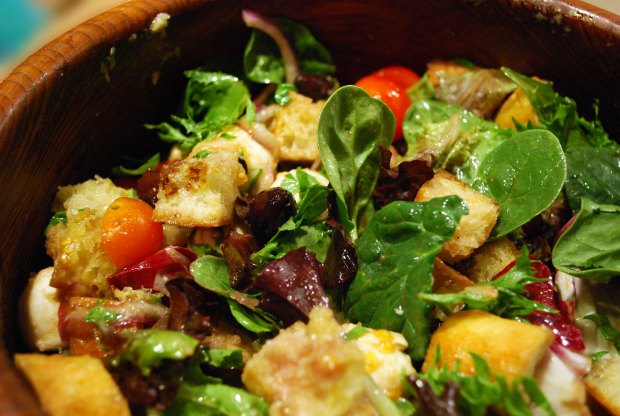
Follow the instructions to prepare the balsamic vinaigrette. In a large bowl, toss the greens with one-half of the balsamic vinaigrette. Then, in a separate bowl, toss the remaining vinaigrette with the roasted garlic, mozzarella, marinated onions, tomatoes, roasted red peppers, olives and croutons. Add this mixture to the mixed greens, tossing to combine.

Evenly distribute the dressed greens among serving plates, and then garnish with the basil, parsley, and cheese. Serve immediately.

Balsamic Vinaigrette
In a mixing bowl, whisk together 2 Tbs. Dijon mustard and 1/3 c. balsamic vinegar. Once they are well combined, slowly whisk in 2/3 c. olive oil until it is incorporated. Season to taste with salt and pepper.

Roasted GarlicRoasted Garlic
Preheat the oven to 325 degrees. Place 4 garlic bulbs [each bulb yields approximately 1/2 cup roasted garlic] with their tops trimmed off by 1/2 inch, cut-side-up, in a casserole dish just big enough to hold the bulbs comfortably. Cover the garlic with 4 cups olive oil, cover the dish with aluminum foil, and then roast in the oven for 45 minutes, or until the garlic is soft. Remove the dish from the oven and allow the garlic to cool for 20 minutes. Remove the garlic from the oil, and then squeeze the garlic cloves out of the skin, reserving the oil for cooking.

Marinated onionsMarinated Onions
Combine 1 red onion, as thinly sliced as possible, 1 clove of garlic, minced (about 1 Tbs.), 1 1/2 Tbs. olive oil, 1 Tbs. fresh basil chiffonade, 1 Tbs. fresh parsley chiffonade, kosher salt and pepper in a large bowl. Season to taste with salt and pepper. Transfer to an airtight container.

Croutons
Preheat the oven to 275 degrees. Arrange 1 pound bread, cut into 1/2 inch cubes, on a baking sheet, drizzle with some olive oil, and then top with a few pinches of butter and a couple sprinkles of salt and pepper. Roast in the oven for 20 minutes, or until the bread is brown and crispy, flipping periodically to avoid burning.panz-bread
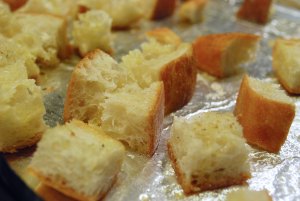
If serving the croutons immediately, sprinkle them with a bit of grated parmesan cheese; if saving the croutons for later, transfer them to an airtight container and store in a cool, dry place for up to 1 week.
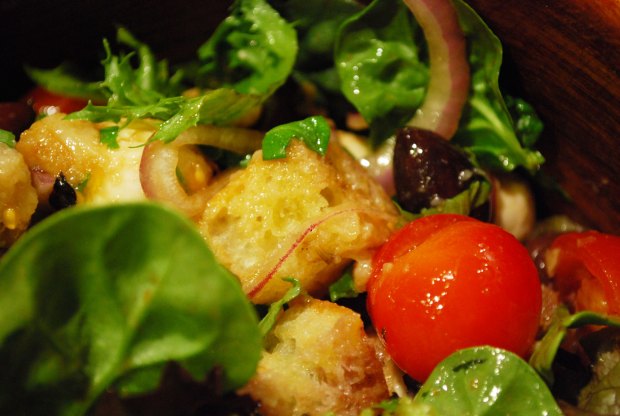
Panzanella Salad

Lemon-Ginger Marmalade – I made it myself!

Lemon Ginger Marmalade

 Clearly I like to cook.  Spending time in the kitchen is one of my favorite things to do, and also serves as a distraction from my other source of constant pleasure – eating!  When I’m cooking, I’m being industrious and I’m concentrating on technique rather than my usual pasttime of contemplating the food that I want to eat but probably shouldn’t.  I’m not as disfunctional as I sound.  I don’t think….

Despite my love for food preparation, and its end result, there are some types of cooking that don’t really occur to me.  I don’t ever have the urge to bake bread, or to make homemade candy.  I don’t love making fancy, complicated composed salads, and I have only once made my own pie dough.  I guess that there are some things that I feel more than okay about purchasing.  Jam has always been in that category. 

I should tell you that I really, truly adore jam.  It started when I moved to France in the fall of 2000.  I hated the milk (which was ultrapasteurized unrefrigerated Parmalat — nasty!) and did not discover “Lait Frais” until years later.  As you can imagine, however, the bread was out of this world.  I quickly adopted the French version of the “petit dejeuner” and ate a bit of bread with jam for breakfast each morning, occasionally treating myself to a croissant with the same fruit topping.  Though the bread choices were myriad, the “confiture” selection was even more impressive.  Stores like La Grande Epicerie and Fauchon offered hundreds of different brands and flavors – from the standards of American breakfast tables to the preserves of non-translatable fruits like arbusses.  All of these were topped, however, when I went to the 2004 Salon d’Agriculture, a French phenomenon I will not soon forget.  In 144,000 square meters of exhibition space, over seven gigantic warehouses, exhibitors from all over France and the world gather to demonstrate and sell their agricultural products – everything from wine to cheese to sausage to rice to tractors to livestock to prize dog breeds.  I could have spent weeks wandering through all the stalls, and still not have seen the whole thing.  I sampled apples from Limousin, cheeses from Haute Savoie, ham from Bayonne, and even saw a fountain of Confiture du Lait from Normandy (basically the most awesome caramel you can imagine).  I was in heaven!  The jams at this expo were extraordinary – lush and vibrant, bursting with flavor, and not overly sweetened or hardened by preservatives and pectin.  These were freshly-picked berries and fruits, conserved at their peak ripeness for year-round enjoyment.  I was sold!

You can probably guess where this post is headed.  Though there are certain food products that I leave to the experts, having this blog has definitely encouraged me to step out of my comfort zone.  In the coming year, I intend to challenge myself and bake a loaf of bread, experiment with salads, and maybe even try my hand at candy-making!  To kick it all off, this past weekend I made my first marmalade. 

What makes a truly delicious jam or preserve is the fruit itself – it must be in season, ripe, and full of natural sweetness.  It being winter right now, choices are limited!  However, citrus is at its peak right now, and a recipe in Fine Cooking magazine looked more than enticing. 

Though the preparation involved about an hour of devoted time for a half recipe, it was cathartic kitchen time, and as soon as the ginger and lemon started cooking, the house smelled wonderful!  If you have the time, let me tell you that this is not a difficult recipe to follow, and the results are unquestionably worth the effort.  I cannot wait to attempt some new combinations – grapefruit and orange, perhaps, or lime and cilantro.  Happy canning!

 Lemon-Ginger Marmalade, from Fine Cooking Issue 97 
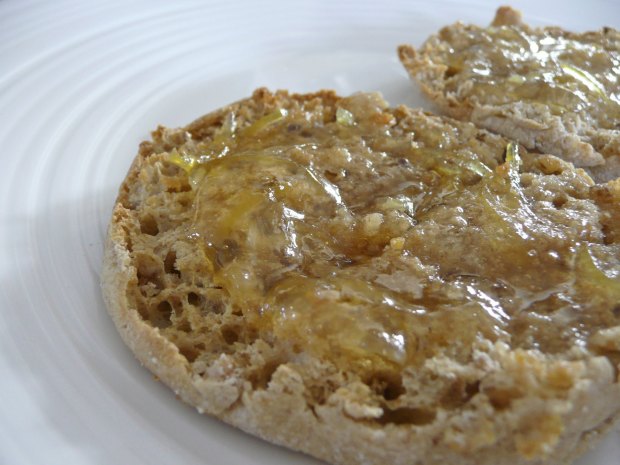
This golden-hued marmalade is right at home on toast, but it’s also divine stirred into plain yogurt or dolloped on coconut ice cream. Find pectin where canning supplies are sold—try supermarkets or hardware stores.

Makes 6-8 cups

lemons-carnage1-1/2 to 2 lb. lemons (6 to 8 medium)
1/2 c. finely chopped fresh ginger
One 1-3/4 -oz. package powdered pectin
6-1/2 c. granulated sugar

Peel the zest from the lemons with a vegetable peeler, avoiding as much of the white pith as possible. Slice the zest strips crosswise very thinly at an angle to make strips about 1/16 inch wide by 1 inch long—you’ll need 1 cup of zest strips. Put the zest in a 4-quart (or larger) saucepan.

Trim the ends from the zested lemons to expose the flesh. With one cut side down on the cutting board, trim the pith off the lemon all the way around and discard the pith. Quarter the lemons lengthwise and remove any visible membranes and seeds. Slice the wedges crosswise 1/4 inch thick—you’ll need about 1-1/2 cups.

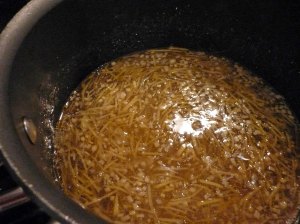
Add the sliced lemons, ginger, and 2 cups water to the lemon zest. Bring to a boil over medium-high heat, adjust the heat to maintain a simmer, and cook until the zest is soft and the membranes start to break down, 6 to 8 minutes.

lemons and pectinWhisk the pectin into the mixture. Increase  the heat to high, add the sugar, and bring to a boil, whisking constantly to smooth lumps. Boil vigorously for 1 minute, whisking constantly (move the pan off the burner momentarily if it threatens to boil over). Remove the pan from the heat and let sit undisturbed for 5 minutes.

Skim any foam and seeds off the surface of the marmalade. Stir gently to redistribute the solids. Transfer the marmalade to heatproof storage containers, let cool to room temperature, and then refrigerate for up to 1 month. For longer storage at room temperature, can the marmalade. See the canning directions below.
 
lemons cannedTo can the marmalade:
Transfer the hot marmalade to clean, hot canning jars, leaving 1/2 inch of headspace in each jar, and wipe the edges clean with a paper towel. Screw the lids on tightly.

Put the jars in a large pot of water fitted with a rack insert. The water should completely cover the jars by at least 2 inches. Return the jars to the pot of water and make sure the water covers them by at least 2 inches. Boil, covered, for 10 minutes. Use tongs to remove the jars; let them cool undisturbed on the counter. You should hear a popping sound as the jars cool, indicating that the vacuum seals have worked.

lemon ginger marmalade on muffin

The Mother of all Sauces

hollandaise sauce for broccoli

This post will be a quickie, but if you know what is good for you, you’ll bookmark it or print it or just emblazon the recipe in your memory.  Today I am imparting to you a sauce that has been handed down to me from my father.  My dad was never the cook of the family, though he was, and is, the unchallenged executive chef in charge of the grill, the pancakes and the hollandaise sauce.

Hollandaise is part of a group of 5 recipes called the Mother Sauces, including Veloute, Bechamel, Espagnole (or Brown Sauce), and Tomato.  From these basic recipes, you can modify and tweak your sauces to your own taste preference and delightful concord with your main dish.

Now, Antonin Careme and Escoffier may differ slightly with my dad about how to proceed with this dish, but I can tell you that my ratios are easy to remember, there’s no clarifying of butter required, and the end results are sublime.  Lemony hollandaise draped over steamed asparagus, eggs benedict, or roasted salmon is a true treat on an Easter morning or for an elegant Sunday Brunch.  Modified slightly into bearnaise sauce, you have the perfect accompaniment to any type of dry-cooked beef – roasted, grilled, or pan seared – and an excellent dipping sauce for french fries.

Hollandaise SauceMaster Sauce – Hollandaise

1 stick of butter
2 egg yolks
juice of 1 lemon

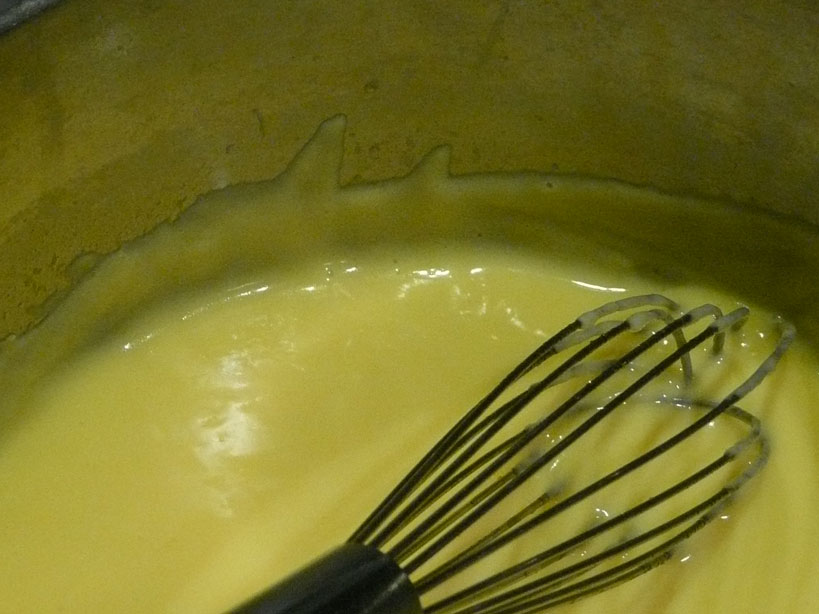
Melt the stick of butter in a small, heavy-bottomed sauce pan.  Set aside to cool slightly.  In a small bowl, whisk together the egg yolks and lemon juice until fully blended.  Set the butter over a medium-low burner and, while whisking the butter constantly, pour the egg yolk mixture into the pan slowly.  Your whisking should stay constant and should try to cover the whole bottom surface of the pan so that no part of the sauce cooks more quickly than any other.  Keep cooking and stirring until you begin to feel and see the sauce thickening up.  Remove the pan from the heat and continue to whisk for another minute or two.  Pour the sauce into a warmed gravy boat or creamer.  If at any point the sauce begins to separate, this means the sauce has gotten too hot.  Immediately remove it from the stove and whisk to see if you can bring it back together.  If it isn’t working within 30 seconds or so, put an icecube into the pan and whisk until the sauce cools and comes back together.  Then remove the ice cube.  Once the sauce has separated once, it is much more fragile than before and you should not attempt to thicken the sauce further.  Once you get the hang of the process, it is actually quite easy.  Some results will be thicker or thinner depending on how much liquid your lemon produces and the size of your yolks, but you will eventually develop an instinct for the correct proportions.

To make Bearnaise:bearnaise sauce ingredients

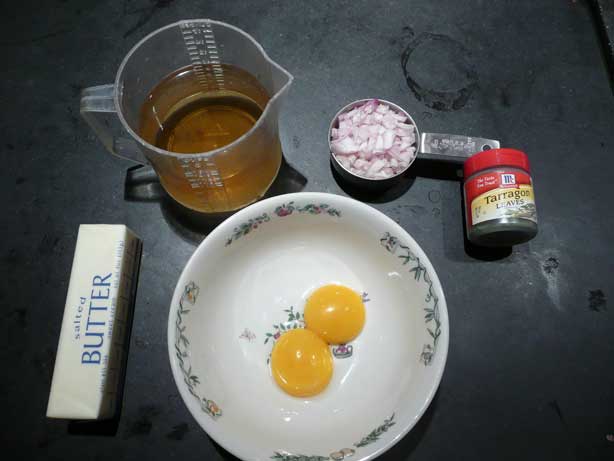
Bearnaise is very similar to hollandaise in method, but the flavor is very different.  Rather than using the juice of a lemon, you will make a flavorful reduction.

1/3 c. finely diced shallots
1/2 c. tarragon vinegar, champagne vinegar, or white wine vinegar
1/2 c. white wine
1-2 Tbs. chopped fresh tarragon or 1-2 tsp. dried tarragon, plus more for finishing.

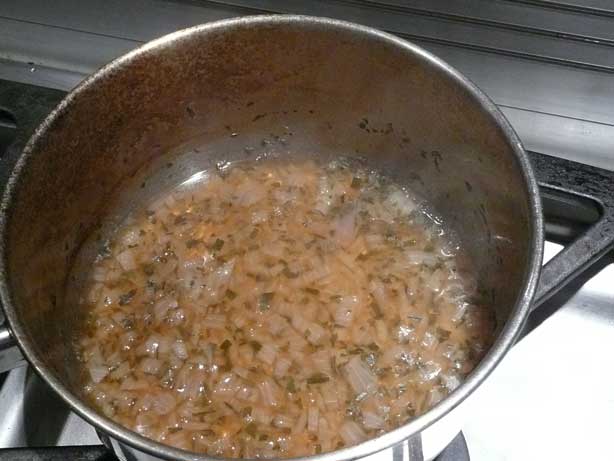
Pour the above ingredients into a small sauce pan.  Bring to boil, then simmer over low heat to reduce the liquids to a scant 2 Tablespoons, approximately 5 minutes.  bearnaise sauce reductionRemember that the solids take up a lot of room in the pan, so eye-ball accordingly – you want the liquid, strained of all solids, to equal just less than 2 Tablespoons.  Proceed with the Hollandaise recipe above, replacing your reduction liquid for the lemon juice.  When the sauce is finished, stir in a couple of teaspoons of fresh tarragon (or a 1/2 tsp. of dried) for color.

With bearnaise, you want to make sure you get the tarragon flavor correct.  If you use tarragon vinegar, use the low-end amount of fresh or dried tarragon.  Taste the sauce before you stir in the tarragon garnish, and adjust your amount accordingly.

Magazine Review: “Saveur” and Roasted Cranberry Sauce

roasted cranberry sauceThis is the second installment of my series of Thanksgiving magazine reviews.  You can see my evaluative criteria here.  My second food magazine review is of SAVEUR — a publication I became aware of through the Orangette blog, where several great recipes from Saveur have been featured.

112 pages total : 37 pages of ads (33%)
32 Recipes
News-stand price: $5.00
Price per recipe: $0.16
# of ads pretending to be articles: only one, and it’s very hard to spot.  It has the heading “The Saveur Chef Series” and includes a recipe for cauliflower with pine nut and current bread crumbs.  But for the miniscule “Advertisement” written across the top of the page, I would not have known it was advertising anything.  Come to think of it, I still am not quite sure what it is an ad for, except perhaps Bill Telepan’s eponymous NYC restaurant.
Recipe Index? Two indexes are provided – one, at the beginning, lists the recipes by article; the second lists them by category.  Both are ‘blink-and-you’ll-miss-em’ small.

Photos: Good, large pictures are scattered throughout the magazine, but are not labeled by recipe and are often separated by a page or two from the recipe they depict.  That’s fine for green beans with hazelnuts, but not so good when it comes to Kasespatzle.

Best Sections:
• The pantry – This section gives you resources to locate the esoteric ingredients used in some of the recipes.  Perfect for all of those “wait, where do I find Thai palm sugar?” moments.
• Source – a short feature story on a specific retailer or product.  This month it was Happy Girl Kitchen Co.’s pickled vegetables, including carrots, squash, and Italian beans – I am intrigued…
• In the Saveur Kitchen – “Discoveries and Techniques from our Favorite Room in the House”, including unusual uses of common ingredients and illustrated technique lessons.

Best Features:
• Within certain articles a little call-out box refers the reader to the web for more ways to use a specific ingredient or for similar or complementary recipes.
• This magazine’s content centers around articles on specific cuisines and their locales, always giving a list of “where to stay”, “where to eat” and “what to do” if you decide to follow in their footsteps.  This issue alone featured New Orleans, the Auvergne region of France, and Laos.
• Rather than always publishing in the traditional recipe format of serving size, ingredient list, then instructions, throughout the magazine you will find short blurbs called “Methods” which condense a recipe into a short prose paragraph – very much like your mom would relay Grandma’s Apple Pie to you over the phone.  The overall impression given is that you can adjust any of the methods to your own taste preference.

Thanksgiving at the Saveur house:
•Two separate sections deal with Thanksgiving – one about classic side dishes, and a second about how the holiday is celebrated in Louisiana.  Sweet Potato Casserole, Oyster Stuffing, Whipped Mashed Potatoes with Celery Root, Oyster stew, Leah Chase’s Roasted Turkey.  Ruling?  Very traditional.

Particularly Unappetizing:
• Traditional Mincemeat Pie (dried and fresh fruit plus rum and beef fat – shudder!!)
• Steamed Fish Mousse
• Pounti (Auvergne-style meatloaf with prunes)

I’m looking forward to cooking:
• *Roasted Cranberry Sauce
• Spinach and Artichoke Dip
• Brussel Sprouts Salad

In Summary, Saveur is a very interesting mixed bag.  The list of recipes, at least in this issue, ranged from a Chile con Queso dip made with Velveeta, canned Ro-Tel tomatoes and Corona beer, to Laap Moo (a Laotian minced pork salad) with chopped fresh galangal, toasted rice powder, kaffir lime leaves and lemongrass.  I recommend this magazine for the adventurous and ambitious chefs of this world – those who want to experience unique flavors from around the world or who want to teach themselves the authentic techniques of food preparation before the advent of the microwave or ready-made pie dough.

Make cranberry sauce*Roasted Cranberry Sauce, cited from Saveur No. 115

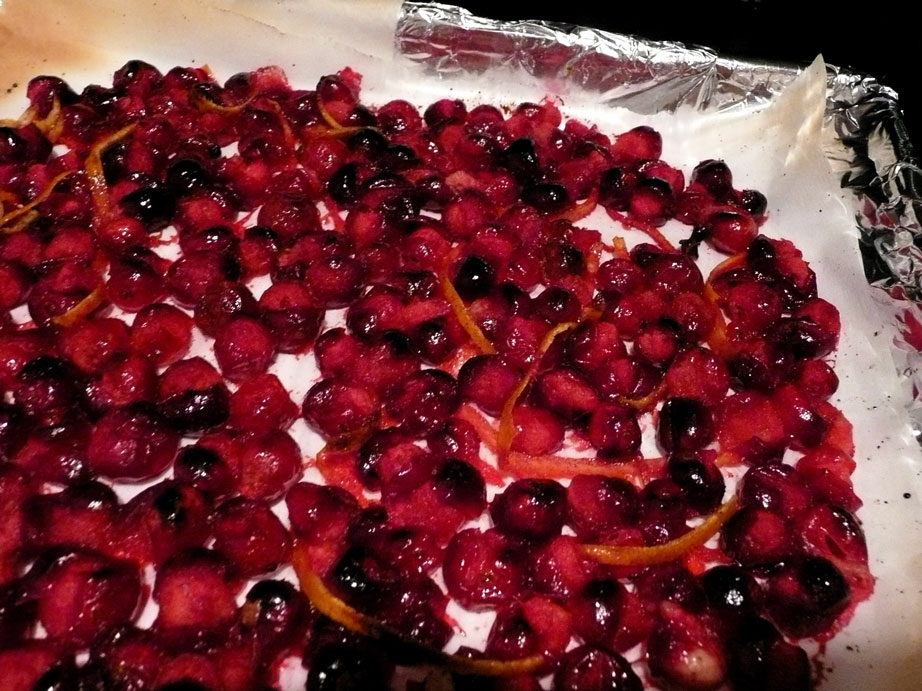
Heat oven to 450 degrees.  Using a peeler, remove peel from one orange, taking off as little of the white pith as possible.  Cut peel into very thin strips about 1 1/2 inches long.  Squeeze juice from orange; strain and reserve 1 Tbs. of the juice.  In a bowl, combine peel, 1 lb. fresh or thawed cranberries, 1 cup sugar, 2 Tbs. extra-virgin olive oil, 1 tsp. kosher salt, 4 smashed green cardamom pods, 4 whole cloves, 2 sticks cinnamon, and 1 small stemmed and thinly sliced jalapeno. Toss and transfer to a parchment paper-lined baking sheet.

Roast until cranberrries begin to burst and release their juices, 10-15 minutes.  Transfer cranberry mixture to a bowl; stir in reserved orange juice and 1 1/2 Tbs. of port.  Let sit for at least 1 hour so that hte flavors meld.  Remove and discard cardamom, cloves, and cinnamon before serving.  Makes 2 cups.

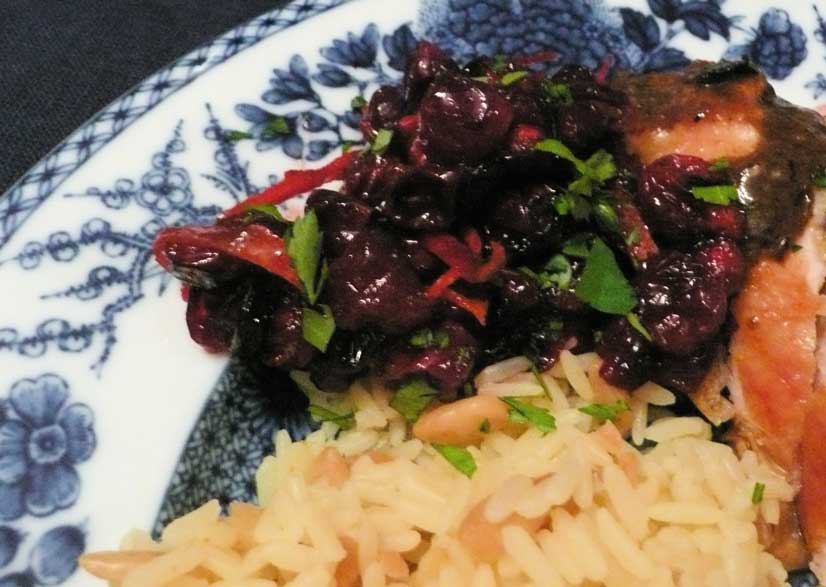
Plated cranberry sauceResults:  I don’t know about your feeling on this, but I found the prose-recipe method really frustrating.  I didn’t see that I needed a jalapeno until too late (so I left it out), and I had to keep rereading the whole recipe over and over to make sure that I only needed to save 1 Tbs. of the orange juice.  Though I know I’m supposed to follow these test recipes exactly, I used ground cardamom and ground cinnamon and omitted the jalapeno.  The results, however, were absolutely delicious.  The sauce was quite tart, which I liked, and the port gave it such a wonderful flavor without making it taste ‘alcoholic’ at all.  The texture was like a thick and chunky chutney, so if you like a more saucey version, this is not the recipe for you.  For me?  Yum yum yum!  This might become an annual feature of my holiday table!