Lemon-Ginger Marmalade – I made it myself!

Lemon Ginger Marmalade

 Clearly I like to cook.  Spending time in the kitchen is one of my favorite things to do, and also serves as a distraction from my other source of constant pleasure – eating!  When I’m cooking, I’m being industrious and I’m concentrating on technique rather than my usual pasttime of contemplating the food that I want to eat but probably shouldn’t.  I’m not as disfunctional as I sound.  I don’t think….

Despite my love for food preparation, and its end result, there are some types of cooking that don’t really occur to me.  I don’t ever have the urge to bake bread, or to make homemade candy.  I don’t love making fancy, complicated composed salads, and I have only once made my own pie dough.  I guess that there are some things that I feel more than okay about purchasing.  Jam has always been in that category. 

I should tell you that I really, truly adore jam.  It started when I moved to France in the fall of 2000.  I hated the milk (which was ultrapasteurized unrefrigerated Parmalat — nasty!) and did not discover “Lait Frais” until years later.  As you can imagine, however, the bread was out of this world.  I quickly adopted the French version of the “petit dejeuner” and ate a bit of bread with jam for breakfast each morning, occasionally treating myself to a croissant with the same fruit topping.  Though the bread choices were myriad, the “confiture” selection was even more impressive.  Stores like La Grande Epicerie and Fauchon offered hundreds of different brands and flavors – from the standards of American breakfast tables to the preserves of non-translatable fruits like arbusses.  All of these were topped, however, when I went to the 2004 Salon d’Agriculture, a French phenomenon I will not soon forget.  In 144,000 square meters of exhibition space, over seven gigantic warehouses, exhibitors from all over France and the world gather to demonstrate and sell their agricultural products – everything from wine to cheese to sausage to rice to tractors to livestock to prize dog breeds.  I could have spent weeks wandering through all the stalls, and still not have seen the whole thing.  I sampled apples from Limousin, cheeses from Haute Savoie, ham from Bayonne, and even saw a fountain of Confiture du Lait from Normandy (basically the most awesome caramel you can imagine).  I was in heaven!  The jams at this expo were extraordinary – lush and vibrant, bursting with flavor, and not overly sweetened or hardened by preservatives and pectin.  These were freshly-picked berries and fruits, conserved at their peak ripeness for year-round enjoyment.  I was sold!

You can probably guess where this post is headed.  Though there are certain food products that I leave to the experts, having this blog has definitely encouraged me to step out of my comfort zone.  In the coming year, I intend to challenge myself and bake a loaf of bread, experiment with salads, and maybe even try my hand at candy-making!  To kick it all off, this past weekend I made my first marmalade. 

What makes a truly delicious jam or preserve is the fruit itself – it must be in season, ripe, and full of natural sweetness.  It being winter right now, choices are limited!  However, citrus is at its peak right now, and a recipe in Fine Cooking magazine looked more than enticing. 

Though the preparation involved about an hour of devoted time for a half recipe, it was cathartic kitchen time, and as soon as the ginger and lemon started cooking, the house smelled wonderful!  If you have the time, let me tell you that this is not a difficult recipe to follow, and the results are unquestionably worth the effort.  I cannot wait to attempt some new combinations – grapefruit and orange, perhaps, or lime and cilantro.  Happy canning!

 Lemon-Ginger Marmalade, from Fine Cooking Issue 97 
This golden-hued marmalade is right at home on toast, but it’s also divine stirred into plain yogurt or dolloped on coconut ice cream. Find pectin where canning supplies are sold—try supermarkets or hardware stores.

Makes 6-8 cups

lemons-carnage1-1/2 to 2 lb. lemons (6 to 8 medium)
1/2 c. finely chopped fresh ginger
One 1-3/4 -oz. package powdered pectin
6-1/2 c. granulated sugar

Peel the zest from the lemons with a vegetable peeler, avoiding as much of the white pith as possible. Slice the zest strips crosswise very thinly at an angle to make strips about 1/16 inch wide by 1 inch long—you’ll need 1 cup of zest strips. Put the zest in a 4-quart (or larger) saucepan.

Trim the ends from the zested lemons to expose the flesh. With one cut side down on the cutting board, trim the pith off the lemon all the way around and discard the pith. Quarter the lemons lengthwise and remove any visible membranes and seeds. Slice the wedges crosswise 1/4 inch thick—you’ll need about 1-1/2 cups.

Add the sliced lemons, ginger, and 2 cups water to the lemon zest. Bring to a boil over medium-high heat, adjust the heat to maintain a simmer, and cook until the zest is soft and the membranes start to break down, 6 to 8 minutes.
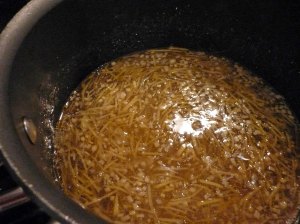
lemons and pectinWhisk the pectin into the mixture. Increase  the heat to high, add the sugar, and bring to a boil, whisking constantly to smooth lumps. Boil vigorously for 1 minute, whisking constantly (move the pan off the burner momentarily if it threatens to boil over). Remove the pan from the heat and let sit undisturbed for 5 minutes.

Skim any foam and seeds off the surface of the marmalade. Stir gently to redistribute the solids. Transfer the marmalade to heatproof storage containers, let cool to room temperature, and then refrigerate for up to 1 month. For longer storage at room temperature, can the marmalade. See the canning directions below.
 
lemons cannedTo can the marmalade:
Transfer the hot marmalade to clean, hot canning jars, leaving 1/2 inch of headspace in each jar, and wipe the edges clean with a paper towel. Screw the lids on tightly.

Put the jars in a large pot of water fitted with a rack insert. The water should completely cover the jars by at least 2 inches. Return the jars to the pot of water and make sure the water covers them by at least 2 inches. Boil, covered, for 10 minutes. Use tongs to remove the jars; let them cool undisturbed on the counter. You should hear a popping sound as the jars cool, indicating that the vacuum seals have worked.
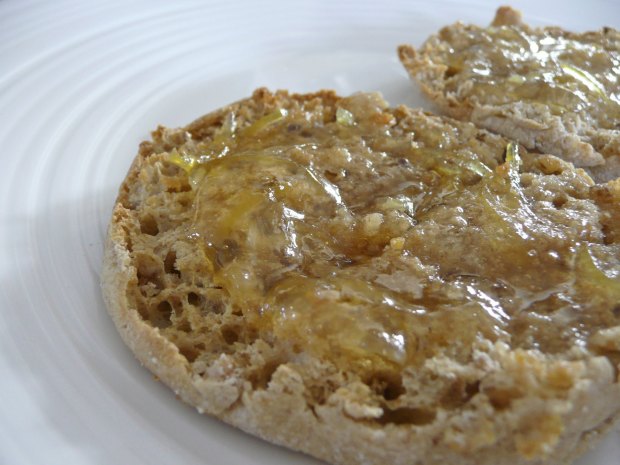
lemon ginger marmalade on muffin

Easy Sticky Buns

Easy Sticky Buns

I am a bad Barefoot Blogger – bad!  I neglected my duties for the past two installments, partly because it was the holidays and partly because the selected recipes didn’t totally appeal to me.  However, when Melissa chose these “Easy Sticky Buns”, I was motivated and reenergized!  For one thing, my mom recently purchased the Barefoot Contessa Back to Basics cookbook and I have been itching to steal it for a week now.  The recipes are very straightforward and simple, but with Ina’s classic flavor profiles and subtle elegance.  Second, I am always looking for new, fun additions to my Sunday Breakfast repertoire.  
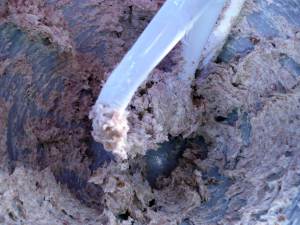
These came out wonderfully – gooey and rich in the center, and crunchy and caramelized on the outside.  I left out the raisins, because RJ doesn’t like them, but I think you could really mix and match with the filling – some dried currants, chopped walnuts, or maple sugar could all add to this recipe.  I wonder, too, if a (somewhat) savory version might be possible – with cooked bacon and sage in the center, and some maple sugar and mustard on the top…

Easy Sticky Buns, from Ina Garten’s Barefoot Contessa Back to Basics
(Makes 12)

Creamed butter and sugar12 Tbs. (1 1/2 sticks) unsalted butter, at room temperature
1/3 c. light brown sugar, lightly packed [I used dark brown sugar, hence the almost black syrup on the top of my buns!]
1/2 c. pecans, chopped in very large pieces (optional)
1 package (17.3 ounces/2 sheets) frozen puff pastry, defrosted
2 Tbs. unsalted butter, melted and cooled
2/3 c. light brown sugar, lightly packed
3 tsp. ground cinnamon
1 c. raisins (optional)

Preheat the oven to 400 degrees. Place a 12-cup standard muffin tin on a sheet pan lined with parchment paper.

Butter and Pecans

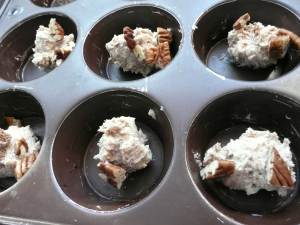
In the bowl of an electric mixer fitted with the paddle attachment, combine the 12 tablespoons butter and 1/3 cup brown sugar. Place 1 rounded tablespoon of the mixture in each of the 12 muffin cups. Distribute the pecans evenly among the 12 muffin cups on top of the butter and sugar mixture.

Lightly flour a wooden board or stone surface. Unfold one sheet of puff pastry with the folds going left to right. Brush the whole sheet with half of the melted butter. Leaving a 1-inch border on the puff pastry, sprinkle each sheet with 1/3 cup of the brown sugar, 1 1/2 teaspoons of the cinnamon, and 1/2 cup of the raisins. Starting with the end nearest you, roll the pastry up snugly like a jelly roll around the filling, finishing the roll with the seam side down.

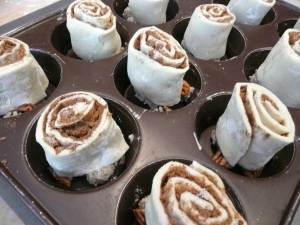
Cut bunsTrim the ends of the roll about 1/2 inch and discard. Slice the roll in 6 equal pieces, each about 1 1/2 inches wide. Place each piece, spiral side up, in 6 of the muffin cups. Repeat with the second sheet of puff pastry to make 12 sticky buns.
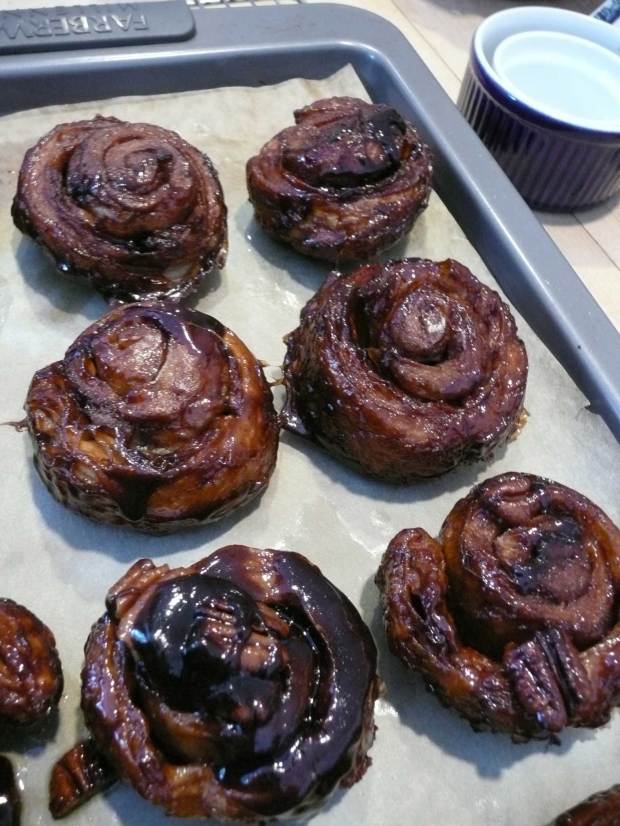
Bake for 30 minutes, until the sticky buns are golden to dark brown on top and firm to the touch. Allow to cool for 5 minutes only, invert the buns onto the parchment paper (ease the filling and pecans out onto the buns with a spoon), and cool completely.

Easy Sticky Buns

Easy Cheese Danish – Ina said so.

I have recently joined the online community of “Barefoot Bloggers.” No, this is not a group of people who spend all day web-surfing without shoes on, nor is it a bunch of crazies who type all their blog posts with their bare feet.  It refers to Ina Garten, aka The Barefoot Contessa, and a group of people who like to blog their ways through her delicious cookbooks.  The rules are simple – the first and fifteenth of every month, a new challenge is posted – a recipe selected from one of Ina’s books or her website.  The whole group then works on that same recipe, either making it “as is” or playing with it a bit to their own taste.  Every second and fourth Thursday of the month, participants post their creations on their respective blogs.  It’s a very fun way to work with a recipe, since you can see how your result compares with your peers’.

Today is the first of the month, so I’m going to participate for the first time on November 13th with Kelly’s pick: herb roasted onions.  If you clicked that link, you probably noticed that her site and mine look embarrassingly similar.  When I saw that, I decided to accelerate my project to learn HTML code so I can alter my own design.  I started by taking a schoolchildren’s DVD on HTML out of the library – I’m going slow and steady here!

So, just to get into the mood of Barefoot Blogging, and warm up before the big game, I decided to catch up with the group and post about the Easy Cheese Danish that Val had selected for a bonus recipe in October.  They looked delicious and, well, easy.  I wanted to stick close to Ina’s directions this time around (like I said, slow and steady!) so I made only a couple of small substitutions.

Easy Cheese Danish
8 oz. cream cheese at room temperature
1/3 cup sugar {this is the only place I really deviated from the recipe – I used 1/4 c. packed brown sugar instead of 1/3 c. white – let’s see what happens!}
2 extra large egg yolks, at room temperature
2 Tbs. ricotta cheese
1 tsp. pure vanilla extract
1/4 tsp. kosher salt
1/2 – 1 Tbs. grated lemon zest (2 lemons) {I got this much lemon zest from 1 lemon, and I found it to be almost too lemony for my taste}
2 sheets (1 box) frozen puff pastry, defrosted
1 egg beaten with 1 tablespoon water, for egg wash

Preheat oven to 400 degrees. Line a sheet pan with parchment paper.

Place the cream cheese and sugar in the bowl of an electric mixer fitted with paddle attachment and cream together on low speed until smooth.  With the mixer still on low, add the egg yolks, ricotta, vanilla, salt, and lemon zest and mix until just combined.  Don’t whip!

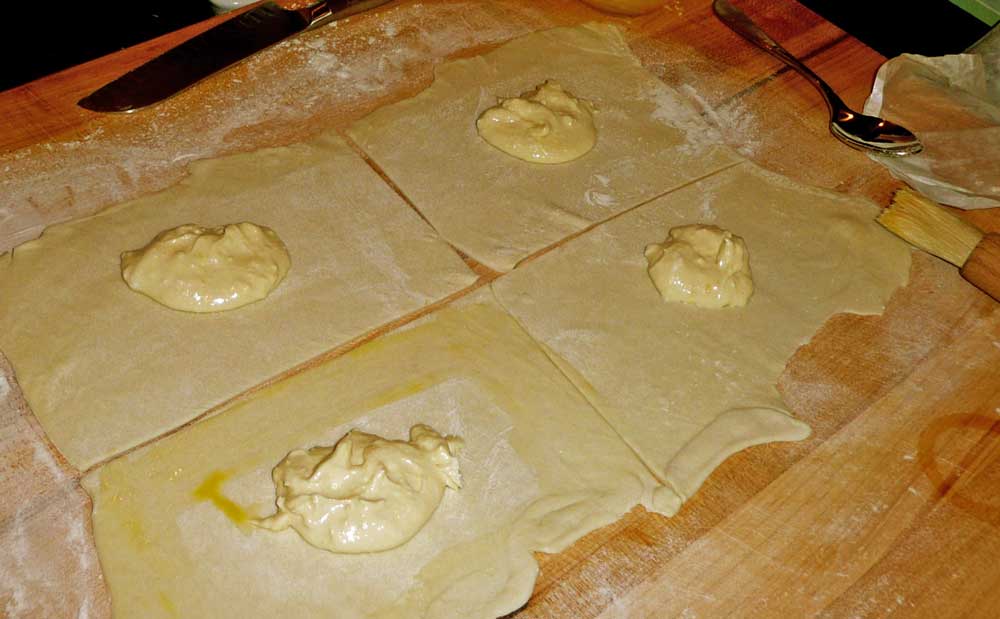
Unfold one sheet of pastry onto a lightly floured board and roll it slightly with a floured rolling pin until it’s a 10×10 inch square.  Cut the sheet into quarters.  Place a heaping tablespoon of cheese filling into the middle of each of the 4 squares.  Brush the border of each pastry with egg wash and fold two opposite corners to the center, brushing and overlapping the corners of each pastry so they firmly stick together.  Bursh the top of the pastries with egg wash.  Place the pastries on the prepared sheet pan.  Repeat with the second sheet of pastry, then refrigerate danishes for 15 minutes.

Bake the puff pastries for about 20 minutes, rotating the pan once during baking, until puffed and brown.  Serve warm.  Makes 8 danish.

Results:  These came out looking amazing (RJ took one right off the baking sheet and popped it in his mouth without asking what was in it – that’s a first!).  I thought they were a wee bit too lemony, and that I should have spread the cheese filling from stem to stern rather than dropping a rounded tablespoon of filling in the center of the pastry square.  All in all, though, very delicious.  And I think that Tara’s pumpkin variation sounds incredible – check it out!  Yes, it is going to be another lovely Sunday morning…

Sunday Morning Crepes

Mmm…Sunday Mornings: usually the one time of the week when I can sleep in for a couple hours, then drowsily rise to eat a leisurely full breakfast from my couch with a full mug of tea and a warm blanket draped over my lap. 

Recently, however, various trips and family obligations have kept me from this decadent routine.  This past weekend, I stayed at a friend’s house on Saturday night, and while I knew that the sleeping-in part would not be a problem, the breakfast was up in the air.

Most everyone who loves food and eating has some sort of routine that they hold sacred.  I have my Sunday Mornings, others have “Roast Chicken Thursdays” or make their salad the same way for every lunch.  Caroline, the friend with whom I was staying this weekend, has a breakfast routine of her own.  She pours cereal – usually mixing two or three different brands – into a pasta bowl and douses it with about a quart of milk, leaving it to sit for a bit before sitting down to the table with a carton of fresh berries and diluted O.J.  Far be it from me to cast aspersions on her breakfast – everyone has their own comforting food traditions – but I was craving my own form of Sunday Morning catharsis.

As we wandered into the kitchen that morning, she went into the pantry to grab her cereals, and I went into her closet to grab the Joy of Cooking.  She shook her head at me with a smile and we went our separate ways.  As she got out a bowl and a spoon, I took down her food processor from the shelf; as she grabbed berries and milk from the fridge, I withdrew eggs, lemons and apple cider.

Eventually, my friend’s husband wandered into the kitchen and I think I lured him to my side of the battlefield, because soon he was flipping crepes alongside me.  When all was said and done, however, and I took my seat at the breakfast table, Caroline passed me a big mug of steaming hot tea and all was right with the world.

Crepes with Apple Cider Syrup, adapted from the Joy of Cooking

For the Crepes:
2 eggs
1/2 c. flour
1/2 c. milk
1/4 c. lukewarm water
2 Tbs. melted butter
2 tsp. sugar
salt

For the syrup:
1 1/4 c. Apple Cider
1 Tbs. Light Corn Syrup
2 Tbs. Brown Sugar
Juice of 1/2 a lemon

Add all of the ingredients for the crepes into the bowl of a food processor or the pitcher of a blender.  Mix until fully blended and a bit frothy at the top.  If using a food processor, pour mixture into a pitcher – or leave it in the blender pitcher – and let sit for 30 minutes so that the liquids absorb the flour.

In the meantime, pour all of the ingredients for the syrup into a small, heavy-bottomed saucepan and stir until blended.  Turn the burner on medium until the mixture comes to a boil, then turn down the heat to maintain a rapid simmer.  Reduce until mixture reaches a syrupy consistency.

When the syrup is where you like it, warm a nonstick skillet over medium heat.  Wrap a tablespoon of butter in one sheet of paper towel, and rub the bundle over the pan to grease it.

Pour some batter into the pan (1/4 cup should be plenty, but it depends on the size of your pan) and immediately tilt the pan around in a circle to spread the batter across the surface.  If you have a wooden crepe-spreader-thingy, all the better. 

Cook for about 1 minute or until the edges of the crepe easily separate from the pan when you pass a thin metal spatula around the perimeter of the skillet.  Flip the crepe and briefly cook it on the other side.  The crepe should be lightly browned.

Remove the crepe to a plate and drizzle with the apple cider syrup and (if you like the crunch) some demerara sugar.  Other winning toppings: lemon juice and sugar; jam of preference; and sweetened cream cheese with cinnamon or finely zested orange peel.  Then, what I like to do is fold the crepe in half and then in half again so it looks like a triangle.  Top it with some berries or whipped cream and voilà – the perfect Sunday Morning!