The Ultimate Feast

Pig Kahuna

Speaking of birthday dinners, as I did in my last post, we just had another birthday around here and boy, was it a biggie!  RJ turned 30 this past weekend, and what did I get my dear husband who eats nothing but meat?  A pig roast!  To be specific, 62 pounds of dressed pork, turning slowly over a low charcoal fire for over 6 hours.

Words can hardly express how phenomenal the entire experience was. RJ had no idea what I had been planning for the past 3 months, and with some wonderful subterfuge his friends and I managed to get him to his mother’s beach house with narry a clue!  His face as he came in the driveway was priceless — astonishment, pleasure and a bit of embarrassment at the number of people we gathered together for the big day.

Though the span of the afternoon is a story in itself — torrential downpours, epic tournament of cornhole, and finally fireworks on the beach — for the purposes of the food blog I’ll stick to the pig.

The pig arrived at around 2 o’clock, dressed (meaning that her internal organs had been removed).  Dave, of The Pig Kahuna, rinsed her thoroughly with fresh water, and inserted the rotisserie spit into the mouth and out the…uh…well, use your imagination.  A couple extra rods were inserted laterally for stability as well — and the pig doesn’t look happy about it!  The final preparation step was to sew her back together and to tie her legs around the spit.

pig-prep

The “Oinkmaster 8000”, Dave’s glorious roasting contraption, was loaded with charcoal and lit.  We waited until the coals were at a low burn, measured only by feel.  Dave said that if he couldn’t hold his hand over the fire at the level of the pig for 6 seconds, then the coals were too hot.  Soon, dear Arnold (our name for the pig, which soon became Arnoldine when we found out she was a Miss Piggy) was mounted on the rotisserie and began her slow roasting.
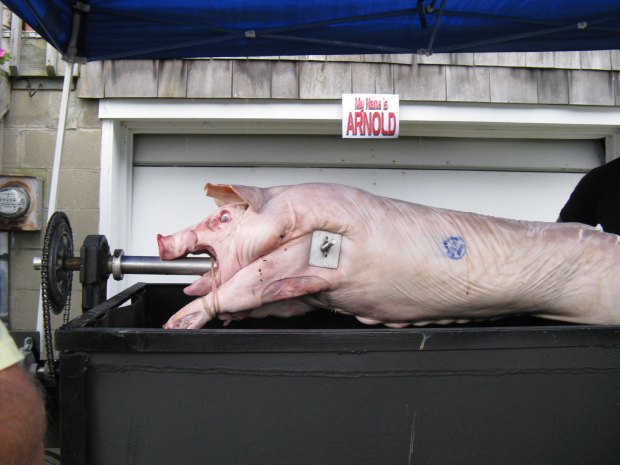
pig-fresh-on-spit

For the six hours she turned, the pig was regularly spritzed with white vinegar.  Though Dave has experimented with cider vinegar and even balsamic, he has found that 6 hours of cooking makes cider vinegar bitter and balsamic vinegar black.  After an hour and a half on the spit, Arnoldine began to self-baste, releasing delicious juices that dripped down over her shoulders and legs.

Pig-2-hour

In three hours, her skin started to get golden, and we watched as it bubbled over the heat of the coals.  With more time, the leg joints began to loosen and the skin split in several places — the beginnings of tenderization.  Somewhere around 4 1/2 or 5 hours in, my brother dared my sister to eat one of the eyeballs, and she did.  She advised that the pig needed more time…

Jes

Finally, after six hours, Dave began the final process — the trick to a perfect roast pig.  The motor that had kept Arnoldine on a steady rotation was stopped and the crowds gathered around to watch Dave crisp the skin.  He added more charcoal to the fire and the flames began to rise up a couple inches from the coals.  Making quarter-turns of the spit, he let each side of the pig sit over the fire for a decent interval.  We saw the skin crisping and crackling, with the juices dripping into the fire creating an atmospheric hiss for the dramatic final moments.
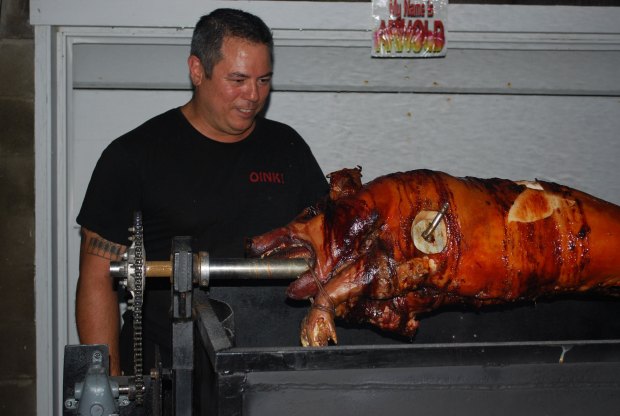
Pig Roast

When the pork ready to serve, Dave asked RJ to aid in the dismounting.  They each took one end of the spit in their bare hands (the low heat left the ends of the spit at only 75 degrees or so), and moved a mahogany-toned Arnoldine to the serving table.  Freed of her metal trappings, the pig nearly fell into perfect serving pieces right in front of us.  Dave offered us bites of the tenderloin (smoky from the more direct fire), the shoulder (nearly white and completely juicy), and the belly (from whence the bacon comes…) to compare the various cuts.  We also sampled the pig skin, which crunched like savory candy.  By now, the crowds were getting rowdy, and everybody’s mouths were watering.

The pork was delectable — succulent and rich when unadorned, and tangy and spicy when doused with Dave’s special barbecue sauce.  Though we had about 65 guests, the pig carried over into lunch for 10 the next day.  As the birthday boy’s wife and party hostess, I was also designated the “keeper of the head”.  Those in the know, Dave said, always go for the pig cheeks — I guess now I’m in the know!  I think I gave my mother-in-law a heart attack, however, when she opened the fridge to find a whole pig’s head staring out at her (with one eye, no less).
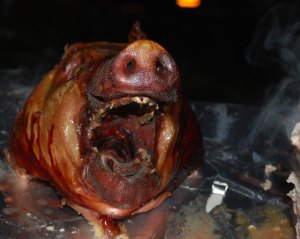
pig-head

All I can say is “wow”.  RJ had a wonderful birthday, complete with (an excess of) meat on a stick, and all of our guests enjoyed watching Arnoldine turn and learning from Dave, the Pig Kahuna himself.  The question is, what can top RJ’s 30th birthday when he turns 40?  Perhaps we’ll have to look into a cow…

Pig-finished-on-spit

Hearty and Refreshing Arugula Salad

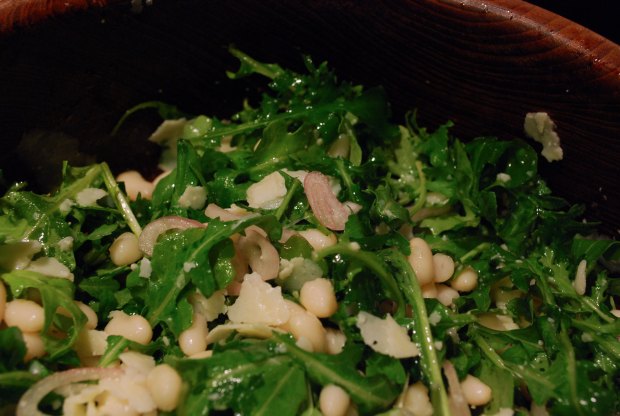
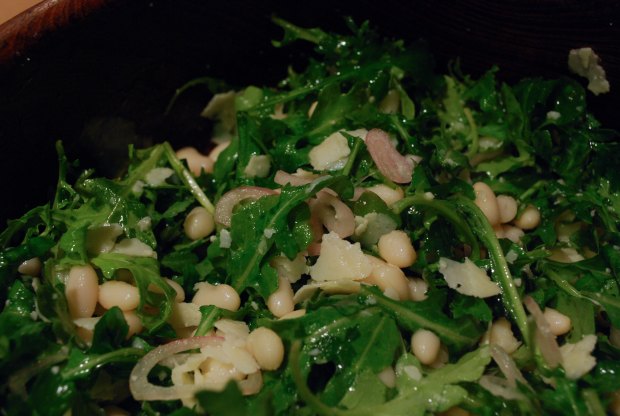
Arugula and White Bean Salad
I don’t know how the weather looks where you are, but Massachusetts has been chilly and rainy for weeks now – not proper June behavior, to be sure. This morning we’ve been looking at intermittent bursts of sun and watching over our shoulder for the oncoming thunderclouds.  We’re hoping for summer to come on strong any day now, but she’s being reluctant.

This arugula salad is my response to this confused weather — an interpretive dance, if you will.  It sounds like it should be a summer salad but in fact the components are demonstratively wintery.  Hearty beans, parmesan cheese, and pickled onions all sound like they should be menu features in December or January, but with a substantial dose of lemon juice and the addition of cherry tomatoes, this salad is perfect for the confused days of June.

Easy Arugula and White Bean Salad

2-3 shallots
High-quality red wine vinegar
5 cups (baby) arugula greens
Cherry or grape tomatoes (optional)
Parmigiano-Reggiano cheese
1 lemon
High-quality extra virgin olive oil
14 oz. can of cannellini or other white beans
salt and pepper

Peel the shallots of their skin and slice crosswise as thinly as possible. Separate the rings and place in a ramekin or other small bowl. Pour red wine vinegar over the shallots to cover. Set aside.

Place the arugula (and cherry tomatoes, if using) in a large salad bowl and shave thin peels of parmigiano-reggiano into the bowl with a vegetable peeler, as much as you like. Then, using a grater or microplane, grate more parmesan over a separate medium-sized bowl until you have about a half a cup.

Dump the can of white beans into a strainer and rinse under running water until clean. Shake the strainer lightly to dispel excess water, and add the beans to the bowl with the grated parmesan. Gently fold the beans in with the parmesan, or lightly toss the bowl until the beans are coated.

Juice the whole lemon into the arugula salad, catching the seeds. Add a couple tablespoons of olive oil to the salad to lightly coat the leaves. Sprinkle a bit of salt and pepper to taste, then toss the greens and parmesan shavings to distribute. Add the white beans on top of the green salad, then place the vinegar-soaked shallots on top of the beans. Sometimes I sprinkle a bit of the shallot-infused vinegar over the salad, but usually the lemon provides enough acidity on its own. Enjoy!

Best Arugula Salad

Fish en Papillote

Finished PapillotteAs I indicated in my last post, something naturally happens as the weather warms whereby I turn away from my many cookbooks (or in the case of this year, pack them into about 10 cardboard boxes and put them in a POD) and instead begin to develop a more spontaneous and improvisational cooking style.  Last night my sister’s plans for whole trout on the grill were thwarted by an ill-stocked fish counter, and I instead purchased two gargantuan halibut steaks (the ones cut cross-wise from the fish’s body) with a glimmer of an idea in mind.

Assembly

When I got home, I raided my mother’s cabinet and refrigerator, pulling out some prepared pesto, a half a tomato, jars of roasted red peppers and marinated artichokes, a lemon and some fresh thyme.  I then cut two large rectangles of parchment paper (you can also use aluminum foil), about 14-16 inches long for my huge steaks, and folded the sheets in half, then opened them up on the counter again.  I put one of the halibut steaks in the middle of one half of each of the parchment paper sheets.  Then, I improvised.

On one steak I rubbed pesto thickly across both cut sides, layered a couple of tomato slices on top, added some roasted red peppers (about three half-peppers), and a couple artichoke hearts, and then drizzled some oil from the artichoke marinade and the juice of half a lemon over the whole thing.  On the other steak, I put  leftover caramelized onions and fennel from my tartlettes, more artichokes, sliced kalamata olives and two tomato slices and doused again with the marinade and lemon.  I placed a big sprig of thyme on the top of each steak, and began the process of sealing up the parchment.

Wrapped

Fold the empty half of parchment over the loaded fish half so that the two cut edges of the parchment touch, and kind of hold those two pieces together (you can use a jar or something to weight them if you need to).  Begin at one of the edges of the center fold and begin working your way around the open edges of the parchment package, folding in tiny overlapping triangles.  Parchment holds fairly well, so just make your triangles tight and use the back of your thumbnail to sharpen the folds.  Aluminum foil is even easier and pretty self explanatory.

The Gourmet Cookbook suggests folding the last triangle under the package, to seal it “completely”.  I didn’t do that (my last fold was up, like the others) and I had one package open up in the oven, and one stay sealed.  Either way, it isn’ t a big deal if a bit of liquid leaks out in the cooking process.
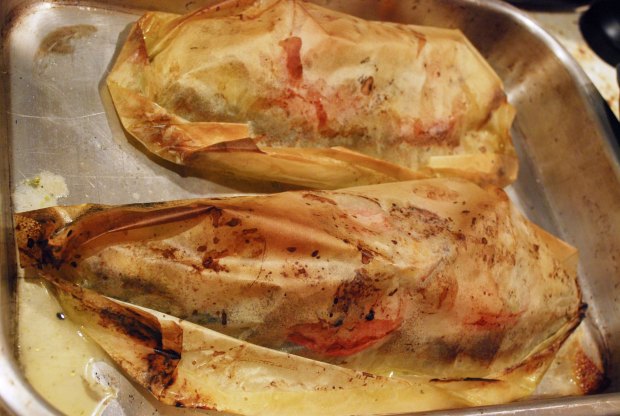
Next step: put a large baking sheet into a pre-heated 500 degree (F) oven for 5 minutes.  Pull it out, and put the fish packages on the hot baking sheet.  Bake for 10 minutes or so (depending on the thickness of the fish you’re using – mine was about an inch of thick halibut and was perfect after 11 minutes) at 500 degrees, then pull out of the oven.  Opening up the package after this is a real treat – the steam whooshes out in an aromatic burst, and one is astonished to find all the vegetables and fish cooked perfectly and in pristine shape and full color.

Papillote

This technique, cooking ‘en papillote’, is wonderful for several reasons.  1) It is very forgiving, as the steam from the vegetables and fish keeps everything pretty moist, even if you leave it a couple extra minutes in the oven.  2) It is quite healthy, seeing that you don’t need any butter or oil (though it is highly recommended to add butter or olive oil at the end as a finishing element) and you can pack the papillote full of veggies.  3) It is an impressive presentation if you put each portion in its own papillotte and serve your guests the package to open themselves at the table.  4) Finally, the technique is wildly versatile – perfect for summer improvisation!  The fish can be cod, snapper, bass, trout, or any number of varieties, and the toppings and aromatics inside could include any combination of herbs, oils, wine, fresh vegetables, cherry tomatoes, olives, citrus zest & juice, capers, spices, vinegar or greens that you like.  Try different pairings to find your favorite melange, or invite your guests to each assemble their own before dinner!