Tongue in Cheek…Musings on Literary Food Porn

Radishes

One of my best friends once dated a guy who claimed to read his pornography.  I don’t mean he **air quotes** purchased Playboys for the articles, I mean that he didn’t care for erotic pictures; he found lusty stories and written accounts to have a greater appeal and, er, effect.  The peccadillos of a true intellectual I suppose…

Until this past week I would have denied that the same preference was possible for a lover of food porn – that aside from the real thing nothing could make the mouth water more than a gorgeously styled gourmet photograph.  Of course, I’m not the first to repeat the wisdom that we taste with our eyes first.  The sight of a deep crimson strawberry, plump and glistening with morning dew can evoke the sumptuous sweetness of the fruit before it even hits the tongue, and increase the anticipation all the more.  Websites such as FoodGawker and Photo Grazing cater to the needs of the average degenerate foodie — offering a harmless fix (It’s just looking!) to get him through the day until he gets home to his own dinner.

Brussels sprouts

Yet this week I have discovered literary food porn and damn, it is gooood…  Erica Bauermeister’s The School of Essential Ingredients is my first indulgence (and you never forget your first, I’m told).  This novel, the author’s debut, is exceptionally crafted.  Bauermeister sculpts each character with rich language and heartfelt empathy, revealing them slowly through their most intimate histories – an elderly couple’s crisis of infidelity and eventual reparation, a young man’s heartbreak over the death of his wife, a new mother’s conflicted self-perception – and then bringing them all together around the counter at the cooking school named in the title.

I find this book nearly impossible to put down.  The stories are intriguing and deeply sincere, and the writing is decadent.  Certain passages have completely blown me away, particularly the lush descriptions of food and the simple but profound metaphors the author composes to explain her characters’ emotional strife.  At one point she writes, after a series of insults from a contemptuous, critical boyfriend: “Chloe felt sometimes that he was tying her up with string, into a small ball that he could throw far, far away from him.”  I cannot tell if you will read that and find it as apt and poignant as I did, or if it will mean nothing without reading the context, but I see that as further evidence of how engrossing the narration really is.  The words are not indulgent literary flourish – they are the story.

tomatoes

I contrast my experience with this book to my reading of The Sharper Your Knife, the Less You Cry: Love, Laughter, and Tears in Paris at the World’s Most Famous Cooking School, a memoir by Kathleen Flinn.  Also about a cooking school, specifically Le Cordon Bleu, Flinn’s writing lacks all of the elegance and expert pacing of Bauermeister’s.  Admittedly, Flinn is a trained journalist and is writing non-fiction.  Nevertheless, the reader could have been, but is not, transported by her book.  I don’t fall in love with her husband-to-be along with her.  I do not feel her frustration or her intense determination — I just hear it.  Does that make sense?  I recall the most basic lesson of college-level creative (and academic) writing — Show Don’t Tell.  Flinn’s book was more of a telling.  As one reviewer put it, “It’s all matter of fact: this happened, she had this amazing experience, she lived this dream, wouldn’t you like to read about it?”  Sure, I guess.

French spice marketThis is not to say I didn’t enjoy the book at all.  I did.  As did many other bloggers and critics.  The thought of dropping everything (or having everything dropped for you and against your will, as in Flinn’s personal story) to go to live in Paris and attend cooking school full time is quite enticing for me!  Plus, the book is riddled with funny stories and some great recipes I cannot wait to try.  I am just saying that I didn’t read The Sharper Your Knife with the same kind of hunger that I did The School of Essential Ingredients.  One review on Amazon.com of the latter book reads, “My main complaint is that there isn’t enough of it. It’s a very short book and feels highly polished, every line labored over until it gleams…but there’s just not enough of them.”  You certainly leave The School of Essential Ingredients wanting more… much like the first course of a fantastic meal.  I cannot wait to see what Erica Bauermeister comes out with next.  Consider your appetites whet!

Thai-Style Stir-Fried Chicken and Basil

Thai Chicken with Basil

For all the flack I give my unadventurous husband, I was not always the intrepid eater that I am today.  My siblings will certainly attest to the years that I spent eating only hamburgers, and one of my best friends and fellow epicures will surely remember a time not long ago when all fish were abhorrent to me.  I credit both my love of cooking and my expanded palate to one person.  I am not sure if she knows this (I will be sure to give her a poke on Facebook to read this post, however) but my friend Robin is the source of all of this.

After receiving my acceptance to college during my senior year of high school, I made the decision to defer my matriculation for a year.  While the “sabbatical year” is very common in Europe for kids that age, it was a recent trend at my school that had a very strong appeal for me.  While New York City and Columbia University certainly was alluring, I wanted to seize the opportunity to try something very new and exciting and ready myself for another four years of academic immersion.  I applied to the Wells College Program for the Arts in Paris, and packed up my film and camera for 6 months in the city of lights.  There, I met Robin who was a vegetarian from Hampshire College in Amherst, MA.  We hit it off immediately, and our bond grew stronger as we realized that her dietary restrictions and my tight budget severely limited our options for meals in Paris.

Her solution, one that seems so obvious now but that at the time was quite a novelty, was to use the dorm kitchen at the Cité Universitaire (where we lived) to cook our own dinners.  This did necessitate a purchase of a mini fridge from the BHV (quite an excursion) in which to horde our creations from the pilfering masses of La Cité, as well as a scouting mission for familiar American ingredients around Paris.  Robin’s French was in its nacent stages, as were my culinary skills, but between the two of us we put together a proper pantry.  My previous experience with cooking was the occasional massive dinner party with my high school friends, where ten or more of us crowded into my mother’s kitchen to clabber together a meal.  With Robin, I was given one-on-one instruction and she introduced me to ingredients that I never would have touched before.  Something about selecting the perfect eggplant from a table at the farmer’s market, hunting down the elusive broccoli, or debating the proper substitution for an American ingredient like sour cream, made my fear of strange vegetables and creative, ad hoc cooking dissipate.  

Over the years since that first stint in Paris, I have come to love vegetables of all kind, have acquired a taste for seafood, and have (obviously) developed a huge passion for cooking.  One victory that I will credit to my friends Julie and Lindsay is my recent acceptance of ethnic foods.  Robin, try as she might, could not convince me to go anywhere near an Indian restaurant.  Lindsay (another vegetarian) and Julie (an omnivore for the most part, unless you offer her boxed mac and cheese) have introduced me to some of my now favorite cuisines – Japanese sushi and Thai food.  Though the following recipe is not typical Thai — it has been adapted for an American audience and for use in homes like my own! — it has some similar flavors.  I really enjoyed this very simple-to-make dish, as did RJ.  Next time I will slice my chicken thinner (as the recipe says to) and use more basil.  They also suggest replacing the basil with mint and cilantro.  I suppose my palate will have to evolve a bit further for that…

Thai-Style Stir-Fried Chicken and Basil, from Fine Cooking (April/May 2009, issue 98)
Serves 2-3

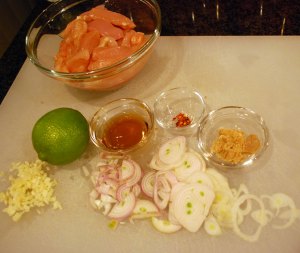
Mise en place2 Tbs. vegetable oil
4 medium shallots, peeled and thinly sliced
2 medium cloves garlic, thinly sliced
1/4 tsp. crushed red pepper flakes
1 lb. chicken breast cutlets (about 1/4 inch thick), cut crosswise into 1-inch-wide strips
1 Tbs. fish sauce
1 Tbs. fresh lime juice
2 tsp. packed light brown sugar
1 cup lightly packed fresh basil leaves
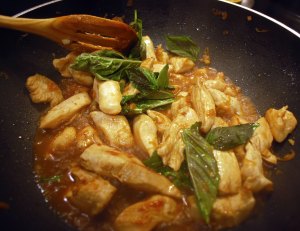
chicken-with-basilHeat the oil in a well-seasoned wok or a heavy-duty 12-inch skillet over medium-high heat until shimmering hot. Add the shallots, garlic, and red pepper flakes; cook, stirring frequently, until the shallots start to soften but not brown, 1 to 2 minutes. Add the chicken and cook, stirring, until it’s no longer pink and the shallots are beginning to brown, 2 to 3 minutes.
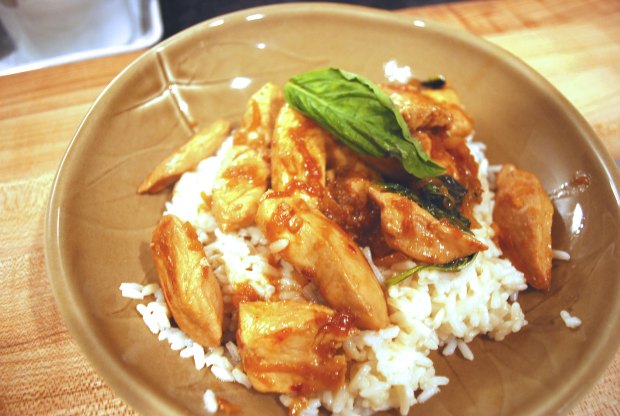
Add the fish sauce, lime juice, sugar, and 1/4 cup water. Cook, stirring frequently, until the chicken is just cooked through and the liquid reduces to a saucy consistency, 2 to 3 minutes. (If the sauce reduces before the chicken is cooked through, add water, 1 Tbs. at a time.) Remove from the heat, add the basil, and stir to wilt it.

Thai Chicken Basil

My Cheese Plate and a Short Dissertation on the Subject

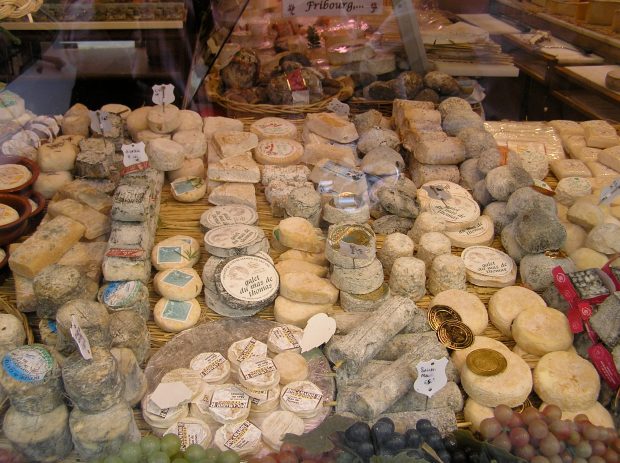
Cheeses in France

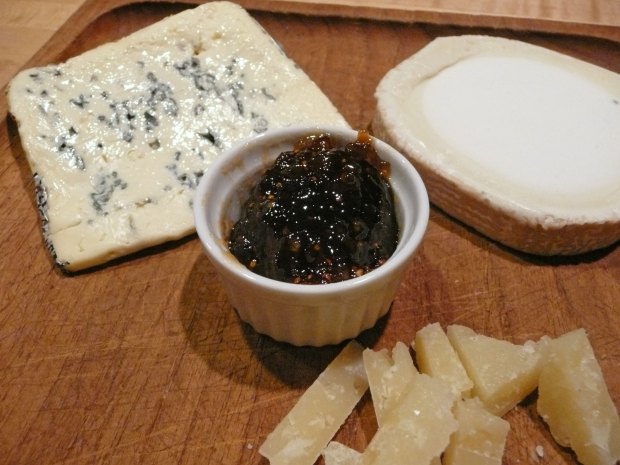
This month’s Barefoot Bloggers bonus recipe was more of a fun free-for-all.  Suggested by Rebecca of Ezra Pound Cake, participating bloggers each put together a cheese plate for mass digital/visual consumption.  I kept mine very simple, and only included 3 time-tested and well-proven crowd pleasers on the plate — St. Agur (a blue cow’s milk cheese from France), Boucheron (a wonderful goat cheese from France), and Pecorino (a sheep’s milk cheese from Italy that comes in many delectable variations – my favorite is Pecorino Nero):

cheese plate

I thought I would include in this post not only some of my favorite cheeses, but also some standard rules for cheese plate construction that I have picked up from books, restauranteurs, and the occasional honest-to-goodness French person!  And they know what they are talking about.  All of them.  Actually, I spent a year working in a cheese store before I began full-time at an art gallery.  And this is what I learned:

1. It is fun to have a theme to your cheese plate, especially if it is served as an hors d’oeuvres course.  The theme can be as general as “Cheese from France” or as acute as “Manchego” (featuring the cheese at different stages of aging).  Obviously the theme you choose should take into account the type of people you have invited – the uninitiated guest may not appreciate the subtle differences in flavor between Loire valley goat cheese and Corsican goat cheese, but the aficionado may enjoy the challenge – and the type of gathering you are hosting – if you are serving a huge multi-course meal, don’t go too crazy or elaborate with the pre-dinner cheese, but having friends for cocktails can be the perfect time to feature the cheeses you love.

cheese-on-bread with fig jam2. When serving cheese as a course during dinner, it is best to limit yourself to one to three cheeses, as more can overwhelm the palate.  In this setting, it is particularly nice to offer a variety – different milks (cow, sheep, and goat), different textures (soft, semi-hard, hard), maybe one blue cheese – and possibly a selection of accompaniments (baguette and walnut bread or crackers; a fig jam or chutney; some honey and walnuts; or a side plate with olives, cured meats, and fresh fruit).  
3. Always serve cheeses at room temperature for optimal flavor.  I usually take my cheese out of the refrigerator 45 minutes to an hour before serving, and leave it in its wrapper until guests arrive.

4. When tasting multiple types of cheese, start with the most mild-flavored (usually the younger cheeses), and move up the scale to the stinkiest or sharpest (blues, washed rind cheeses, etc.) so that you don’t lose your discerning palate before you even begin!  For this reason, it is always a good idea to know a little bit about the cheeses you’re serving before the party – ask your cheesemonger for a taste, or at least his/her opinion.

5. As a very general rule, when pairing wines with cheese, it is always a good bet to pick a wine from the same region as the cheese – Epoisses with a red Burgundy, Chaource with a Champagne, a chevre with a Sancerre.  Some fun exceptions are the blue cheeses which almost always LOVE a sweeter wine, such as ruby Port or a Sauternes.

So, those are some basic guidelines.  The most important one, however, is: 

6. KEEP EXPERIMENTING!  There are so many wonderful cheeses out in the world, and U.S. farms are now producing some absolutely fantastic examples.  Here are a couple of my favorite cheeses:

cheese-zoomSt. Agur: pictured on my cheese plate, this is a cow’s milk double-cream blue from the Auvergne region of France.  It is less salty and less piquant than other blues, and has a fabulously creamy texture.  I sometimes drizzle a little honey over a spread of this for a great contrast of flavors.  If it weren’t so gosh darned expensive (about $23/lb.), I’d brush my teeth with it. 🙂

RobiolaRochetta:  These mixed-milk cheeses are über-creamy (read: runny) and rich, with a flavor that gathers in strength as it ages.  I could eat these both (but especially the rochetta) in their entirety with just a baguette and a glass of Bordeaux to wash it down.   In fact, please note my last supper request!

Beaufort: This was one of the first cheeses that I truly appreciated.  I was introduced to it in Paris by a French woman who insisted that her daily cheese consumption was the reason for her physical fitness.  Quite a philosophy!  Beaufort tastes similar to gruyere, but has a fruity overtone and a more complex, layered flavor delivered in a subtle progression.

Abbaye de Belloc: This is the most gentle of the cheeses listed here – semi-firm in texture with a creamy, mouth-coating finish and an understated flavor profile.  It is pleasing to nearly every palate and, personally, transports me back to the side of a mountain in the Pyrenees.  That is one of the wonderful things about food – not only does it taste good, it has the ability to conjure up lovely memories.

Humboldt Fog:  When I worked at the cheese shop, this was one of my weaknesses.  From the outside, it looks like a brie – it has a bloomy rind and tends to soften (liquefy, really) from the outside in.  Through the middle of the cheese is a line of vegetable ash, similar to what you would see in a Morbier.  The goat cheese from this west coast producer is almost fluffy in texture, and embodies all that is wonderful in the taste of a good chevre, with a distinctive American look and feel.

Taleggio:  I had to wrap up with the stinkiest of my list.  This northern Italian cheese has a washed rind, meaning that during the affinage period it is ‘washed’ with a rinse of sea water (some cheeses are washed with wine or brandy too) – this promotes molds that prefer the moist surface, and aids the maturing process.  While I have a taste for VERY stinky cheeses too (like Epoisses which is washed with a strong local brandy), taleggio is nice in that the rind has a strong, complex aroma while the interior is more mild and oozy – not nearly as threatening as it seems.

Well, that list of favorite cheeses was longer than I thought!  Thanks for reading, and please leave your comments as to your favorite cheeses – I’m always looking for new ones to try!  If you can’t get enough cheese, check out the other Barefoot Bloggers’ boards.

The Omnivore’s Hundred – Play Along!

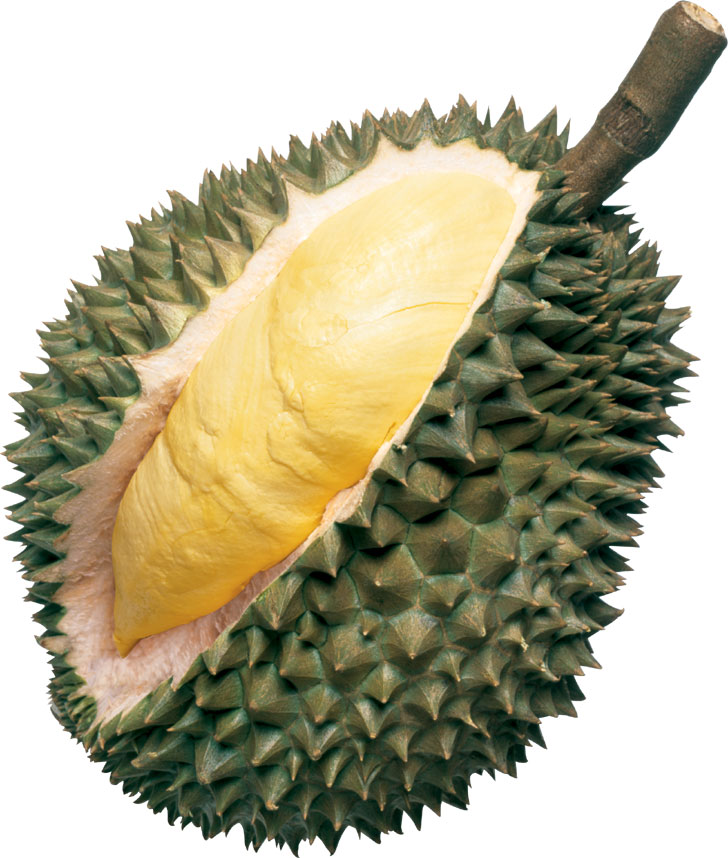
durian

Several months ago, Andrew from Very Good Taste posted a list of 100 things that every good omnivore should try in their lifetime.  The list is nothing if not random – he makes no claims that the separate items are particularly good tasting, let alone transformative experiences, yet there is quite a diversity here, which I can respect.  I have followed his instructions (posted below) and found my own results pretty revealing.  Basically, I can consider myself an omnivore.  I will try almost anything once, with the exception of some live foods (oysters are okay, insects are not) and really spicy foods, because I am deathly afraid my palate will never recover.

Speaking of never recovering, I am on the fence about #46, Fugu.  There is a chance of death with every bite, a chance which I would consider not worth taking.  However, if I actually were to find myself in a very well-known and respected Japanese restaurant in Tokyo, with my honor at stake, I might just dig in.  In fact, whenever I came to a point of uncertainty on the list, I often decided that if I were presented with this item while in its country or province of origin, I would indeed try a bite.  Brown cheese, snake, and pig intestines all sound pretty grotesque to me, but I would give it a go – if only for the right to tell the tale.  Please let me know if you have some tales to tell about any of the below!  And who can guess which of the 100 is pictured above?

Andrew’s Directions:

1) Copy this list into your blog or journal, including these instructions.
2) Bold all the items you’ve eaten.
3) Cross out any items that you would never consider eating.

The VGT Omnivore’s Hundred:

1. Venison
2. Nettle tea
3. Huevos rancheros
4. Steak tartare
5. Crocodile
6. Black pudding
7. Cheese fondue
8. Carp
9. Borscht
10. Baba ghanoush
11. Calamari
12. Pho
13. PB&J sandwich
14. Aloo gobi
15. Hot dog from a street cart
16. Epoisses
17. Black truffle
18. Fruit wine made from something other than grapes
19. Steamed pork buns
20. Pistachio ice cream
21. Heirloom tomatoes
22. Fresh wild berries
23. Foie gras
24. Rice and beans
25. Brawn, or head cheese
26. Raw Scotch Bonnet pepper
27. Dulce de leche
28. Oysters
29. Baklava
30. Bagna cauda
31. Wasabi peas
32. Clam chowder in a sourdough bowl
33. Salted lassi
34. Sauerkraut
35. Root beer float
36. Cognac with a fat cigar
37. Clotted cream tea
38. Vodka jelly/Jell-O
39. Gumbo
40. Oxtail
41. Curried goat
42. Whole insects
43. Phaal
44. Goat’s milk
45. Malt whisky from a bottle worth £60/$120 or more
46. Fugu
47. Chicken tikka masala
48. Eel
49. Krispy Kreme original glazed doughnut
50. Sea urchin
51. Prickly pear
52. Umeboshi
53. Abalone
54. Paneer
55. McDonald’s Big Mac Meal
56. Spaetzle
57. Dirty gin martini
58. Beer above 8% ABV
59. Poutine
60. Carob chips
61. S’mores
62. Sweetbreads
63. Kaolin *the link on this is bad, and a google search of Kaolin turned up a lot of results with the word diarrhea in them – here, I draw the line.
64. Currywurst
65. Durian
66. Frogs’ legs
67. Beignets, churros, elephant ears or funnel cake
68. Haggis
69. Fried plantain
70. Chitterlings, or andouillette
71. Gazpacho
72. Caviar and blini
73. Louche absinthe
74. Gjetost, or brunost
75. Roadkill
76. Baijiu
77. Hostess Fruit Pie
78. Snail
79. Lapsang souchong
80. Bellini
81. Tom yum
82. Eggs Benedict
83. Pocky
84. Tasting menu at a three-Michelin-star restaurant.
85. Kobe beef
86. Hare
87. Goulash
88. Flowers
89. Horse
90. Criollo chocolate
91. Spam
92. Soft shell crab
93. Rose harissa
94. Catfish
95. Mole poblano
96. Bagel and lox
97. Lobster Thermidor
98. Polenta
99. Jamaican Blue Mountain coffee
100. Snake