Tongue in Cheek…Musings on Literary Food Porn

Radishes

One of my best friends once dated a guy who claimed to read his pornography.  I don’t mean he **air quotes** purchased Playboys for the articles, I mean that he didn’t care for erotic pictures; he found lusty stories and written accounts to have a greater appeal and, er, effect.  The peccadillos of a true intellectual I suppose…

Until this past week I would have denied that the same preference was possible for a lover of food porn – that aside from the real thing nothing could make the mouth water more than a gorgeously styled gourmet photograph.  Of course, I’m not the first to repeat the wisdom that we taste with our eyes first.  The sight of a deep crimson strawberry, plump and glistening with morning dew can evoke the sumptuous sweetness of the fruit before it even hits the tongue, and increase the anticipation all the more.  Websites such as FoodGawker and Photo Grazing cater to the needs of the average degenerate foodie — offering a harmless fix (It’s just looking!) to get him through the day until he gets home to his own dinner.

Brussels sprouts

Yet this week I have discovered literary food porn and damn, it is gooood…  Erica Bauermeister’s The School of Essential Ingredients is my first indulgence (and you never forget your first, I’m told).  This novel, the author’s debut, is exceptionally crafted.  Bauermeister sculpts each character with rich language and heartfelt empathy, revealing them slowly through their most intimate histories – an elderly couple’s crisis of infidelity and eventual reparation, a young man’s heartbreak over the death of his wife, a new mother’s conflicted self-perception – and then bringing them all together around the counter at the cooking school named in the title.

I find this book nearly impossible to put down.  The stories are intriguing and deeply sincere, and the writing is decadent.  Certain passages have completely blown me away, particularly the lush descriptions of food and the simple but profound metaphors the author composes to explain her characters’ emotional strife.  At one point she writes, after a series of insults from a contemptuous, critical boyfriend: “Chloe felt sometimes that he was tying her up with string, into a small ball that he could throw far, far away from him.”  I cannot tell if you will read that and find it as apt and poignant as I did, or if it will mean nothing without reading the context, but I see that as further evidence of how engrossing the narration really is.  The words are not indulgent literary flourish – they are the story.

tomatoes

I contrast my experience with this book to my reading of The Sharper Your Knife, the Less You Cry: Love, Laughter, and Tears in Paris at the World’s Most Famous Cooking School, a memoir by Kathleen Flinn.  Also about a cooking school, specifically Le Cordon Bleu, Flinn’s writing lacks all of the elegance and expert pacing of Bauermeister’s.  Admittedly, Flinn is a trained journalist and is writing non-fiction.  Nevertheless, the reader could have been, but is not, transported by her book.  I don’t fall in love with her husband-to-be along with her.  I do not feel her frustration or her intense determination — I just hear it.  Does that make sense?  I recall the most basic lesson of college-level creative (and academic) writing — Show Don’t Tell.  Flinn’s book was more of a telling.  As one reviewer put it, “It’s all matter of fact: this happened, she had this amazing experience, she lived this dream, wouldn’t you like to read about it?”  Sure, I guess.

French spice marketThis is not to say I didn’t enjoy the book at all.  I did.  As did many other bloggers and critics.  The thought of dropping everything (or having everything dropped for you and against your will, as in Flinn’s personal story) to go to live in Paris and attend cooking school full time is quite enticing for me!  Plus, the book is riddled with funny stories and some great recipes I cannot wait to try.  I am just saying that I didn’t read The Sharper Your Knife with the same kind of hunger that I did The School of Essential Ingredients.  One review on Amazon.com of the latter book reads, “My main complaint is that there isn’t enough of it. It’s a very short book and feels highly polished, every line labored over until it gleams…but there’s just not enough of them.”  You certainly leave The School of Essential Ingredients wanting more… much like the first course of a fantastic meal.  I cannot wait to see what Erica Bauermeister comes out with next.  Consider your appetites whet!

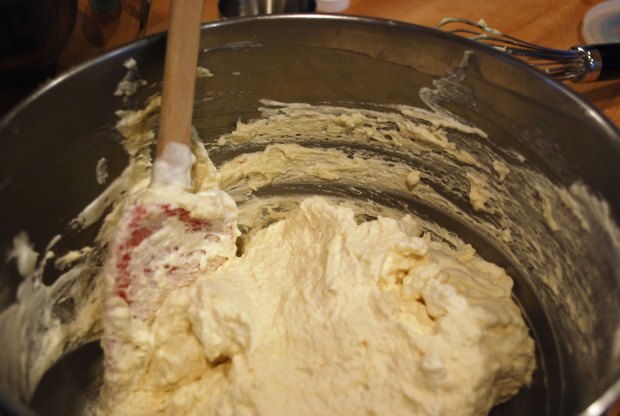
Tiramisu Cake

Tiramisu Cake

Since I started food blogging, I have participated in a group called “The Barefoot Bloggers.”  The idea was a good one — every other week a different participant chose a recipe from one of Ina Garten’s cookbooks and the group would all post on the same recipe.  I loved being able to read how all of the creative home cooks out there altered the recipes to suit their tastes, their available ingredients, or their equipment limitations.  It’s amazing to see how many variations on spaghetti and meatballs are possible!

cake-in-pans

Yet, a week before my honeymoon, I pointed out to the group organizer that of the 200 or so participants, only about 3/4 of them were actually posting to their blogs on a regular basis, let alone posting on the group recipe as was “required”.  I thought it really took away from the experience if you tried to click each link on the blogroll and only slightly more than half had actually participated in the bi-weekly recipe challenge.  Not too long after that email, I was unceremoniously cut from the group, along with a fair amount of others.  Having only missed one or two weeks over the 6 months I’d been a member, I found the decision to cut me spiteful… but I digress.

cake-filling-2

A far more exclusive “cooking the book” group is the Tuesdays with Dorie contingent.  Now these ladies are diligent.  Well-organized, fun, and committed, this group is one to emulate.  Since they are not taking any new members, I am forced to do just that.  I love reading their weekly adventures in shortbread, pies, and cakes (oh, the cakes!) as they cook their way through Dorie Greenspan’s Baking: From My Home to Yours.  This week, I was unavoidably compelled to tag along.  The recipe, chosen by Megan of My Baking Adventures, is Tiramisu Cake.  I LOVE Tiramisu.  Tiramisu cake was my wedding cake (there’s a 6 inch cake top in my parents’ fridge right now, in fact) since it was a perfect compromise between chocolate (RJ’s favorite but somehow kinda morbid for a wedding — am I crazy?) and the traditional but boring and tasteless white cake.
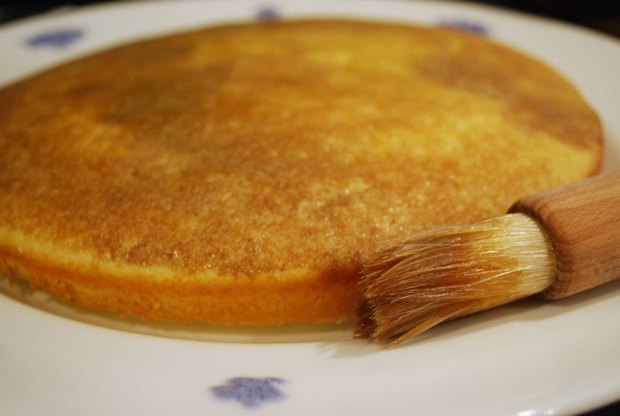
Cake liqueur soaked

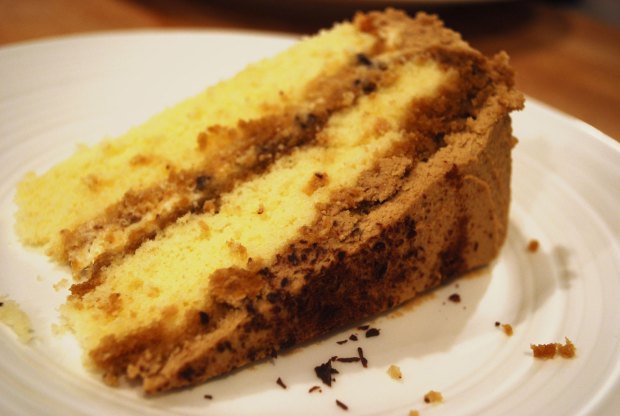
So, this week, I played along.  Though I’m not on the official blogroll, making this cake and eating it was rewarding enough!  RJ called it “decadent and scrumptious” (with only a modicum of sarcasm over the literary language of food writing).  I thought it was very good, though the multiple steps and extended effort made me ask more than once “why aren’t I making real tiramisu?”   The cake was certainly delicious, with a tight crumb and a perfect balance of the ascerbic coffee, the slight booziness of the alcohol, and the sweetness of the creamy filling.  I doubted the balance at first and did not use all of the “espresso syrup” suggested in the recipe, and I regret that — going forward I will trust in Dorie!

Check out the recipe by visiting Megan, at My Baking Adventures.

Tiramisu Cake Slice

Zucchini-Tomato Gratin

Tomato & Zucchini Vegetable Gratin

Well, she’s got another winner.  I am so very glad that I instituted the “Cookbook Challenge” um, for myself, because before this week I hadn’t picked up Patricia Wells’ The Paris Cookbook in many, many years except to hunt down restaurant recommendations.  What a great resource it is!  Despite its major failing, the utter lack of food porn, each of the three recipes I made this week has been absolutely delicious.  From the earthy, layered flavors of the lentil salad to the creamy texture of the cheesy polenta to this newest revelation – a bright, fresh-tasting gratin – Patricia Wells has not disappointed me yet.

gratin-1

When I generally think of gratins, my mind’s eye sees a heavy spoonful of stacked sliced potatoes oozing cream and dragging strings of elastic cheese from the serving dish.  It is a lovely picture, indeed, yet the subject of today’s post is rather the opposite in terms of the key words “heavy”, “oozing”, and “cream”.  Thankfully, the cheese remains, standing alone as it were, to defend the moniker “gratin”.

gratin-2

The internet reveals a bit of a controversy over the exact definition of a gratin.  Some define the term as “A top crust consisting of browned crumbs and butter, often with grated cheese”, and others deny the primacy of the bread crumbs, defining au gratin as “any dish having a lightly browned, crisp crust on top, esp. one topped with bread crumbs or grated cheese and broiled briefly.”  About.com gives an explanation for the discrepancy: “In English, au gratin usually means ‘with cheese,’ whereas in French it’s more like ‘baked dish with crusty top.'”  Anecdotal evidence on the same site verifies that this crust may be composed of any number of alchemic reactions: “According a French friend of mine, le gratin dauphinois, aka pommes de terre dauphinoises, should never include cheese. The real thing is made with potatoes baked in a simple béchamel sauce or a mix of milk and cream which cooks away and leaves the impression of a kind of cheesy sauce.”

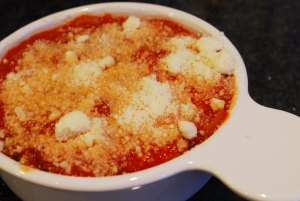
gratin-3Whatever your definition of gratin, I would argue that cheese-on-top is never a bad call.  This dish uses Parmigiano-Reggiano to create a bubbling, browned surface layer that belies the vibrant, clean flavors beneath.  Since Patricia is such a stickler for “very good” and “fresh” and “the best you can find” ingredients throughout her book, I felt it would be a failure to do anything less than OBEY on this first Cookbook Challenge.  Thus, I used day-old sourdough bread from a local bakery, San Marzano canned tomatoes, and authentic Parmigiano-Reggiano from my favorite cheese shop.  I can’t tell you if it made a difference, since I’ll never make it any other way – this was really really good.  I’ll also never look at the word ‘gratin’ with such a narrow mind – it seems that the possibilities for layering, binding, and topping this shallow-dish creation are truly infinite.  Just don’t forget the crust…
gratin-5

Richard-Lenoir Market Zucchini-Tomato Gratin, from Patricia Wells’ The Paris Cookbook
(4 Servings)

1/3 c. fresh breadcrumbs
1 lb. small fresh zucchini, scrubbed and cut into thin rounds
fine sea salt to taste
12 zucchini blossoms (optional)
2 c. Tomato Sauce (see below recipe)
1 c freshly grated Parmigiano-Reggiano cheese

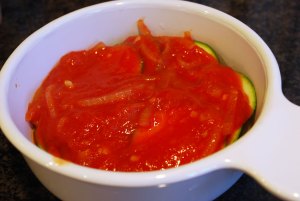
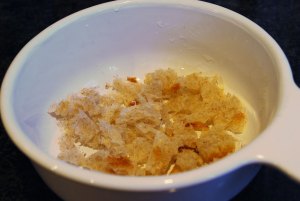
Preheat the oven to 450 degrees F. In a 1-quart gratin dish, layer half of the bread crumbs, half of the zucchini, a fine sprinkling of sea salt, half of the zucchini blossoms, if using, and half of the tomato sauce. Continue with the remaining bread crumbs, half of the cheese, the remaining zucchini, a fine sprinkling of sea salt, the remaining blossoms, if using, the remaining tomato sauce and the remaining cheese.

Place the dish in the center of the oven and bake until the gratin is bubbling and crisp, 20 to 25 minutes. Serve warm or at room temperature.

gratin-9

Tomato Sauce (makes 3 cups)

4 Tbs. extra-virgin olive oil
1 small onion, peeled and sliced
2 plump, fresh cloves garlic, peeled and minced
sea salt to taste
Two 28-oz. cans peeled tomatoes in their juice
1 bouquet garni: several sprigs of fresh parsley, several bay leaves, and several celery leaves, tied in a bundle with cotton string

In a large skillet, heat the oil, onions, garlic, and salt over moderate heat. Cook just until the onions are soft and translucent, 3 to 4 minutes. Place a food mill over the skillet and puree the tomatoes directly into the pan. Add the bouquet garni and stir to blend. Simmer, uncovered, until the sauce is thickened, about 15 minutes. Taste for seasoning. Remove and discard the bouquet garni. The sauce may be used immediately, stored in the refrigerator for up to 2 days, or frozen for up to 3 months.

Polenta of the gods

Polenta

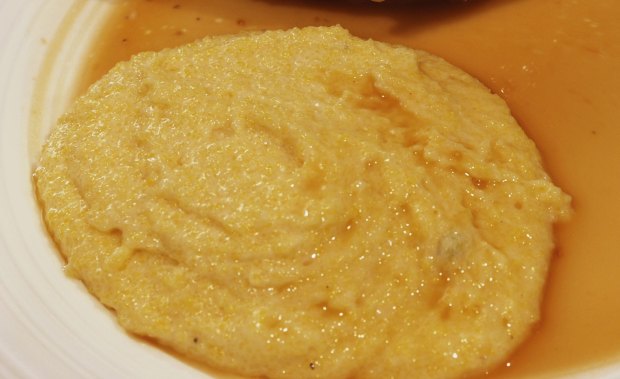
To spare you another dissertation on why I love Patricia Wells’ The Paris Cookbook, I will instead refer you to my first post on the book, and get right to the heart of the matter.  This polenta is sinfully, sinfully delicious.  Why then do I call it “polenta of the gods” rather than “Satan’s cornmeal”?  Because this is a dish I would think is a staple on heaven’s divine menu.  It is laden with rich cheeses and luxuriously melts in your mouth.  The reduced chicken stock, provided you use real, homemade, quality stuff, is the perfect flourish — adding both depth of flavor and visual interest to a side dish that often goes overlooked.

Easy Polenta RJ and I served this with a simple pan-roasted chicken breast and these caramelized shallots and it was all divine.  I can see this as a special occasion side dish (too rich for every day, but quick and easy enough to do on a weeknight for guests) to accompany braised meats, or with a mix grill of sorts.  Just be warned about two things: 1) this is not a light and airy side dish – it is silky smooth but also dense with cheese and 2) use the best ingredients you can find – homemade chicken stock (or really good store-bought) and artisinal cheese such as Abbaye de Bel’loc or good Manchego since this is a simple and straightforward dish, the quality of the parts equal the quality of the whole.

Helene’s “Polenta” with Sheep’s Milk Cheese, from Patricia Wells’ The Paris Cookbook
(Yield 4 servings)

3 2/3 c. Homemade Chicken Stock, or more as needed
3/4 c. corn flour or fine-grain yellow cornmeal
7 oz. French Basque sheep’s milk cheese, freshly grated (2 1/2 cups)
8 oz. mascarpone cheese

Reduce the chicken stock: in a 6-quart saucepan, bring 2 cups of the stock to a boil over high heat. (Make sure you use a large saucepan, to prevent the stock from boiling over.) Boil until the mixture is thick and syrupy, reduced to about 1/2 cup, 10 to 12 minutes. Transfer the liquid to the top of a double boiler, set it over simmering water, cover, and keep warm.

In a large, heavy saucepan, combine the cornmeal and the remaining 1 2/3 cups chicken stock. Stir with a wooden spoon to blend. Cook the mixture over high heat, stirring, until it is thickened and leaves the side of the pan as it is stirred, about 2 minutes. Reduce the heat to low, add both cheeses, and stir to blend. Cook, stirring to melt the cheeses and thoroughly combine the mixture, about 2 minutes more. The mixture should be soft and pourable. (If it is not, thin it out with additional chicken stock.)

Pour the mixture into warmed shallow soup bowls. Drizzle with the reduced chicken stock, and serve.
Polenta plated