The Ultimate Feast

Pig Kahuna

Speaking of birthday dinners, as I did in my last post, we just had another birthday around here and boy, was it a biggie!  RJ turned 30 this past weekend, and what did I get my dear husband who eats nothing but meat?  A pig roast!  To be specific, 62 pounds of dressed pork, turning slowly over a low charcoal fire for over 6 hours.

Words can hardly express how phenomenal the entire experience was. RJ had no idea what I had been planning for the past 3 months, and with some wonderful subterfuge his friends and I managed to get him to his mother’s beach house with narry a clue!  His face as he came in the driveway was priceless — astonishment, pleasure and a bit of embarrassment at the number of people we gathered together for the big day.

Though the span of the afternoon is a story in itself — torrential downpours, epic tournament of cornhole, and finally fireworks on the beach — for the purposes of the food blog I’ll stick to the pig.

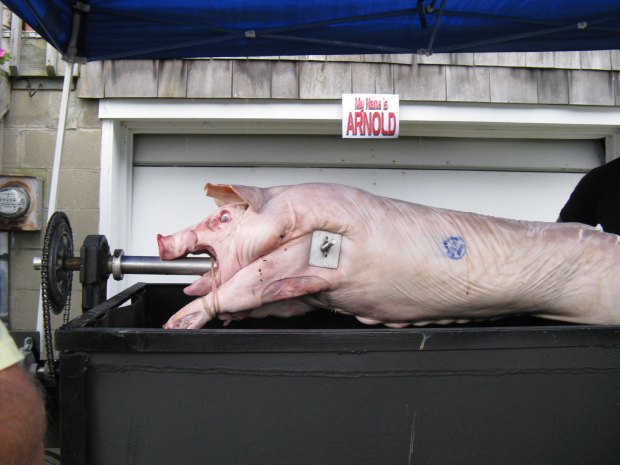
The pig arrived at around 2 o’clock, dressed (meaning that her internal organs had been removed).  Dave, of The Pig Kahuna, rinsed her thoroughly with fresh water, and inserted the rotisserie spit into the mouth and out the…uh…well, use your imagination.  A couple extra rods were inserted laterally for stability as well — and the pig doesn’t look happy about it!  The final preparation step was to sew her back together and to tie her legs around the spit.

pig-prep

The “Oinkmaster 8000”, Dave’s glorious roasting contraption, was loaded with charcoal and lit.  We waited until the coals were at a low burn, measured only by feel.  Dave said that if he couldn’t hold his hand over the fire at the level of the pig for 6 seconds, then the coals were too hot.  Soon, dear Arnold (our name for the pig, which soon became Arnoldine when we found out she was a Miss Piggy) was mounted on the rotisserie and began her slow roasting.
pig-fresh-on-spit

For the six hours she turned, the pig was regularly spritzed with white vinegar.  Though Dave has experimented with cider vinegar and even balsamic, he has found that 6 hours of cooking makes cider vinegar bitter and balsamic vinegar black.  After an hour and a half on the spit, Arnoldine began to self-baste, releasing delicious juices that dripped down over her shoulders and legs.

Pig-2-hour

In three hours, her skin started to get golden, and we watched as it bubbled over the heat of the coals.  With more time, the leg joints began to loosen and the skin split in several places — the beginnings of tenderization.  Somewhere around 4 1/2 or 5 hours in, my brother dared my sister to eat one of the eyeballs, and she did.  She advised that the pig needed more time…

Jes

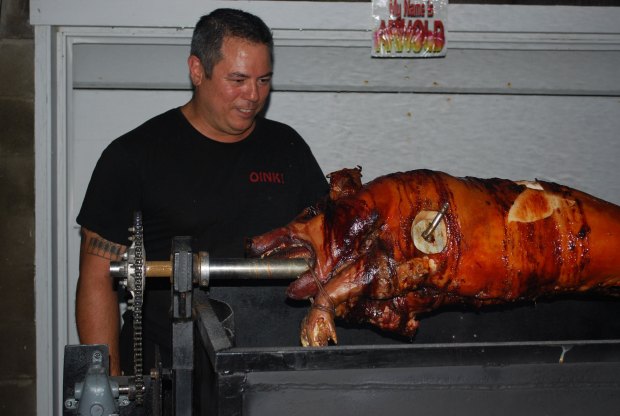
Finally, after six hours, Dave began the final process — the trick to a perfect roast pig.  The motor that had kept Arnoldine on a steady rotation was stopped and the crowds gathered around to watch Dave crisp the skin.  He added more charcoal to the fire and the flames began to rise up a couple inches from the coals.  Making quarter-turns of the spit, he let each side of the pig sit over the fire for a decent interval.  We saw the skin crisping and crackling, with the juices dripping into the fire creating an atmospheric hiss for the dramatic final moments.
Pig Roast

When the pork ready to serve, Dave asked RJ to aid in the dismounting.  They each took one end of the spit in their bare hands (the low heat left the ends of the spit at only 75 degrees or so), and moved a mahogany-toned Arnoldine to the serving table.  Freed of her metal trappings, the pig nearly fell into perfect serving pieces right in front of us.  Dave offered us bites of the tenderloin (smoky from the more direct fire), the shoulder (nearly white and completely juicy), and the belly (from whence the bacon comes…) to compare the various cuts.  We also sampled the pig skin, which crunched like savory candy.  By now, the crowds were getting rowdy, and everybody’s mouths were watering.

The pork was delectable — succulent and rich when unadorned, and tangy and spicy when doused with Dave’s special barbecue sauce.  Though we had about 65 guests, the pig carried over into lunch for 10 the next day.  As the birthday boy’s wife and party hostess, I was also designated the “keeper of the head”.  Those in the know, Dave said, always go for the pig cheeks — I guess now I’m in the know!  I think I gave my mother-in-law a heart attack, however, when she opened the fridge to find a whole pig’s head staring out at her (with one eye, no less).
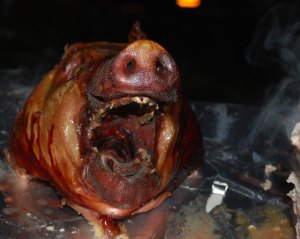
pig-head

All I can say is “wow”.  RJ had a wonderful birthday, complete with (an excess of) meat on a stick, and all of our guests enjoyed watching Arnoldine turn and learning from Dave, the Pig Kahuna himself.  The question is, what can top RJ’s 30th birthday when he turns 40?  Perhaps we’ll have to look into a cow…

Pig-finished-on-spit

A New Show in Town

Pizza Romana

I wonder how many people out there are like me: when my birthday comes around (or within 4 months…) my mind immediately turns to restaurants.  Rather than thinking about holes in my summer wardrobe or dropping hints about my need for a new iPod, I go online and search for the location of my birthday dinner.  This year, while I was well underway with making my June 22nd reservation, my husband pre-empted me with a surprise the week before — a dinner and birthday gift rolled up into one.

He took me, and two friends, to Stir — Barbara Lynch’s new venture in the South End.  Not only did we eat a great meal, but we watched it being cooked in front of us by two of Ms. Lynch’s skilled chefs.  The concept is straightforward and brilliant: each class is based on a different cookbook, selected from one of the many stacked on the bookshelves on one wall of the cozy kitchen.  Two talents from the Barbara Lynch Gruppo choose 3 or more recipes from the cookbook to demonstrate and serve to the guests, who number no greater than nine.  My birthday dinner, based on The River Cottage Meat Book, consisted of french fries, charcuterie (cured meats, salami, and pork rillettes), sweetbreads with bacon and fava beans, and crispy pork belly with apple sauce.  It was not to be believed.  Of course, the entire meal is paired with excellent wines by the course, and a copy of the cookbook is yours to keep.  I left Stir that night with a smile from ear to ear and a book called Meat under my arm.
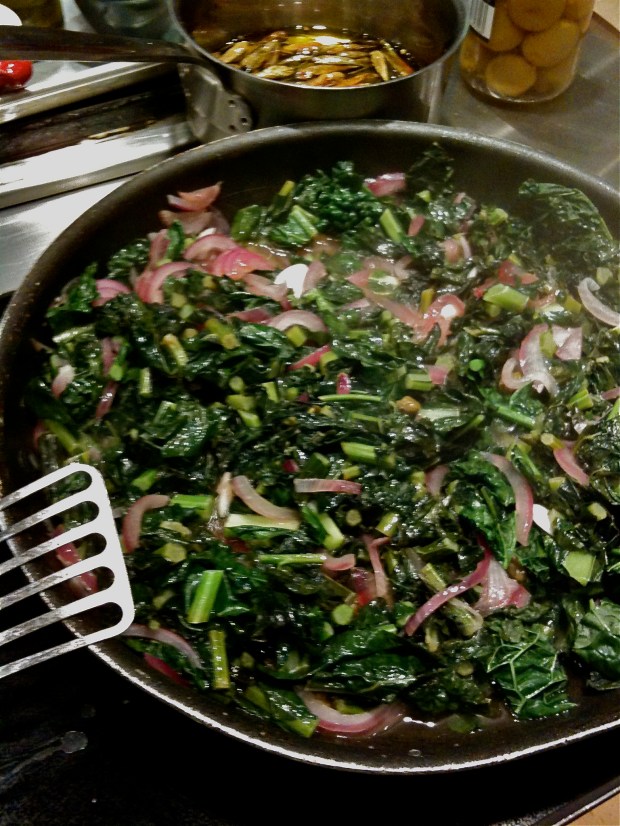
Kale

My mother’s birthday followed closely behind mine, and I borrowed RJ’s wonderful idea.  For Mom, the cookbook du jour was A16: Food + Wine, named for the famed San Francisco restaurant.  Nate Appleman, the chef/owner of A16, was recently named Rising Star Chef of the Year by the James Beard Foundation and ranked as one of Food and Wine Magazine’s Best New Chefs 2009.  The featured recipes included pizzas (bianco – with green olives, parmesan and chili oil; Romana – with tomatoes, anchovies and oregano; and margherita – with mozzarella, basil and tomatoes); halibut with a preserved meyer lemon, caper and pistachio crust and a side of delicious kale; and chocolate budino, the most heavenly chocolate-on-chocolate tart I’ve ever tasted, topped with olive oil and sea salt.

Halibut

What is so lovely about Stir is that it feels like a dinner party among friends.  They only allow 8-9 people at a time, and the chefs encourage questions and dialogue as they cook their way through the menu.  Of the people around the table at my mom’s birthday dinner, half were repeat attendees (one guy was on his fourth visit) and the rest was my family.  It felt very familiar and casual, despite the decadent food and wine.

There’s also a tactile element I really enjoy – at my first Stir experience they passed around raw pork belly so we could feel the skin before the cooking process made it crunchy like candy, and the other night we handled pizza dough at different stages of rise so we could understand the results of proofing and kneading.

IMG_0024Best of all, however, is the staff.  In June, we met Molly, the executive sous chef at Stir, and Jericha, one of the butchers at the Butcher Shop.  This month, Molly was again regaling us with her fun tales of culinary school but stationed just to my left was none other than Barbara Lynch!   I can’t tell you what a treat it was to watch and learn from this master chef.  She forced the elastic pizza dough into submission, loosed handfuls of kosher salt with abandon, and divulged some of her favorite places to eat in Boston/Cambridge: Oleana, Hungry Mother, and Sel de la Terre (plus Cambridge One and Upper Crust for pizza).  Personally, I must confess that my favorite place to eat in Boston is Stir.  The experience is unique, unpredictable, and fun – it would be perfect for a first date if it weren’t so gosh darn expensive.  While you’re saving up, however, consider buying the book, due out in the fall, to tide you over: STIR: Mixing It Up in the Italian Tradition.  While I haven’t seen it, I would bet the farm that it is fabulous, and will be appearing soon on the shelves at my house.
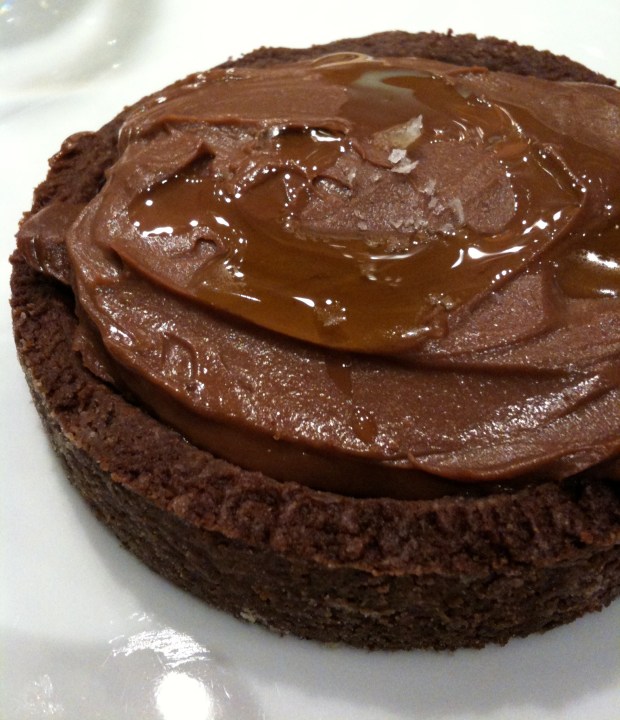
Chocolate Budino

Summer Lovin’ Crostata

crostataBefore I ever started writing a food blog, I was reading food blogs.  Many, many of them.  My favorites are listed on the right-hand side of this page — those are the ones I wholeheartedly endorse.  I do so because I can count on each of them, albeit for different things.  When I need to know what to cook for RJ (and am unconcerned about calorie intake), I visit the Pioneer Woman.  When I am feeling healthy and adventurous, I’ll often check in with Molly.  And when I’m in the mood to dream of Paris, I click into Clothilde’s site.  Other blogs I read daily, because they post frequently and because they provide not only recipes but also reviews, interesting links, and unique perspectives.  One of these is Adam’s Amateur Gourmet site.
Adam is a reliable and lovable source, especially because he is so straightforward about his ‘amateur’ status.  His pictures aren’t pristine like Deb’s, and he doesn’t have pastry chef credentials like David.  But he’s witty (see his comic strip posts) and unpretentious (he did a post about the books in the Momofuku Ko bathroom) and he makes a mean pork roast.  What else could you want in a daily pick-me-up read?

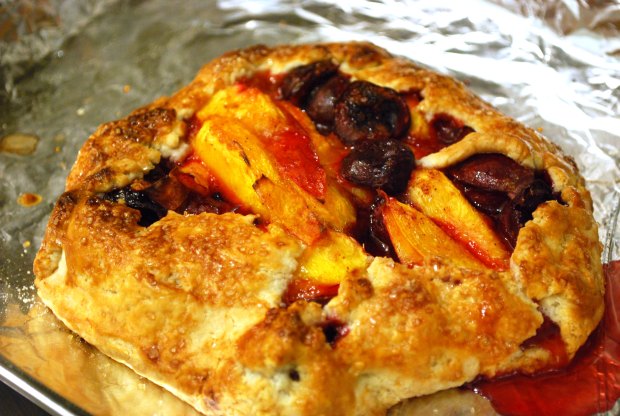
Anyway, I mention Adam because he hasn’t steered me wrong yet (though I’ll admit I haven’t gone up every alley he recommends: Janet Jackson Breast Cupcakes, anyone?).  His roasted broccoli (via Ina Garten) is a life-changer, and he has given me many a fine cookbook recommendation, thus feeding my addiction.  So when he suggested, nay, ordered me to go Crostata Crazy, I did.  I cut up some nectarines and pitted some cherries and while I intended to cheat on the pie crust and use Pillsbury, circumstances (read: Whole Foods is not actually a supermarket) forced me to make my own and I’m glad I did.  All the work was done by my Cuisinart — all I had to do was measure 4 or 5 pantry ingredients, pulse, then roll out the dough after a half hour in the fridge.  The results?  Impressive, to say the least, and bursting with summer flavors.  A quarter of the recipe below makes a crostata for two.  Make the whole batch to have pie dough on hand for the next time and a dessert for six on the table in an hour.

crostata with summer cherriesCherry and Nectarine Crostata, adapted from Napa Style’s Michael Chiarello via Amateur Gourmet
(Serves 6)

Tart Dough:
2 1/2 cups unbleached all-purpose flour
2 tablespoons granulated sugar
2 teaspoons salt
1 cup (1/2 pound) chilled unsalted butter, cut into tablespoon-size pieces
1/4 cup ice water, or more if needed
1 teaspoon pure vanilla extract

Filling:
4 cups of fruit of your favorite combination: pitted fresh cherries, sliced nectarines, berries, apples, diced rhubarb, etc.
1/4 cup granulated sugar (adjust to your taste and the type of fruits used)
1 tablespoon unbleached all-purpose flour
1/4 teaspoon ground cinnamon
1/4 teaspoon salt

1 egg yolk beaten for egg wash
2 teaspoons coarse sugar (like Sugar in the Raw)
Directions
Make the tart dough: Combine the flour, sugar, and salt in a food processor and pulse to blend. Add the butter and pulse until the mixture forms coarse crumbs. Stir together the 1/4 cup ice water and the vanilla; sprinkle the water over the mixture in the processor and pulse just until a dough forms, adding a little extra ice water if necessary. Divide the dough in half, and shape each half into a 1-inch-thick round. Wrap 1 disk tightly in plastic wrap and refrigerate for at least 1 hour; freeze the other for a future use.

Put a pizza stone in the oven and preheat the oven to 425ºF for 45 minutes. Remove the dough from the refrigerator about 15 minutes before rolling to soften it slightly.

Place the dough round between 2 sheets of parchment paper and roll into a 13-inch round, flouring the round lightly as needed to keep the dough from sticking. Remove the top sheet of parchment. Slide a pizza peel or rimless baking sheet under the bottom sheet of parchment.

Make the filling: Combine the fruit, sugar, flour, cinnamon, and salt in a bowl and toss well. Fill the center of the dough round with the fruit in an even layer, leaving a border of about 1 1/2 inches. Fold the border up and over the fruit to make a rim. Brush the rim with egg wash, then sprinkle with coarse sugar. Trim the excess parchment with scissors.

Use the pizza peel or baking sheet to transfer the crostata, still with parchment underneath, to the oven, sliding it, with the paper, directly onto the pizza stone. Bake until the crust is nicely browned and the cherries are bubbling, about 40 minutes. Remove from the oven with the peel or baking sheet and let cool on a rack for 15 minutes before serving. Serve warm.

Duck Lasagna Strapazatta

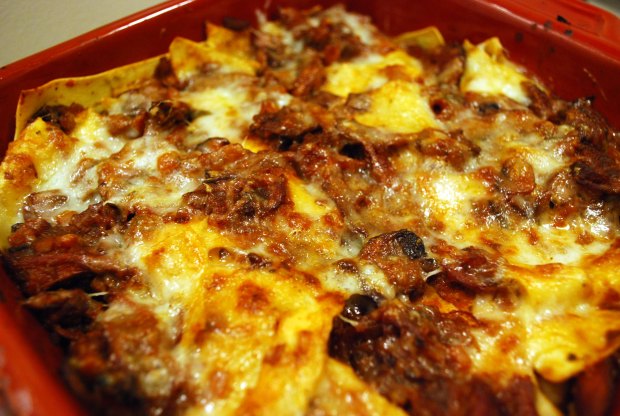
Duck Lasagna

The final recipe I tested for my Cookbook Challenge review of the Sweet Basil Cookbook was Duck Lasagna Strapazatta.  I picture many readers saying to themselves: “Duck – check.  Lasagna – check.  Strapa-wha?”  In general, I try not to go into long, pedantic descriptions of certain foods, as both the well-informed and the uninterested among us might yawn at a recounting of the conflicts over the definitive elements of cassoulet or the supposed aphrodisiacal properties of oysters. Yet strapazatta is not a term you come across frequently, and even my Google searches neglected to produce a consensus on the definition.

From what I gather, strapazatta literally translates to “bungled” in Italian and is used in cooking to refer to ‘free-form’ dishes.  I am copying the spelling directly from the cookbook, though online another recipe title often pops up: uova strapazzate, or scrambled eggs.  It seems likely that strapazatta is an Americanization of the word strapazzate and that the general concept is a stirred-up, rustic preparation — here, of lasagna (also known as lasagne: further proof of my theory).

So much for avoiding long-winded explanations…  To keep the rest brief: I liked this, I didn’t love it.  I think the best translation based on what I put on the table was the first: “bungled”.  The port made the sauce quite sweet, and it neglected the strong savory component (oregano? more fontina?) to counter it.  In addition, the noodles refused to cooperate — the short lasagna pieces didn’t separate well and I ended up having to place them in the dish in rows, much as I would have with whole lasagna noodles.  The texture was phenomenal, however, with the pleasing contrast of rough shredded duck, sheets of smooth pasta, and crusty cheese topping.  If I hadn’t been following the recipe so closely, for the purposes of a proper review of the cookbook, I might have thinned out the sauce with some beef stock and added a couple of savory herbs to finish.  All told, however, the ragu had real merit as a concept — it just needed a few tweaks and a different pasta to top.

Duck Lasagna Strapazatta, from the Sweet Basil Cookbook [Printable Recipe]
(serves 4 to 6)

4 duck confit legs

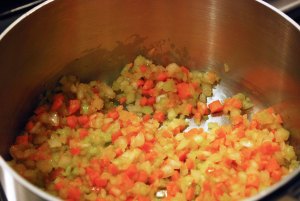
mirepoix2 Tablespoons olive oil
1 carrot, peeled and diced (about 1 cup)
1 Spanish onion, diced (about 1 cup)
2 stalks celery, diced (about 1 cup)
2 cloves garlic, minced (about 2 Tbs.)
10 white mushrooms, quartered (about 2 cups)
2 large portobello mushrooms, stemmed and sliced into 1/2 inch wide strips
1 Tbs. dried porcini mushrooms
2 cups port wine
1 bay leaf
1 tsp. chopped fresh sage
2 Tbs. Worcestershire sauce
1 cup red sauce (use your favorite marinara sauce or follow the recipe below)

Fresh pasta sheets, cut into 3-inch wide strips
2 cups grated fontina cheese

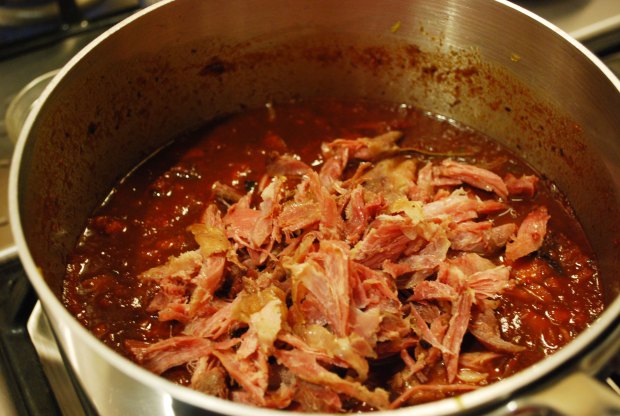
In a large saucepan, heat the olive oil over moderate heat. Add the carrot, onion and celery. Saute the mixture for 5 to 10 minutes, until the ingredients begin to brown. Add the garlic and the white and portobello mushrooms. Continue sauteing for 5 more minutes, until the ingredients begin to caramelize. Add the dried porcini mushrooms, port, bay leaf, and sage. Bring the mixture to a boil, and then add the Worcestershire sauce and the red sauce. Decrease the heat and allow the sauce to stew for 8 to 10 minutes, until all of the flavors have had a chance to get acquainted. Stir the duck in with the sauce and remove from the heat.

Duck_RaguMeanwhile, in a large pot, bring 6 quarts of water to a boil. Add a pinch of salt and the pasta, stirring it to keep from sticking. Cook for 1 minute, or until al dente [I used no-boil lasagna noodles and 2 minutes of boiling softened them up, though I would recommend serving this over penne rigate or rigatoni or even pappardelle — adjust cook time accodingly]. Drain thoroughly.
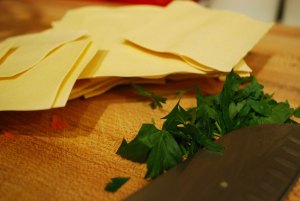
Duck_pastaStir the cooked pasta in with the sauce. Transfer the pasta and sauce to a large casserole dish, sprinkle with the fontina, and bake in the oven [at 350 degrees] until the cheese is bubbling. Serve garnished with parsley.

P.S. — the cookbook also suggests that subbing in sliced eggplant for the duck would make a lovely vegetarian version.

duck lasagna