
Now, that’s more like it! Beautiful, flaky croissants – some filled with chocolate or ham and cheese, and others simply plain – all smelling exactly like a French patisserie. I am immensely proud of the three day creation that is pictured above. Apparently, when chocolate and pastry are involved, my wariness over cholesterol and saturated fat completely dissipates. Perhaps I should give up my prejudice towards the bacon explosion and those who love it, and admit that everyone has the right to choose his or her own vices.
While – as you can see – the results above look quite scrumptious, I still question whether they worth the three days of dough making, dough-rolling, and dough manipulating. The fact that I had the time and the patience to wait for these treats is “I Cannot Believe I Did That, Volume 2”. We’ll get to Volume 3 after I detail for you the laborious weekend process:
Step 1 — Make the dough by mixing yeast, flour, water, milk, sugar and a bit of butter with your electric mixer dough hook so that it goes from this:
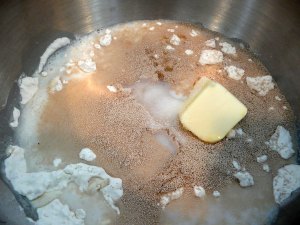 to this:
 The dough was extraordinarily stiff at this point, which worried me, but I haven’t yet gotten to the adding tons and tons of butter stage, so stiffness is to be expected. The dough rested like this for 8 hours until I took up the butter. As it turns out, I did not do all of my homework ahead of time, and found out I was a half-stick short of the needed unsalted butter, so I substituted some salted butter (the yellower, softer stuff on the bottom). I also was out of parchment paper, so used two of my non-stick plastic cutting board mats to pound the sliced butter into a proper butter square:

And then placed it in the middle of my rolled-out square dough, and folded up the dough around the butter, like an envelope:

Then there was a LOT of rolling and folding, rolling and folding, with the purpose of incorporating many thin layers of butter into the dough to create the pockets of air and the chewy texture of the pastry, upon baking. Fast forward to day 3:
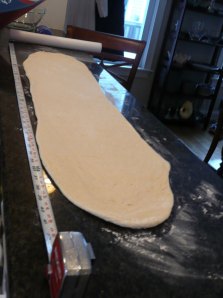 The above is a picture of me “waking up the dough”, whereby I tried desperately to roll the dough out as long as possible, without widening it too much. The only counter in my kitchen long enough to accommodate this ‘wakened’ dough was the bar-height counter that passes over from the kitchen to the dining room. So I was standing on tip-toes and twisting my upper body in strange directions to complete this step! Finally, however, I was able to reach the required length, and then I cut notches to divide the dough for the croissants (please ignore the messy dining room table!!):
 I rolled up the croissants as directed, and set them on baking sheets lined (again) with my non-stick plastic cutting board mats, since I still had not had a chance to get to the store for parchment paper. No matter, these babies needed to proof for 2 hours:
 Once the croissants had expanded and seemed ready to go, I baked them for the required time, switching the trays from top rack to bottom rack and vice versa, once in the middle of the cooking time. I made chocolate ones:
 and some ham and cheddar ones, just to see what they’d be like:
 The results were quite impressive! Flaky with butter, and a browned exterior that rivaled the products of the finest French pastry chefs! So, I cannot believe I did it – three days, and a couple of strained biceps, later, I had a slew of fresh croissants that I made all by myself.
Now, for “I Cannot Believe I Did That, Volume 3” — my shame, and my sorrow, and the reason that I truly resent all of the incredible time and effort that went into making these croissants. The lesson we should learn from ‘Volume 3’ is a simple one: don’t forget to purchase all required ingredients and supplies before starting a recipe. As a corollary to that rule, do NOT attempt to substitute plastic sheets for parchment paper in all applications:
 I CANNOT BELIEVE I DID THAT!!!
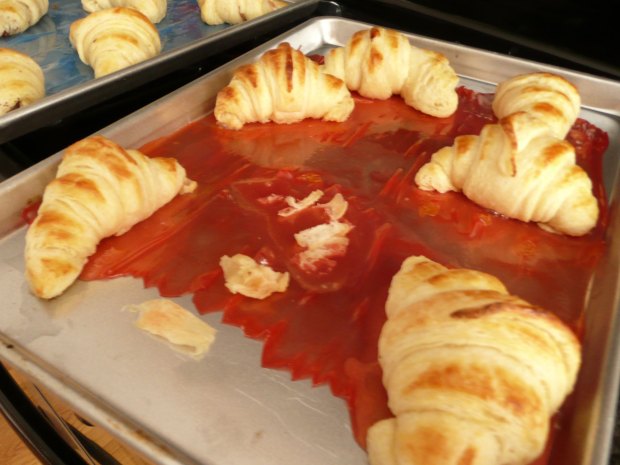 Yes – I put the plastic sheets in the oven, completely forgetting that I had used them to proof the croissants, and that I had not replaced them with parchment paper. Needless to say, we didn’t actually get to enjoy these bad boys. I sampled a bite or two of pastry off the top, but ended up so afraid that I would kill myself and my husband if we ate the melted plastic that I eventually threw them all out. Sad… But don’t let this stop you from giving this recipe a go! For some great tips, check out Fine Cooking’s website.
Classic Croissants, by Jeffrey Hamelman in Fine Cooking Issue #97
(Yields 15)
For the dough:
1 lb. 2 oz. (4 cups) unbleached all-purpose flour; more for rolling
5 oz. (1/2cup plus 2 Tbs.) cold water
5 oz. (1/2 cup plus 2 Tbs.) cold whole milk
2 oz. (1/4 cup plus 2 Tbs.) granulated sugar
1-1/2 oz. (3 Tbs.) soft unsalted butter
1 Tbs. plus scant 1/2 tsp. instant yeast
2-1/4 tsp. table salt
For the butter layer
10 oz. (1-1/4 cups) cold unsalted butter
For the egg wash
1 large egg
Make the dough
Combine all of the dough ingredients in the bowl of a stand mixer fitted with the dough hook. Mix on low speed for 3 minutes, scraping the sides of the mixing bowl once if necessary. Mix on medium speed for 3 minutes. Transfer the dough to a lightly floured 10-inch pie pan or a dinner plate. Lightly flour the top of the dough and wrap well with plastic so it doesn’t dry out. Refrigerate overnight.
Make the butter layer
The next day, cut the cold butter lengthwise into 1/2-inch-thick slabs. Arrange the pieces on a piece of parchment or waxed paper to form a 5- to 6-inch square, cutting the butter crosswise as necessary to fit. Top with another piece of parchment or waxed paper. With a rolling pin, pound the butter with light, even strokes. As the pieces begin to adhere, use more force. Pound the butter until it’s about 7-1/2 inches square and then trim the edges of the butter. Put the trimmings on top of the square and pound them in lightly with the rolling pin. Refrigerate while you roll out the dough.
Laminate the dough
Unwrap and lay the dough on a lightly floured work surface. Roll into a 10-1/2-inch square. Brush excess flour off the dough. Remove the butter from the refrigerator—it should be pliable but cold. If not, refrigerate a bit longer. Unwrap and place the butter on the dough so that the points of the butter square are centered along the sides of the dough. Fold one flap of dough over the butter toward you, stretching it slightly so that the point just reaches the center of the butter. Repeat with the other flaps . Then press the edges together to completely seal the butter inside the dough. (A complete seal ensures butter won’t escape.)
Lightly flour the top and bottom of the dough. With the rolling pin, firmly press the dough to elongate it slightly and then begin rolling instead of pressing, focusing on lengthening rather than widening the dough and keeping the edges straight.
Roll the dough until it’s 8 by 24 inches. If the ends lose their square shape, gently reshape the corners with your hands. Brush any flour off the dough. Pick up one short end of the dough and fold it back over the dough, leaving one-third of the other end of dough exposed. Brush the flour off and then fold the exposed dough over the folded side. Put the dough on a baking sheet, cover with plastic wrap, and freeze for 20 minutes to relax and chill the dough.
Repeat the rolling and folding, this time rolling in the direction of the two open ends until the dough is about 8 by 24 inches. Fold the dough in thirds again, as shown in the photo above, brushing off excess flour and turning under any rounded edges or short ends with exposed or smeared layers. Cover and freeze for another 20 minutes.
Give the dough a third rolling and folding. Put the dough on the baking sheet and cover with plastic wrap, tucking the plastic under all four sides. Refrigerate overnight.
Divide the dough
The next day, unwrap and lightly flour the top and bottom of the dough. With the rolling pin, “wake the dough up” by pressing firmly along its length—you don’t want to widen the dough but simply begin to lengthen it with these first strokes. Roll the dough into a long and narrow strip, 8 inches by about 44 inches. If the dough sticks as you roll, sprinkle with flour. Once the dough is about half to two-thirds of its final length, it may start to resist rolling and even shrink back. If this happens, fold the dough in thirds, cover, and refrigerate for about 10 minutes; then unfold the dough and finish rolling. Lift the dough an inch or so off the table at its midpoint and allow it to shrink from both sides—this helps prevent the dough from shrinking when it’s cut. Check that there’s enough excess dough on either end to allow you to trim the ends so they’re straight and the strip of dough is 40 inches long. Trim the dough.
Lay a yardstick or tape measure lengthwise along the top of the dough. With a knife, mark the top of the dough at 5-inch intervals along the length (there will be 7 marks in all). Position the yardstick along the bottom of the dough. Make a mark 2-1/2 inches in from the end of the dough. Make marks at 5-inch intervals from this point all along the bottom of the dough. You’ll have 8 marks that fall halfway between the marks at the top.
Make diagonal cuts by positioning the yardstick at the top corner and the first bottom mark. With a knife or pizza wheel, cut the dough along this line. Move the yardstick to the next set of marks and cut. Repeat until you have cut the dough diagonally at the same angle along its entire length—you’ll have made 8 cuts. Now change the angle of the yardstick to connect the other top corner and bottom mark and cut the dough along this line to make triangles. Repeat along the entire length of dough. You’ll end up with 15 triangles and a small scrap of dough at each end.
Shape the croissants
Using a paring knife or a bench knife, make a 1/2- to 3/4-inch-long notch in the center of the short side of each triangle. The notch helps the rolled croissant curl into a crescent. Hold a dough triangle so that the short notched side is on top and gently elongate to about 10 inches without squeezing or compressing the dough—this step results in more layers and loft.
Lay the croissant on the work surface with the notched side closest to you. With one hand on each side of the notch, begin to roll the dough away from you, towards the pointed end.
Flare your hands outward as you roll so that the “legs” become longer. Press down on the dough with enough force to make the layers stick together, but avoid excess compression, which could smear the layers. Roll the dough all the way down its length until the pointed end of the triangle is directly underneath the croissant. Now bend the two legs towards you to form a tight crescent shape and gently press the tips of the legs together (they’ll come apart while proofing but keep their crescent shape).
Shape the remaining croissants in the same manner, arranging them on two large parchment-lined rimmed baking sheets (8 on one pan and 7 on the other). Keep as much space as possible between them, as they will rise during the final proofing and again when baked.
Proof the croissants
Make the egg wash by whisking the egg with 1 tsp. water in a small bowl until very smooth. Lightly brush it on each croissant.
Refrigerate the remaining egg wash (you’ll need it again). Put the croissants in a draft-free spot at 75° to 80°F. Wherever you proof them, be sure the temperature is not so warm that the butter melts out of the dough. They will take 1-1/2 to 2 hours to fully proof. You’ll know they’re ready if you can see the layers of dough when the croissants are viewed from the side, and if you shake the sheets, the croissants will wiggle. Finally, the croissants will be distinctly larger (though not doubled) than they were when first shaped.
Bake the croissants
Shortly before the croissants are fully proofed, position racks in the top and lower thirds of the oven and heat it to 400°F convection, or 425°F conventional. Brush the croissants with egg wash a second time. Put the sheets in the oven. After 10 minutes, rotate the sheets and swap their positions. Continue baking until the bottoms are an even brown, the tops richly browned, and the edges show signs of coloring, another 8 to 10 minutes. If they appear to be darkening too quickly during baking, lower the oven temperature by 10°F. Let cool on baking sheets on racks.
Make ahead tips
The croissants are best served barely warm. However, they reheat very well, so any that are not eaten right away can be reheated within a day or two in a 350°F oven for about 10 minutes. They can also be wrapped in plastic or aluminum foil and frozen for a month or more. Frozen croissants can be thawed overnight prior to reheating or taken from the freezer directly to the oven, in which case they will need a few minutes more to reheat.
variations
Chocolate Croissants: Chop some good-quality bittersweet chocolate and distribute it along the length of the notched end of the dough triangle after you’ve stretched it—use about 1/2 oz. or 1-1/2 Tbs. for each one. Roll it up just like a plain croissant but without stretching out or bending the legs. Proof and bake the same.
Ham and Cheese Croissants: After stretching but before rolling up each croissant, put a thin layer of sliced ham on the dough at the notched end. Tuck it in if it lies more than a little outside the surface of the dough. Put a layer of thinly sliced or grated cheese—good Cheddar or Gruyère is best—on top of the ham. Without stretching or bending the legs, roll the dough tightly. Proof and bake the same.
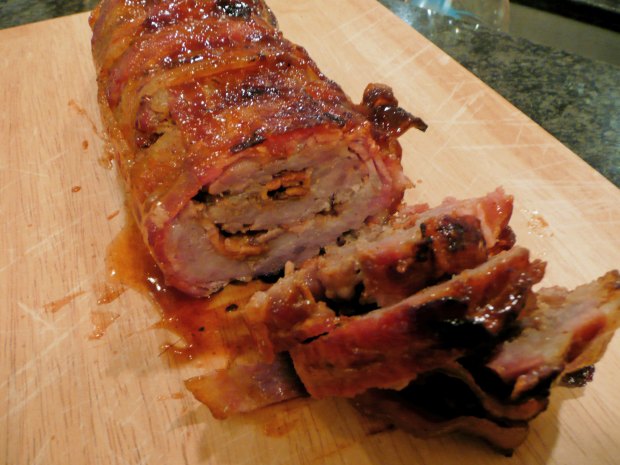
 Next the “recipe” called for a particular brand of barbecue rub (coincidentally, the one the inventors are selling!) so I grabbed one can from a 4-tin spice gift pack which said “pork rib rub” — two out of three ain’t bad! I sprinkled it over the weave. May I interject, at this moment, that I might be more embarrassed to have the above weave in my house than that other kind of weave on my head? Yeah.
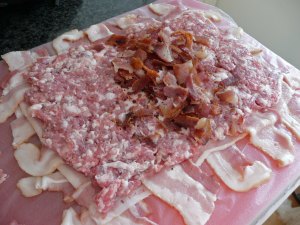 Then more rub and barbecue sauce. Intelligent woman that I am, I began this whole process on a sheet of plastic wrap. Which allowed me to enter a zen state and imagine that I was rolling sushi…
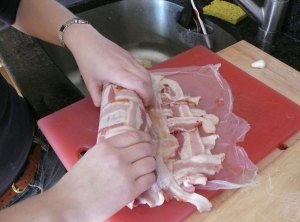 I got a very tight roll this way, and didn’t bacon-up my cutting board too badly. The result looked pretty good, we thought:
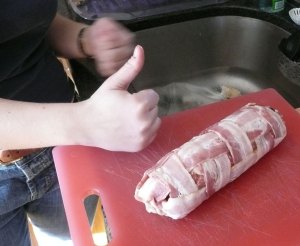 Then we put it in the fridge to keep its shape until the next day, Super Bowl Sunday. Which gave RJ enough time to read through the whole article. He now wanted a smoker. Yes, it can also be baked, but RJ hears grill and starts in with the Tim Allen AR, AR, ARRRR. He ran to Home Depot to buy a smoker box and hickory chips. We ended up with chips from a Jack Daniels barrel. Hey, it worked! After 2 hours, here’s what we ended up with:
 Don’t mind his dopey expression — he’s very VERY excited. Then, we had to glaze the bacon explosion. We chose our absolute favorite barbecue sauce, Cincinnati’s own
 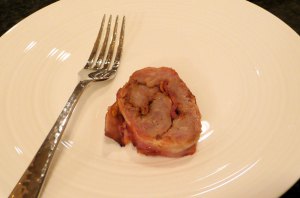 The taste? Well, we decided that we didn’t put enough barbecue sauce inside or enough spice rub on the outside. It basically tasted like pork on pork. Which some people (RJ) like. I had a bite, and it wasn’t bad, but it wasn’t enough to make me to continue to eat the pork-on-pork! Whatever, at least I can say I did it – the BACON EXPLOSION! POW! :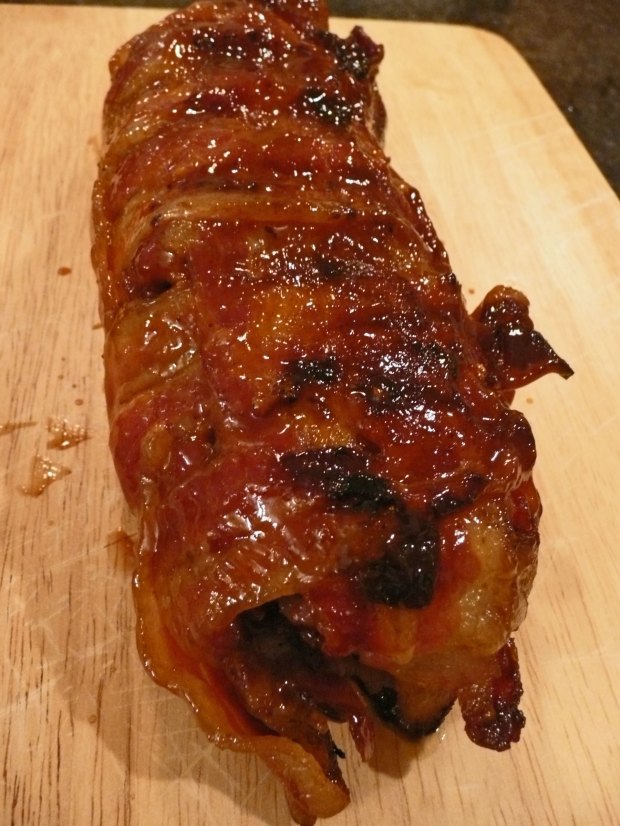

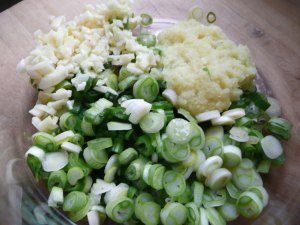 Five-Treasure Fried Rice, by Ellie Krieger in Fine Cooking issue #97 (serves 4+)
 2 Tbs. canola oil
 Heat all but 1 tsp. of the oil in a large nonstick skillet or stir-fry pan over medium-high heat. Add the broccoli stems, carrots, and bell pepper and cook, stirring frequently, until the vegetables begin to soften, 3 to 5 minutes. Add the edamame and corn and cook until the edamame is thawed, about 1 minute. Add the scallion, ginger, and garlic and cook, stirring, until the raw garlic aroma subsides, about 1 minute. Add the rice and Canadian bacon and cook, stirring, until heated through, 3 to 5 minutes.
 2 Tbs. cornstarch
 In a heavy-duty 12-inch nonstick skillet, heat 1-1/2 Tbs. of the oil over medium-high heat until very hot. Add half of the shrimp in a single layer. Cook without disturbing until deep golden and spotty brown on one side, about 2 minutes. Using tongs, quickly flip each shrimp and continue to cook until the second sides are spotty golden brown, about 1 minute longer. (The shrimp may not be cooked through at this point.) Transfer the shrimp to the prepared sheet. Add another 1 Tbs. of the oil to the skillet and repeat with the remaining shrimp, transferring them to the sheet when done.
 From My Table...to Yours