Soupe a L’Oignon

fos-final-soup

After I graduated from high school, I deferred my acceptance to college and took a sabbatical year.  What does a budding epicure do with a year of freedom?  Go to Paris, of course!  To be truthful, at that time in my life I had hardly caught the culinary bug.  I went to Paris to become a photographer, and ended up falling in love with art history.  Yet inevitably, the city’s gastronomical powers took hold of me and I was smitten – with macarons, with cassoulet, with steak frites and, most of all, with French Onion Soup.

Perhaps not as glamorous as oysters at Le Dome or duck at Tour d’Argent (which I’ve never done, by the way, but it’s on my list), French onion soup is omnipresent at the adorable corner bistros and thus a reliable friend during the long and rainy Parisian winter.  Not to mention the fact that it is just so darn delicious.  The heady smell of a winey, beefy broth is intertwined with the savory aromas of browning Swiss cheese as you cup your hands around the lions-head porcelain bowl at your favorite neighborhood stop.

My favorite onion soup story comes from my second lengthy stay in Paris, during my Junior year of college.  RJ came to visit me – his first trip abroad – and we found out we shared a love of the soup!  When we looked for places to eat lunch or dinner, I always checked the menu for onion soup since it was one thing I knew would not offend his delicate palate, and no hidden vegetables would appear to ruin his meal!  One evening, we stopped into “Le Christine” – a tiny restaurant in the Latin Quarter.  RJ predictably ordered the Soupe a L’Oignon.  When my first course arrived, RJ was approached by the host.  In his hand was the handle of a large kettle.  Placed before RJ was a plate of handmade croutons and freshly grated gruyere.  The host ladled the soup from the kettle into RJ’s bowl, and RJ garnished his own soup.  It was quite a presentation, and since then RJ has loved Paris, and requests French onion soup as soon as winter sets in.

Soupe a L’Oignon (French Onion Soup), adapted from Julia Child’s Mastering the Art of French Cooking

1 1/2 lbs. or about 5 c. of thinly sliced yellow onions
3 Tbs. butter
1 Tbs. oil
1 tsp. salt
1/4 tsp. sugar
3 Tbs. flour
2 quarts boiling brown stock, canned beef bouillon or 1 quart of boiling water and 1 quart stock or bouillon
1/2 c. dry white wine or dry white vermouth
salt and pepper to taste
12 to 16 slices of French bread cut 3/4 to 1 inch thick
olive oil or beef drippings
1 cut clove of garlic
3 Tbs. cognac
1 to 2 c. grated Swiss or Parmesan cheese
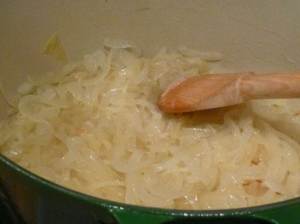
fsp-white-onionsPreheat your oven to 325 degrees F.  In one pot, keep the stock/broth/bouillon hot.  In another, cook the onions in the butter and oil over medium-low heat, covered, for 15 minutes.  Uncover, raise heat to moderate, and stir in the salt and sugar. Cook for 30 to 40 minutes stirring frequently, until the onions have turned an even, deep golden brown. Sprinkle in the flour and stir for 3 minutes.
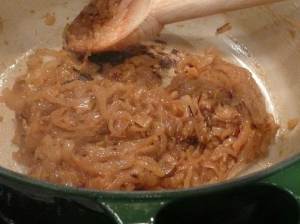
fsp-dark-onionOff heat, blend in the boiling liquid. Add the wine, and season to taste. Simmer partially covered for 30 to 40 minutes or more, skimming occasionally. Correct seasoning. Set aside uncovered until ready to serve.

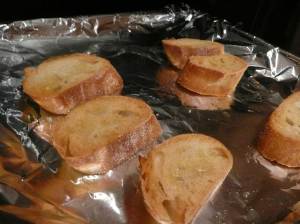
Meanwhile, place the bread in one layer in a roasting pan and bake in a preheated 325-degree oven for about half an hour, until it is thoroughly dried out and lightly browned. fsp-croutonHalfway through the baking, each side may be basted with a teaspoon of olive oil or beef drippings. After baking, each piece may be rubbed with cut garlic.
Preheat the oven’s broiler and move an oven rack to the highest it can go while still fitting your soup bowls.
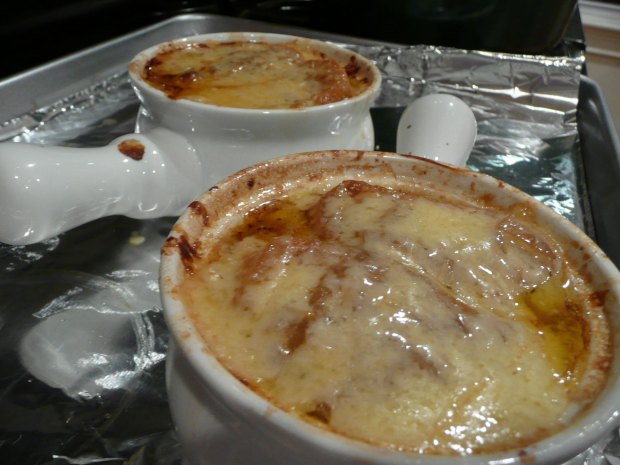
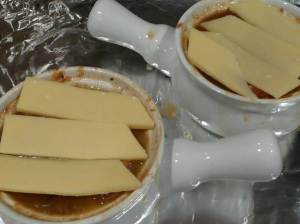
Reheat soup to a simmer. Just before serving, stir in the cognac. Pour the soup into an oven-proof tureen or individual soup bowls. fos-gruyereFloat the rounds of toast on top of the soup, and spread the grated cheese over it [I had my first bowl made this way, but found that most of the cheese fell into the soup. My second bowl, I cut thick slices of gruyere and lay them over the toast round, which gave the top of the soup a nice thick cheese topping.] Broil for 3-7 minutes until the cheese is nice and bubbly and beginning to brown around the edges.
Prosciutto-Sage Pork Roast

Roast Pork Loin with Prosciutto-Sage Butter

Before my current job at a museum, I worked at a non-profit art gallery in Boston.  What I have come to find about the people that work in the arts – not so much the artists themselves but the ‘gallerinas’, the fundraising folks, the museum educators – is that they really like to eat and cook.  At the gallery, my colleagues and I would compare gourmet leftovers and fancy composed salads on our lunch break.  To celebrate a big sale or a successful opening, we would treat ourselves to fancy cheese, oysters and pate at the french restaurant across the street or even go out to the newest “it” restaurant in the South End.  I wonder if an appreciation for culinary arts is a natural extension of a love of the visual arts.  It is said that we eat with our eyes first…

In any case, one recipe shared over that convivial lunch table surrounded by paintings is the one that follows.  My dear friend Caroline, who generally is not fond of pork, shared this super simple preparation with me.  An easy-to-make compound butter really ramps up the flavor and presentation of the relatively inexpensive pork roast.  Perfect for the holidays and as an addition to my running list of don’t-break-the-bank-but-impress-your-guests-anyway recipes.  I have, on other occasions, mixed in a heavy tablespoon of roquefort cheese with the butter for a bit of a twist, but this is Caroline’s original recipe and it is fabulous.  It went so fast at my mom’s dinner party that by the time I’d grabbed my camera for the final shot, all that was left is what you see above!

Roast Pork with Prosciutto-Sage Butter

1/4 lb. thinly sliced prosciutto di Parma
2 Tbs. minced shallots
6-12 leaves fresh sage, chopped (choose number of leaves depending on size of the leaves and your taste for sage)
1 stick unsalted butter, softened
salt and pepper to taste
monstrous boneless pork loin (it doesn’t matter the size – if you have butter left over after coating it, just freeze it and use it later)

Preheat oven to 400 degrees F.  In a small bowl, mix together the prosciutto, shallots, chopped sage and softened butter.  Salt and pepper to taste, adjusting amount of salt if you are using salted butter.  Pork Loin roastIf you have any fancy flavored salts, this is a good time to use them as well – I have a “Sel de Merlot” from France which is delicious in this recipe.  Set butter aside.
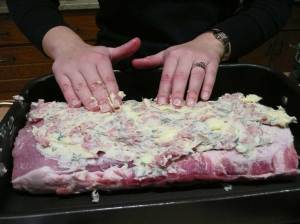
Place pork on a cutting board, fatty side up.  Trim off as much fat as you can without completely (re)butchering the loin and wasting perfectly good meat [see photo :)].  The idea is to replace most of the pork fat with the flavored butter fat. 

Pork roast with Flavored butterIf you think you made more butter than your pork loin will require, scoop butter out of the small bowl with a spoon in smaller batches so that you don’t contaminate the unused butter.  In my case, having such a monstrous loin, I just slathered the whole stick on there with my hands.  Definitely make sure you spread the butter out evenly and that the goodies are distributed across the top of the meat.
Roast the loin in the oven at 400 degrees for 15-20 minutes.  Then, turn the oven heat down to 325 degrees and cook for another 20 minutes per pound or so.  You should take the pork out of the oven when a meat thermometer stuck horizontally into the meat (parallel to the cutting board and in the center of the loin) reads 150 degrees internal temperature – I usually check it after an hour to see where I stand.  Do not overcook or the roast will be dry and nowhere near as yummy.  Again, feel free to experiment with different flavor combinations in the butter – if Michelangelo, Monet, and Picasso never experimented, the art scene would be pretty bland today!

Braised Beef Short Ribs with Coriander and Cardamom

 beef-final1

Yet another braise to get us all through the winter months. It is hard to imagine, with the wind biting below zero, that winter is not yet upon us. Harder still to think that we have another couple weeks of “technically fall” before the Winter Solstice. Nevertheless, it is cold in New England, and gosh darnit I want to braise.

At the grocery store, I saw some great looking English Short Ribs, and I valiantly thumbed through my 4-inch binder of clipped recipes to locate a short rib preparation that I hadn’t yet attempted. I found a recipe from an April 2007 issue of Bon Appetit (pre-redesign: those were the days) for coriander and cardamom spiced Short Ribs printed in the annual Restaurant issue’s R.S.V.P. section. The restaurant in question was the Inn at West View Farm in Dorset, VT and a woman named Cheryl Parker O’Connor requested the recipe. No sooner had I finished and tasted this delicious dish, but what do I see in my November (2008) Bon Appetit magazine? The same recipe, from the same Inn, in the same (R.S.V.P.) section, requested by Franklin Moore of Montreal.

This bugs me on a number of levels. First – I am using up ridiculous amounts of storage space in my small condo pantry for all my recipe clippings and cookbooks. If the editors of Bon Appetit (or other food magazines for that matter) are going to just reprint the same recipes they have in previous issues, it is very possible that I will have duplicate clippings in there, thus extending the years it will take me to cook through the growing pile, as well as the angst my husband has over the size of said pile. Second – as I have mentioned before, I have often requested recipes through Bon Appetit‘s R.S.V.P. section – in particular a Valentine’s Day special from New York’s Nice Matin (Red snapper with a Blackberry Merlot Sauce) that still haunts me – to no success. Yet this “Mr. Moore” from “Montreal” dares to ask for a recipe that has ALREADY BEEN PRINTED BEFORE, and Bon Appetit has the gall to give give it to him! Over my transcendent snapper dish, no less!  Finally – I am unnerved by the very thought that Bon Appetit is running out of new recipes to print.  My blog, not to mention the rest of the foodie blogosphere, relies on the illusion that there will never be an end to the number of possible ingredient combinations printed in our cookbooks and magazines.  If Bon Appetit is repeating recipes already, what will our children write about on their blogs that hasn’t already made it onto the internet?  Oh, the humanity!

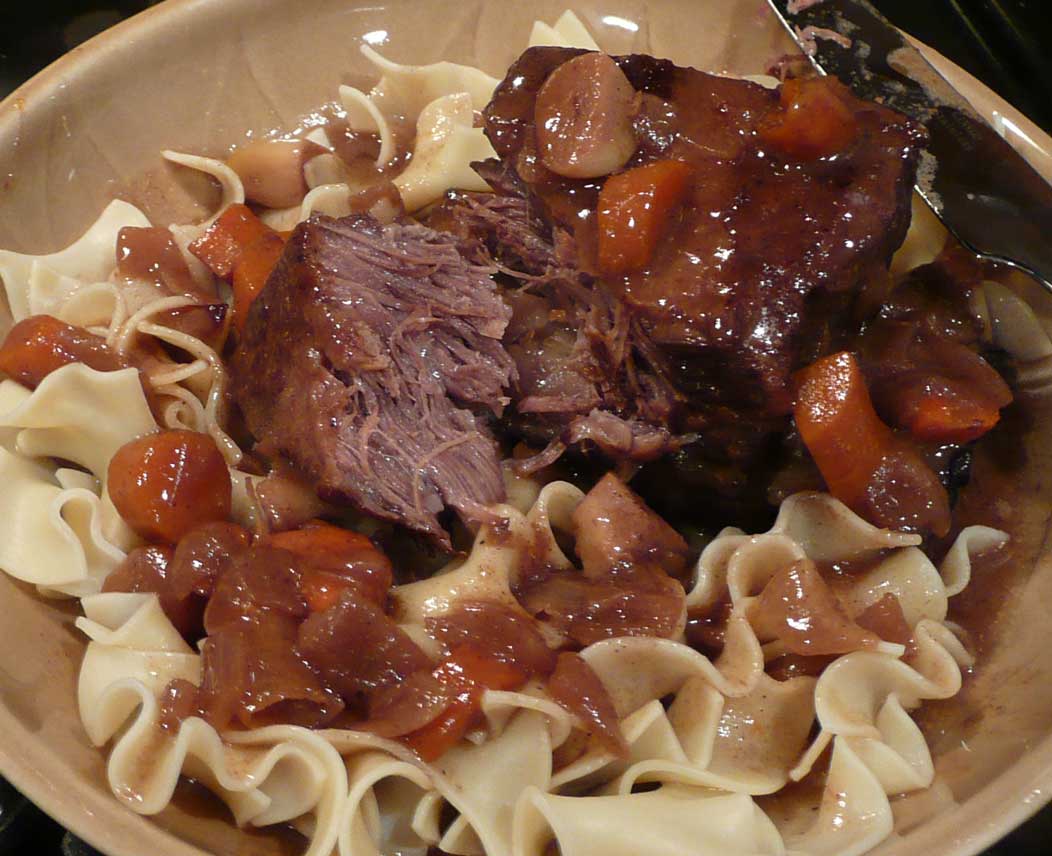
OK, rant over.  Back to the food.  These were damn good short ribs!  I can see why so many (including Cheryl and Franklin) are fans.  As RJ said, the flavor and spice balance is perfect – enhancing the meatiness rather than overpowering it.  We served the ribs with lots of the cooking liquid over egg noodles.  RJ thinks potatoes are too heavy to be paired with a braised meat – I tend to disagree, as does the Inn at West View Farm which “serves the ribs with mashed potatoes, braised carrots and snap peas”, but the noodles worked fine as a compromise. 

Braised Beef Short Ribs with Coriander and Cardamom, from Bon Appetit twice over (this text, though, is out of the April 2007 issue – very slight changes were made to the November reprint)!

(Serves 4 to 6)Beef ribs

1/2 c. canola oil
4 lbs. beef short ribs
4 large carrots, peeled and coarsely chopped
1 large onion, chopped
1 large leek (white and pale green parts only), chopped
1 whole head of garlic, halved crosswise
1 Tbs. ground coriander
1 Tbs. ground cardamom
2 Tbs. all-purpose flour
1 750ml. bottle of dry red fruity wine, such as Zinfandel
2 c. low salt chicken broth

Beef short ribs braising liquid

Preheat oven to 325 degrees F.  Heat canola oil in heavy large ovenproof pot over high heat.  Sprinkle short ribs with salt and pepper.  Working in batches, add ribs to pot and cook until brown on all sides, about 6 minutes per batch.  Transfer ribs to large bowl.  Add carrots, onion, leek and garlic to pot.  Cook until vegetables are brown, stirring often, about 12 minutes.  Add coriander and cardamom, then flour; stir to coat the vegetables.  Add wine and bring sauce to a boil.  Return ribs and any accumulated juices from bowl to pot.  Add chicken broth.  Bring to boil, cover, and transfer pot to oven.  Braise ribs until tender, about 2 hours.

[Bon Appetit here notes that this recipe can be made up to two days ahead, cooled on the counter uncovered, then refrigerated.  They say that the added resting time is good for the flavor of the dish.  I did make this ahead and found it was delicious, plus it made it easier to scoop out some of the extra fat that had cooled on the surface.]

If made ahead, warm up the dish on the stovetop.  Remove the ribs to a large platter.  Stain sauce into large saucepan, discarding solids in strainer (as you can see above, I did not do this step – I like carrots!).  Bring sauce to boil, then pour over ribs and serve.

**A couple of nights later, I took the remaining short rib and shredded it up with two forks.  The shredded  meat can be used in Enchiladas or mixed in with your favorite (homemade) tomato sauce for a quick ragu.

Shredded Beef ribs

A Tart for the Holidays


tart-final

This year I had two Thanksgivings – the formal one, on Turkey day, with my husband’s family, and a second one with my family over the following weekend.  As this is the first year RJ and I are going into the holidays as a married couple, there have been many discussions about how best to handle the division of our time and pay proper homage to each family.  Our solution involves a lot of shuttling around the greater Boston area, but we think we have found a good balance of time spent, meals shared, and presents exchanged. 

A colleague said to me last week that Thanksgiving is what Christmas should be – a day of fun feasting, collaborative cooking, and quality family time without the stress of holiday shopping and credit card debt.  RJ loves Thanksgiving but dreads Christmas for all the aforementioned schlepping to fit everything into the 2-day window of official Christmas.  It was nice to see that we could do a second (smaller) Thanksgiving on Saturday, November 29th without a loss of sincere holiday feeling.  Plus we had twice the turkey, twice the pies, and twice the family face time.  Perfect!  I think for once we made it through a holiday with everyone happy!

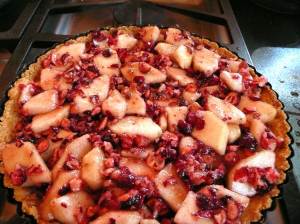
I had such a great time on (proper) Thanksgiving, cooking with my mother-in-law at her house.  When the boys went to sit in the freezing cold at a high school football game they were sure to lose, we basted the turkey, prepped the vegetables, and armed ourselves for the onslaught of relatives that would come through the door at 2.  Unfortunately, as I’ve already confessed, we did not take photos on that day, and I regret that.  Thankfully the internet has provided many of them for us, as you can see here.  On Saturday, however, I remembered to pull out the trusty Panasonic and snap away, bringing you the beauty that is the “Festive Cranberry-Pear Tart.”  I would very highly recommend this delicious tart for your next holiday meal or potluck party.  It was a huge hit, and tastes just as good at breakfast as it does for dessert.  Then again, I’m a pie-for-breakfast kind of girl.

Festive Cranberry-Pear Tart in a Walnut Shortbread Crust, from Fine Cooking Issue No. 74

For the Shortbread Crust:Shortbread tart crust

1 large egg yolk
1 Tbs. half and half
1/2 tsp. pure vanilla extract
1 1/2 c. unbleached all-purpose flour
3 Tbs. granulated sugar
1/2 tsp. table salt
1/4 lb. (1 stick) cold unsalted butter, cut into 1/2 inch dice
1/3 c. walnuts, toasted and finely chopped 

For the Cranberry-Pear Filling:
3 large ripe pears, like Anjou or Bartlett
2 c. fresh cranberries, picked through and rinsedRaw Cranberry Pear Tart
1 Tbs. brandy
2/3 c. granulated sugar
2 tsp. unbleached all-purpose flour
1/2 tsp. ground cardamom
1/2 tsp. ground ginger 1/4 tsp. ground cinnamon
1/8 tsp. ground allspice
1/8 tsp. table salt

For the Buttery Brown Sugar Streusel:
1/3 c. plus 1 Tbs. unbleached all purpose flour
1/4 c. packed light brown sugar
1/8 tsp. table salt
2 Tbs. unsalted butter, melted
1/4 tsp. pure vanilla extract

Make the crust: Position a rack near the center of the oven and heat the oven to 400 degrees F.  In a small bowl, mix the egg yolk, half and half, and vanilla.  Put the flour, sugar, and salt in a food processor; pulse until combined.  Add the butter and pulse until the butter pieces are no longer visible.  With the processor running, add the yolk mixture in a steady stream and then pulse until the moisture is fairly evenly dispersed, 10 to 20 seconds.  Transfer the mixture to a bowl.  Using your hands, mix in the chopped walnuts to distribute them evenly.  The dough will be a mealy, crumbly mass.

Cranberry-Pear Tart

Pour the crumb mixture into a 9 1/2 in. round fluted tart pan with removable bottom.  Starting with the sides of the pan, firmly press the crumbs against the pan to create a crust about 1/4 inch thick.  Press the remaining crumbs evenly against the bottom of the pan.  Prick the bottom of the crust all over with a fork and freeze for 10 minutes.  Bake until the sides just begin to darken and the bottom is set, 15 min.  Transfer to a cooling rack.  Reduce the oven temperature to 350 degrees.

Make the filling: Peel the pears, quarter them lengthwise, core, and cut crosswise into 1/4 inch thick slices.  In a food processor, coarsely chop the cranberries.  In a medium bowl, mix the pears, cranberries, and brandy.  In a small bowl, mix the sugar, flour, cardamom, ginger, cinnamon, allspice, and salt; add to the cranberry-pear mixture, tossing to combine.  Spoon the filling into the par-baked crust, leveling the filling and packing it down slightly with the back of a spoon.

Streusel

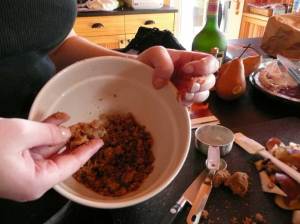
Make the streusel and bake: In a small bowl, mix the flour, brown sugar, and salt.  Add the melted butter and vanilla.  Combine with your fingers until the mixture begins to clump together in small pieces when pressed.  Sprinkle the streusel over the filling, breaking it into smaller pieces if necessary.  

Bake at 350 degrees F until the fruit is tender when pierced with a fork and the streusel and the edges of the crust are golden brown, about 50 minutes.  If the tart begins to get overly brown at the edges, cover with foil.  Let the tart cool on a rack until it’s just barely warm before serving.  The tart will keep, covered and at room temperature, for two to three days.

**The issue from which I pulled this recipe, the October/November 2005 issue, is a very strong one – it contains one of my favorite cookie recipes (white chocolate, cranberry and oatmeal), a great pot roast recipe, and a mushroom soup with sherry that I love!  You can buy back issues of Fine Cooking here.

Cranberry Pear Compote

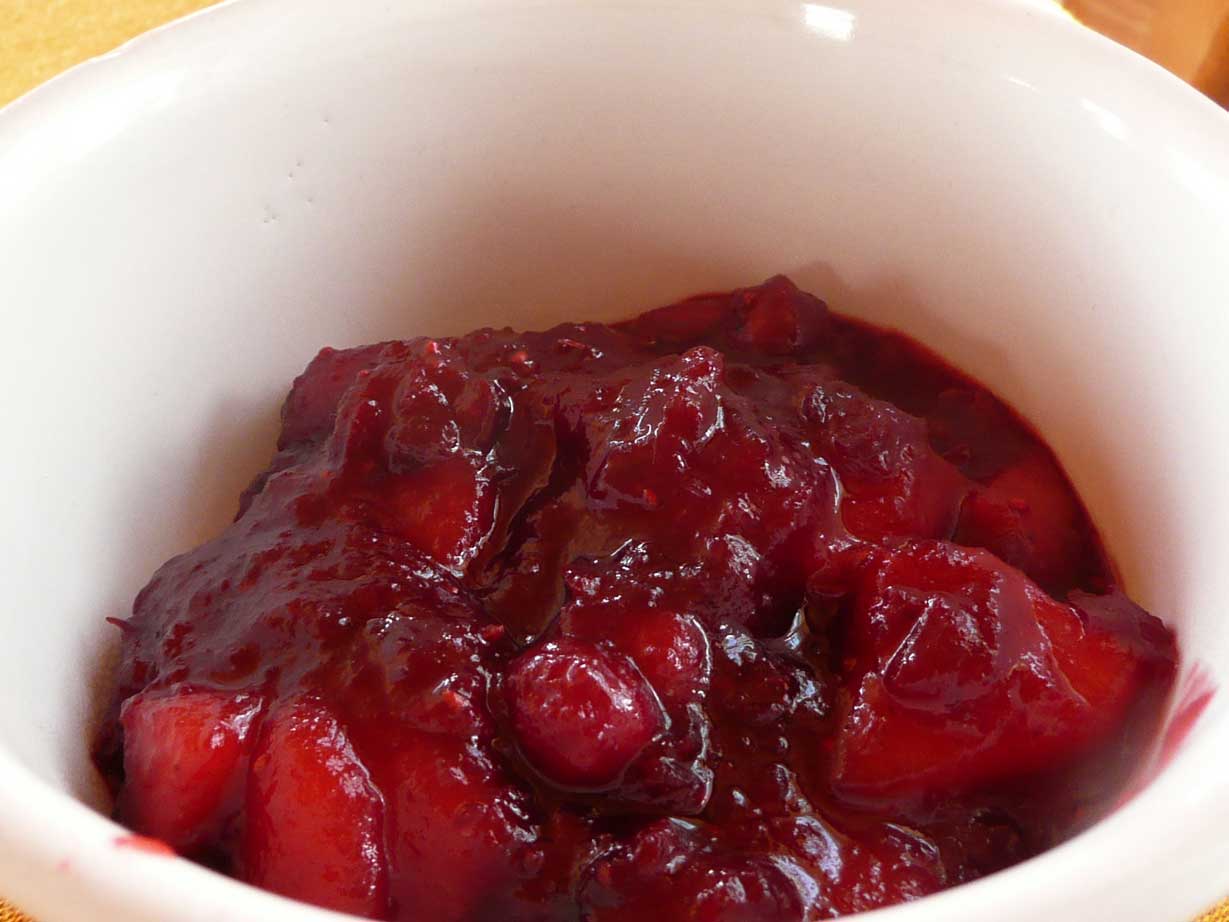
Making this recipe I had plenty of leftover cranberries in the bag, as well as leftover spiced pear-cranberry mixture.  I put both of these, maybe 1 1/2 c. of fruit total, in a small saucepan and added about a 1/2 c. of water and 1/2 c. of ruby port.  I cooked the fruit over medium-low heat until all of the cranberries had popped and the pears were tender.  The final product was sweet and flavorful – I can see it would be good over ice cream, but we used it as a second cranberry sauce with our turkey.

Cranberry Pear compote